Sharing One Carrier Between Two Adults: Fit Guide
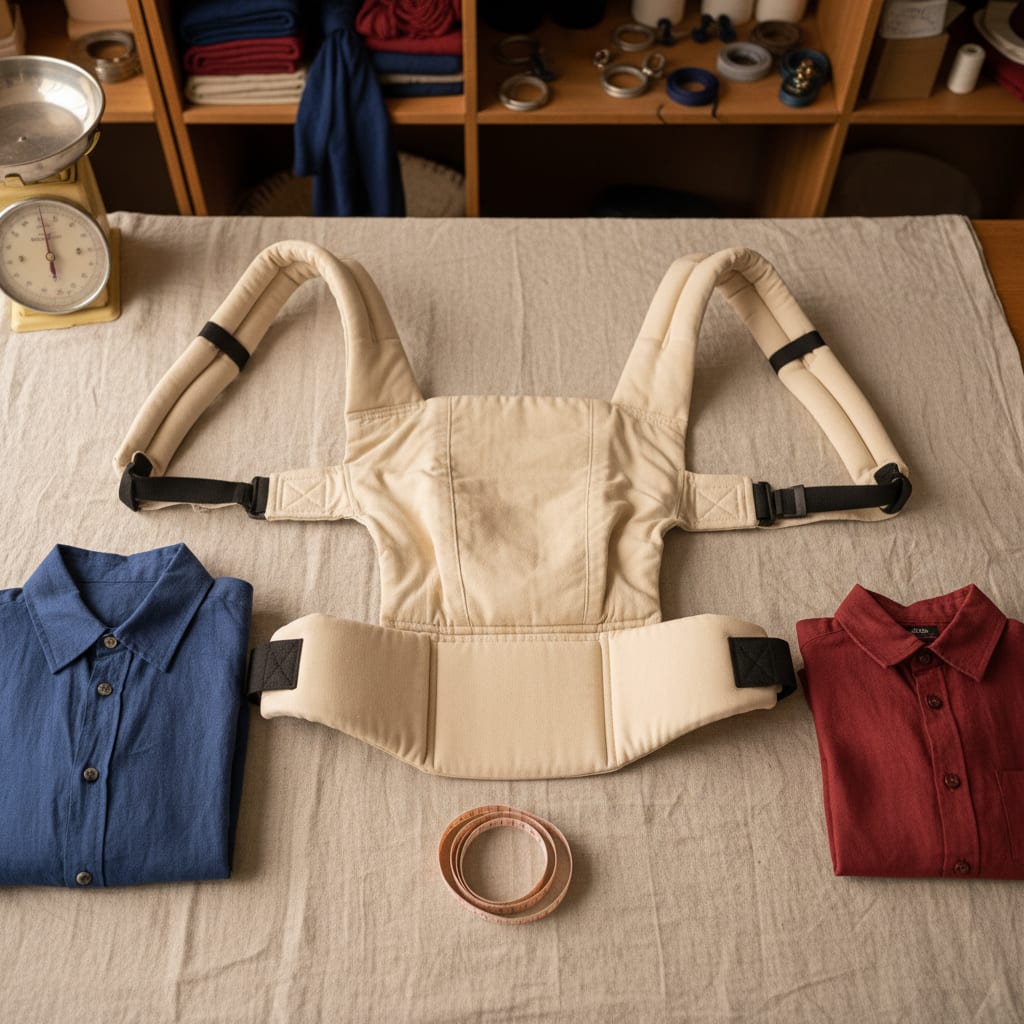
Two adults can share one carrier, and most households should — buying a second is usually solving the wrong problem. Only three things need to change at a handover: waistband circumference and height, shoulder-strap length, and chest-clip height. The seat width stays where it is, because that setting belongs to the baby, not to you. Reset those three, run the fit checks, and the same carrier can move between a 5’2” wearer and a 6’2” one all day. What you need is a repeatable thirty-second ritual, not a “men’s carrier”.
There is no such thing as a dad carrier
Carriers do not fit genders; they fit dimensions. The four that actually matter are torso length (shoulder to hip, which decides panel height on your body), shoulder width and slope, chest breadth (which decides where a chest clip can comfortably sit), and waist or hip circumference.
Those vary enormously within any group and overlap between groups. A short-torsoed tall man and a long-torsoed short woman can need almost identical settings. So “which carrier for dads” is the wrong question, and the right one is: does this carrier’s adjustment range cover both of our bodies? The colour of the marketing photo is not a spec.
The three settings that change at a handover
Waistband. Circumference is obvious. Height is the one people forget: waistband position sets how high your baby rides, and comfortable height differs between bodies. Some people wear it on the hips, some at the natural waist, and the same carrier can sit in two different places on two people and be correct on both.
Shoulder straps. These take the biggest change, especially between very different torso lengths. Loosen fully before you put the carrier on, then tighten from the top down with your baby supported.
Chest clip or cross. On a buckle carrier, the chest clip should sit between the shoulder blades at the back or across the sternum at the front, depending on the design — comfortably, without pulling the straps inward into the neck. Its height changes with shoulder width, and it is the fastest thing to get wrong on a handover because it is behind you.
The one setting that does not change
Seat width. The panel spans knee to knee for your baby’s current size, with knees higher than the bottom in the M-position the International Hip Dysplasia Institute describes. That is a property of the baby, so it stays put when the carrier changes wearer. If your carrier’s seat setting keeps getting nudged during handovers, that is a sign it is being adjusted for adult comfort — which it should never be.
Panel height sits in between. It is set for the baby, but on very different torsos the same panel can land differently relative to your own chest; that is a reason to re-check the top edge against your baby’s shoulders, not a reason to change the setting.
The thirty-second handover ritual
Do it in this order and it becomes muscle memory:
- Loosen everything — waistband, both shoulder straps — before the carrier comes off, so the next wearer starts from slack.
- Waistband on first, at your own preferred height, genuinely snug. This carries the load.
- Baby in, seat checked: knee to knee, knees above bottom, back supported.
- Shoulder straps from the top down, supporting your baby with one hand, until the panel is flush against their back with no air gap.
- Chest clip last, and at your height.
- Kissable-height check: without leaning forward, you should be able to kiss the top of your baby’s head. If you cannot, the whole carry is too low.
Then the safety pass, which does not get skipped because the previous adult already did it: face visible, chin clear of the chest, TICKS and airway checks every single time. A carry that was correctly fitted on one body is not evidence about the other.
Buying one carrier for two people
Choose for the harder-to-fit body. If one of you is at the very short or very tall end of a carrier’s adjustment range, that person’s fit decides the purchase, because the person in the middle of the range will be fine either way.
Then look for adjustment range as an actual feature rather than a slogan. Extendable or adjustable torso height, a long waistband or an extender option, and shoulder straps that can be worn parallel or crossed all widen the window that one carrier can serve. A Lillebaby Complete All Seasons is a fair worked example of that category — extendable torso, wide waistband range, six positions — though the specific model matters less than checking those features exist on whatever you buy. The mechanisms are decoded in the buckle carrier guide.
Some formats share better than others by construction. Tie-on carriers — mei tais, half-buckles — share brilliantly, because there are no fixed settings to compromise on. Woven wraps share well: one size 6 fits most adults, and each wearer simply ties their own. Stretchy wraps are re-tied per wearer anyway. Ring slings share worst, because sling length is chosen to suit the wearer, so two very different adults may genuinely need two slings.
If the fit gap between you is large enough that one carrier really cannot span it, that is the moment to read a ranked comparison rather than a decoder. Only Mom Reviews covers carriers that work for petite wearers, which is where the smaller partner’s shortlist usually starts.
When the second wearer says it hurts
The most common story: one adult finds the carrier comfortable, the other finds it agony, and both conclude it is a body problem. Usually it is a settings problem — the second wearer inherited the first wearer’s strap lengths and simply tightened over the top of them.
Start from full slack, every time. Then work through the ordinary causes of shoulder load — waistband too loose so the shoulders take everything, carry too low, straps not spread — which are all in carrier shoulder pain.
There is also a real learning gap worth naming without any hand-wringing about it: whichever adult wears less gets less practice, and less practice looks exactly like poor fit. Ten minutes around the house is worth more than a first attempt in a car park. A back carry, in particular, is a two-person skill to learn safely — start with when and how to begin back carries and have the confident wearer spot the newer one.
Where sharing pays off most is the settling shift. A partner who can competently wear the baby can take the evening walk, the fussy hour, or the stretch where a baby who will only sleep while held needs a body that is not the feeding parent’s. That is a genuinely different kind of help than holding the baby while someone showers.
The dry aside: the household that buys two carriers to avoid adjusting one will own four carriers by the first birthday.
FAQ: sharing a baby carrier between two adults
Can two people share the same baby carrier?
Yes, and most households only need one. Reset the waistband, shoulder straps and chest clip at every handover, leave the seat width alone because that belongs to the baby, and run the fit and safety checks each time.
Do dads need a different baby carrier?
No. Carriers fit torso length, shoulder width, chest breadth and waist size, not gender. Choose a carrier whose adjustment range covers both adults, and if one of you sits at the edge of that range, buy for that person.
What settings change when someone else wears the carrier?
Waistband tightness and height, shoulder-strap length, and chest-clip height. Seat width and panel height are set for your baby and should not be moved for adult comfort.
Why is the carrier comfortable for one of us and not the other?
Almost always because the second wearer tightened over the first wearer’s settings instead of starting from full slack. Loosen everything, fit the waistband first, then the straps top-down. If it still hurts, the carry is probably riding too low.
Which carriers are easiest for two adults to share?
Tie-on carriers such as mei tais, because nothing is set in hardware, and woven wraps, because one long wrap suits most adults. Buckle carriers with an extendable torso share well too. Ring slings share worst, since length is matched to the wearer.