Soft Structured Carriers Explained: Panels to Buckles
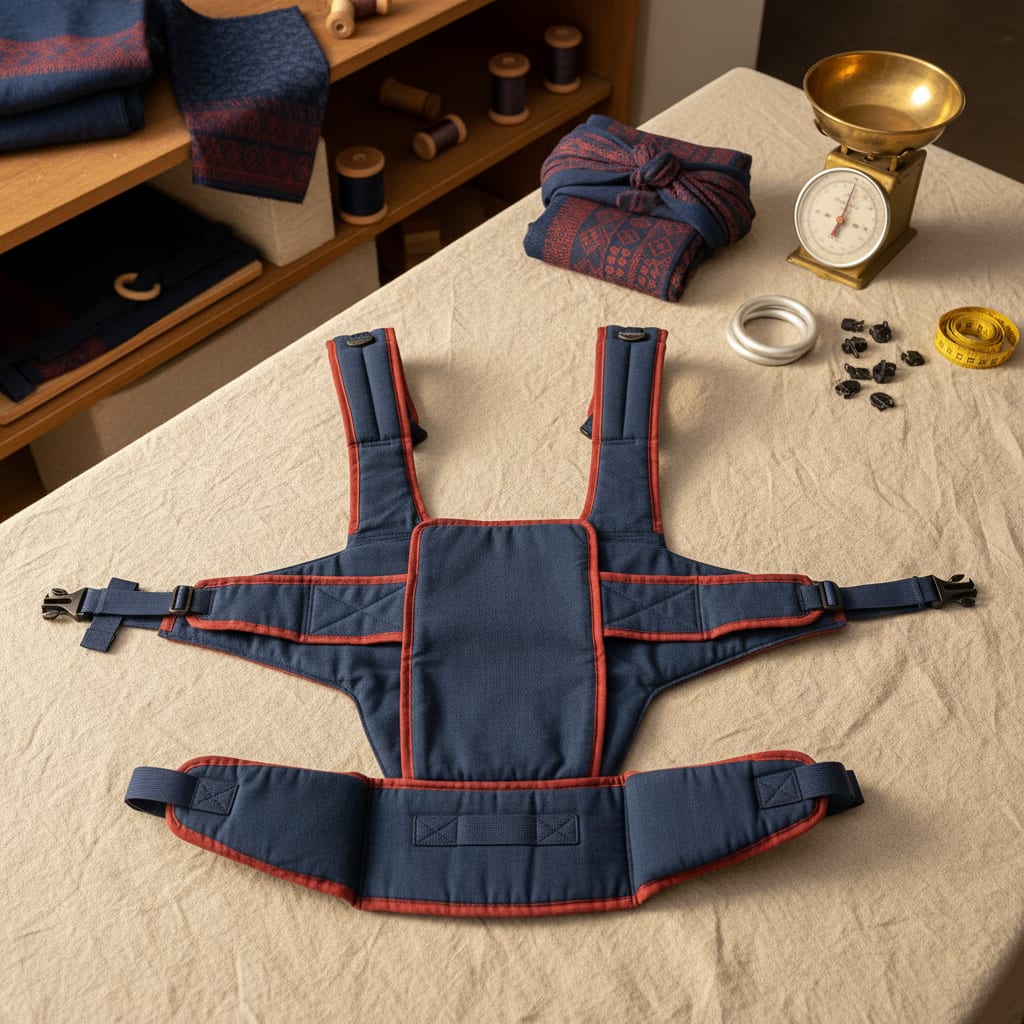
A soft structured carrier (SSC) — the buckle carrier most people picture when they hear “baby carrier” — is four components pretending to be one product: a fabric panel that forms baby’s seat and back support, a padded waistband that should carry most of the load on your hips, two shoulder straps, and a set of adjusters connecting everything. Understand those four parts and every SSC on the market becomes legible, because brands differ mainly in how each component is built, not in what the carrier fundamentally is. That’s this guide: the anatomy, the trade-offs, and worked examples — no rankings.
The original quirkybaby.com shop sold and taught these carriers for fifteen years; this page resurrects the education half of that job.
The panel: where baby actually lives
The panel’s job is to hold baby in the M-position — knees above bottom, seat deep from knee to knee. Two specs matter and neither is on the box in plain language:
Seat width. A seat that supports knee-to-knee at four months dangles a newborn’s legs straight down and squeezes a toddler’s. This is why “newborn to toddler” carriers exist on a spectrum from adjustable-panel designs (drawstrings, snaps, or velcro that narrow the seat — the Tula Free-to-Grow is the canonical example, rated 7–45 lb without an insert) to fixed-panel designs that fit a narrower age band excellently and the edges of it badly.
Panel height. Too short for your kid and there’s no upper-back support (fine for a toddler who wants arms out; wrong for a sleeping infant). Too tall and you can’t see or kiss the head. Panel height against your specific child’s torso is the single most under-checked spec in secondhand buying.
The newborn question: what “newborn ready” actually means
A soft structured carrier for a newborn is three separate claims, and a carrier has to satisfy all three before the phrase means anything.
A stated minimum. Every mainstream SSC prints a floor in its manual — the three models named on this page state 7 lb — and that floor is a manufacturer limit, not a readiness verdict. A 7 lb minimum on the box says nothing about whether your particular five-day-old has the neck control and breathing margin for upright carrying; a premature, low-birth-weight or low-tone baby needs the pediatrician’s go-ahead regardless of what the panel is rated to.
A seat that narrows to your baby, not to the average baby. This is where most “it came with the carrier so it must fit” errors live. The healthiest position, per the International Hip Dysplasia Institute, is hips spread apart to the side with the thighs supported and hips and knees bent. On a newborn that means the seat fabric has to reach from the back of one knee to the back of the other — and a seat left at its four-month setting simply does not: the legs hang straight down from the crotch, which is the exact geometry the M-position exists to avoid. Set the seat narrow first, load the baby second, then look at the knees from the side. Knees level with or above the bottom, fabric knee to knee, nothing pulled taut.
Inserts versus a panel that narrows. Two different design answers to the same problem. Older lineups shipped a bolster insert — a wedge that raised a small baby up the panel and narrowed the seat. Current lineups mostly replaced it with an adjustable panel (snaps, a drawstring or a fold-up seat) that does the same job without the extra padding, which is why a modern carrier can claim newborn use “without an insert.” Neither approach is better in the abstract; what matters is that you use the one your carrier was designed around. If you inherited a model whose newborn mode requires its insert, the insert is part of the carrier — a rolled towel, a folded muslin or a cushion is not a substitute, has no tested geometry, and can push a small chin toward a small chest.
And then check the airway, because newborn size changes it. High enough on your chest that you can kiss the top of the head without craning, face turned to the side and visible with a glance, nothing — not fabric, not a hood, not your own body — across the nose or mouth, and roughly two fingers of space under the chin. Re-check a few minutes in. A newborn settles into a panel after loading, and the position at minute ten is the one that counts.
The waistband: the actual load path
A structured waistband on the hips should carry the majority of the weight — same engineering as a backpacking hip belt. Differences that are real: waistband width and padding depth, lumbar support (the Lillebaby Complete All Seasons, rated 7–45 lb, is the worked example of a built-in lumbar pad), and maximum belt length. If a carrier hurts your shoulders, the waistband is suspect number one — the full diagnostic sequence is in the shoulder-pain clinic.
Straps and buckles: comfort geometry and shareability
Padded straps differ in width, curve, and whether they can cross on your back — crossing redistributes load away from narrow or sloped shoulders and is a feature worth actively seeking if straps chronically slide. The chest clip sets strap width; the webbing and buckles are where quality shows honestly (smooth adjustment under load, buckles that require two motions to open). SSCs are also the easiest type to share between different-sized adults — count the seconds of re-adjustment between wearers if that’s your household.
Carry modes: read the manual, not the marketing
Most current SSCs document some subset of: front facing-in (universal), front facing-out (needs head control and a seat mode that keeps knees supported), hip, and back (gated at independent sitting by most manufacturers). A carrier listing “4 positions” isn’t better than one listing three — it’s answering a different question. Which positions your baby is actually ready for is developmental, and the positions-by-age guide maps those gates.
An all-position worked example: the Ergobaby Omni 360 — newborn-ready from 7 lb without an insert, all four modes documented, rated to 45 lb. Named because it’s canonical and well-reviewed, not because it “wins”: a fixed-panel carrier that fits your torso beats an all-mode carrier that doesn’t.
The honest trade-offs of the type
Where SSCs excel: speed to a safe fit, adult-to-adult sharing, long wears (real waistband), back carries, and machine-washable indestructibility. Where they don’t: newborn softness (a wrap molds to a five-day-old in a way no panel does), packability (the padding that makes them comfortable makes them bulky), and hot climates (mesh versions help). The failure mode to avoid: treating the SSC as a fashion object with straps. It’s load-bearing equipment; buy it like a backpack, fitted to the larger wearer’s torso and adjusted for each.
If you’re still deciding between types rather than models, the QB Quiz decision tree settles that question first — it’s the higher-leverage decision. And once the type is settled and you want a ranked, tested pick, that’s our sibling review site’s job rather than ours: start with their best carriers for petite moms if you’re short-torsoed, since torso length decides more SSC purchases than anything on the box.
FAQ: soft structured carriers
What does “soft structured carrier” actually mean?
Structured (a shaped panel, padded waistband, and buckles — unlike a wrap) but soft (no rigid frame — unlike a hiking backpack carrier). The term covers everything from budget to boutique; the anatomy is identical across the price range.
Can a newborn go in a soft structured carrier?
Many current models support newborns from around 7 lb via adjustable seats or newborn modes — check your specific carrier’s stated minimum and newborn instructions. The airway rules are the same as any carrier: upright, high, chin off chest, face visible, always.
Do I need an infant insert?
Only if your specific carrier’s newborn mode requires one — that design has mostly aged out of current lineups in favor of adjustable panels. If you inherited an older model that needs its insert, use the actual insert, not a rolled towel and optimism.
How long do soft structured carriers last?
Typical ratings run to around 45 lb — toddler territory — and the fabric usually outlives the need. Check webbing, stitching, and buckles annually and after any machine wash; retire anything frayed. Secondhand SSCs are a fine buy once you’ve verified the model against recall lists and the hardware against your own eyes.