How Many Baby Carriers Do You Need? An Honest Answer
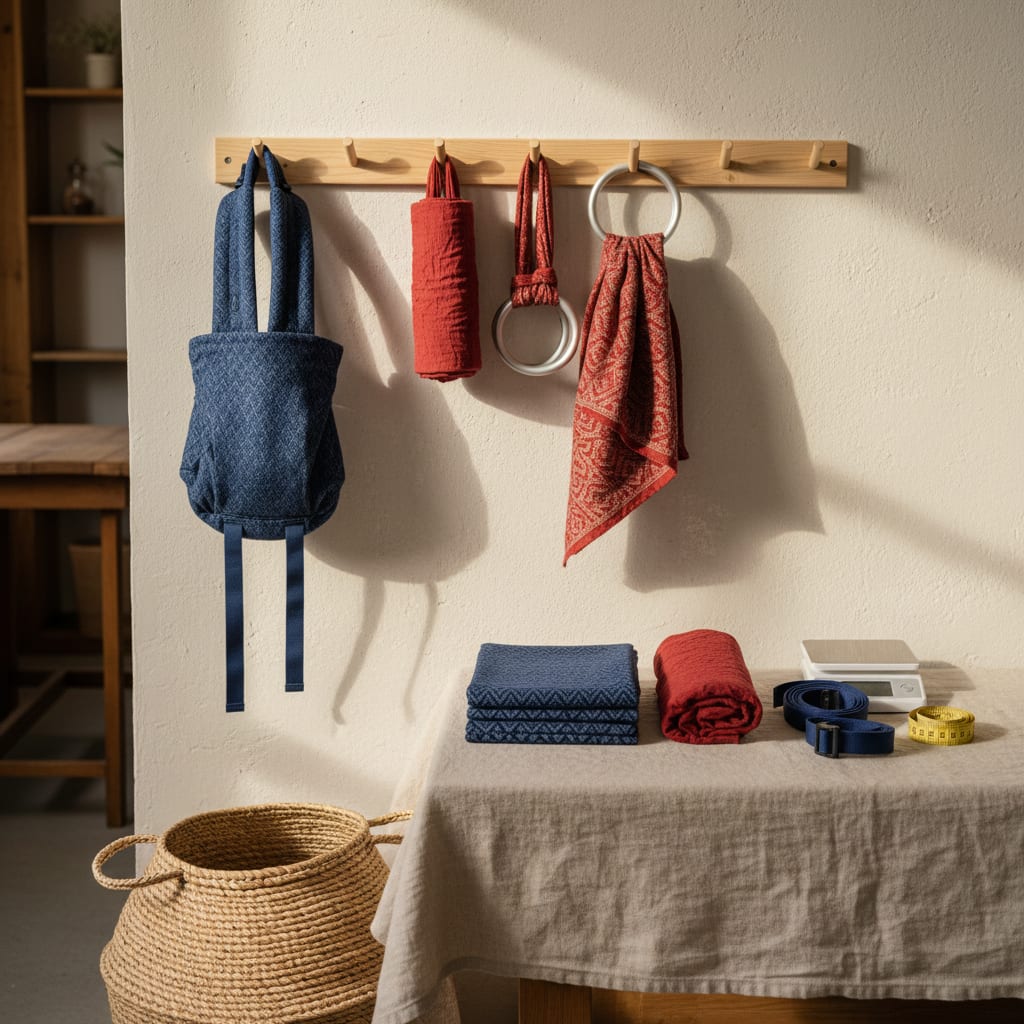
One, if it fits you and covers your day. Two is where most families honestly land — a soft option for the newborn months and a structured one for the long haul. Three or more is a hobby, which is a perfectly good thing to have, but it is not a requirement and nobody should be told otherwise on a registry. The useful question isn’t how many carriers you own; it’s how many jobs your carriers cover. Count the jobs, then buy the smallest number of carriers that covers them.
The one-carrier case is stronger than the internet suggests
A single adjustable, newborn-capable buckle carrier can take a baby from around 7 lb to toddlerhood, front and back, indoors and out. So can a single size-6 woven wrap, if you’re willing to learn it. Plenty of families do the entire first two years on one carrier and feel no lack, and the ones who look happiest doing it are usually the ones who fitted it properly in week one instead of buying a second carrier to solve a fit problem.
That’s the dry aside worth internalising: a large share of second carriers are bought to escape a problem the first carrier didn’t actually have.
The five triggers that genuinely justify a second
1. The newborn softness gap. Your buckle carrier’s newborn mode is technically fine and your five-day-old still looks happier in cloth. A stretchy wrap costs little, lasts a season, and buys you the fourth trimester. Legitimate.
2. Two wearers with very different bodies. Most buckle carriers adjust between adults in seconds, so this trigger is rarer than people think — but if one wearer is short-torsoed and the other is not, or one flatly refuses to re-adjust anything ever, a second carrier keeps the peace. Also legitimate.
3. Climate. Three layers of jersey in August is a real problem with a real solution: a single-layer woven carry or a mesh-panel buckle carrier. A summer carrier and a winter carrier is a defensible pair.
4. A back carry you can’t do in what you own. Stretchy wraps are front-only, permanently. If your baby is sitting unaided, wants to see the world, and you want your front back, you need a type that does back carries — a woven, a mei tai, or a buckle carrier.
5. Logistics: laundry and a car spare. A blowout at the far end of a walk is an argument for a second carrier that fits in the boot. This is the most under-rated trigger and the cheapest to satisfy second-hand.
Reasons that feel like triggers but aren’t
The carrier hurts. Almost always fit, not fitness for purpose. Waistband too low, straps too loose, seat too narrow, panel riding up your back — the diagnostic sequence is in the shoulder-pain clinic, and it fixes more carriers than it condemns.
The baby “hates” it. Frequently a hungry, tired, or overstimulated baby rather than a carrier verdict. Try again after a feed, in motion, at a different time of day.
Resale-value logic. “It holds its value so it’s basically free” is how wardrobes happen. It isn’t false; it’s just not a reason to buy a thing you don’t need a job done by.
A different colour. No notes. Enjoy yourself, just don’t file it as a need.
Count jobs, not carriers
Run your actual week against this list and see how many rows a single carrier already covers:
| Job | What it needs |
|---|---|
| Newborn, home, all-morning wear | Soft, mouldable, pre-tie-able |
| Quick up-and-down errands | Seconds to load, packs small |
| Long walks and hikes | Two shoulders plus a structured waistband |
| Back carry for a curious toddler | A type rated for back carries |
| Hot weather | Single layer or mesh panel |
| Second wearer | Fast adjustment or a shared type |
| Spare in the car | Anything compact you already trust |
Most one-carrier families are covering five of seven and genuinely not missing the other two. Most two-carrier families cover all seven. If you’re covering seven with four carriers, something is being bought for a reason other than coverage — which is fine, but name it honestly.
The cheapest ways to add coverage
Second-hand. Carriers are durable goods and the resale market is deep. Verify the model against current recall lists, then inspect it yourself: webbing for fraying or fading, stitching at the strap-to-panel joins, buckles for clean click and smooth release, rings for casting flaws on a sling. If any of those give you pause, walk away — this is load-bearing equipment.
Babywearing libraries and rentals. Many areas have a lending library or a meetup that rents carriers for a month at a time. Trying a woven wrap for four weeks before spending real money is the single highest-value move in this whole hobby.
Borrowing. A friend’s outgrown stretchy wrap costs nothing and answers the “will I even like wrapping” question definitively.
What not to buy at any price: bag-style slings that curl a newborn into a C-shape, and narrow-based carriers that dangle the legs straight down. The International Hip Dysplasia Institute asks for thighs supported knee to knee with knees above the bottom; a deeply discounted carrier that can’t do that isn’t a bargain. Whatever you own or borrow still has to pass the same check — tight, in view at all times, close enough to kiss, chin off the chest, back supported. The safety guide is the ten-second version to run on anything new-to-you, and anything that seems clinical rather than mechanical goes to your pediatrician.
Worked example for the “one good carrier” plan: an adjustable, newborn-capable buckle carrier like the Ergobaby Omni 360, rated 7–45 lb across four carry positions. Named as canonical, not crowned — a fixed-panel carrier that fits your torso beats an all-mode carrier that doesn’t.
When to stop, and what to do with the surplus
Carriers age out quietly. A stretchy wrap that sags, a sling you’ve stopped reaching for, an infant-only carrier your child outgrew — pass them on while they still have life in them, with the manual if you have it, and retire anything with frayed webbing or a tired buckle rather than selling it. Somebody in your local babywearing group is exactly one carrier away from a much better month.
If you haven’t chosen your first carrier yet, do the type decision before the count decision — the QB Quiz walks it. And if you’re building a registry, keep the list short on purpose; the registry guide explains why.
FAQ: how many carriers
Is one baby carrier really enough?
For many families, yes. One adjustable, newborn-capable carrier — or one woven wrap you’ve learned properly — covers birth to toddlerhood. A second gets added when a specific job appears that the first genuinely can’t do, most commonly newborn softness, back carries, or heat.
What’s the most common two-carrier combination?
A stretchy wrap or ring sling for the newborn months, plus a buckle carrier for everything after. Acquired in that order, and often with the wrap bought second-hand because its season is short.
Should I buy a second carrier before the baby arrives?
Generally no. Registry day predates the two variables that decide everything — your baby’s size and your own tolerance for learning curves. Buy one, fit it, live with it for a month, and let the gaps declare themselves.
Are second-hand baby carriers safe?
Usually, with inspection. Check the model against recall lists, then examine webbing, stitching, buckles, and rings yourself. Skip anything frayed, faded at stress points, or missing its manual for a model you don’t already know.
Do I need a special carrier for a toddler?
Not necessarily — plenty of standard buckle carriers are rated to around 45 lb and woven wraps have no meaningful ceiling. Dedicated toddler carriers buy taller panels and wider seats, which matter more for long wears than for supermarket rescues.