Baby Carrier Quiz: Which Type Is Right for You?
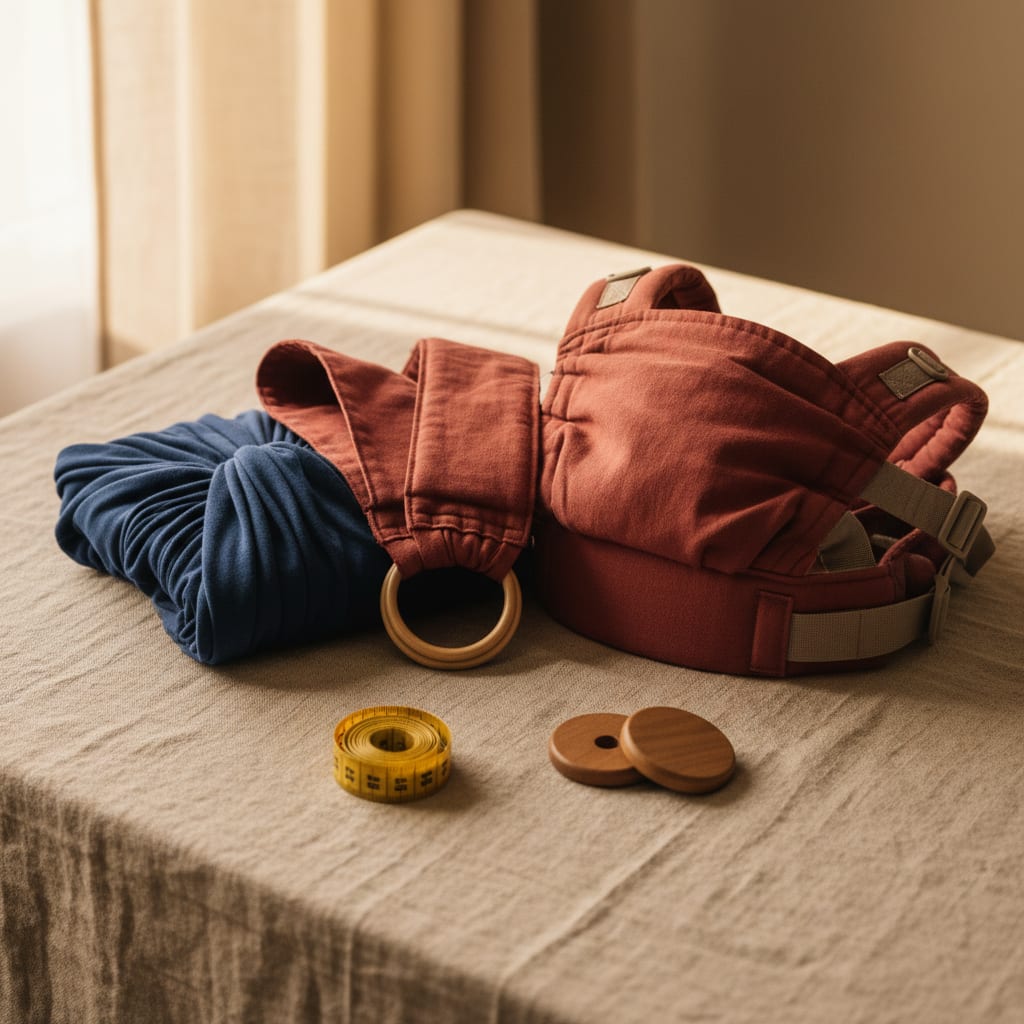
This is a baby carrier quiz you walk yourself — six questions, no form, no email, no winner announced at the end. If you’re wondering how to choose a baby carrier, here’s the answer in one paragraph: don’t start with brands — start with six questions about your baby’s age, how long you’ll wear, who else will wear it, your tolerance for learning curves, your climate, and your budget. Those answers point to a carrier type (stretchy wrap, ring sling, woven wrap, or buckle carrier), and the type decision does most of the work. The specific model matters far less than the internet implies, and fit matters more than either.
Old-timers may remember this page’s ancestor: the original quirkybaby.com shop ran a carrier-finder quiz — the QB Quiz — that got passed around parenting forums for years. This is that idea rebuilt as a decision tree, which is why the questions ask about your life rather than your preferences.
Before the quiz: the one non-negotiable
Whatever you choose must hold your baby in a safe position: high, tight, visible, chin off chest, knees above bottom. Every mainstream carrier type can do this when fitted correctly. The safety guide covers the full check — run it on whatever the tree hands you.
Question 1: How old is your baby?
Under about 3 months: stretchy wraps and ring slings are in their prime, and buckle carriers work if the model supports a newborn without an awkward insert (many current ones adjust down to around 7 lb). 3–12 months: everything works; this is the golden age of the buckle carrier. Toddler: woven wraps, buckle carriers in larger sizes, and your increasingly philosophical acceptance that they’ll demand “up” and then immediately “down.”
Question 2: How long are your typical carries?
Under 30 minutes, many times a day (school runs, errands, the fussy hour): a ring sling’s on-and-off speed wins. An hour or more at a stretch (walks, naps, housework): you want two shoulders and a waistband — buckle carrier or woven wrap — because single-shoulder carriers concentrate load. If your shoulders already complain, read the shoulder-pain fit clinic before blaming any carrier.
Question 3: Who else will wear it?
If two adults of different sizes will share one carrier, buckle carriers adjust fastest between bodies — this is their quiet superpower. Wraps technically fit everyone (you tie them to size every time), but both wearers have to actually learn to wrap. If one of you won’t, be honest about that now.
Question 4: What’s your learning-curve tolerance?
Zero patience, need it to work today: buckle carrier. A weekend of practice sounds fine: stretchy wrap or ring sling. You enjoy mastering things and want maximum range: a woven wrap — the manual transmission, and the only type that does everything from day one to preschool.
Question 5: What’s your climate?
Multiple fabric layers wrapped around two warm bodies is a feature in January and a problem in August. Hot-climate wearers should weight mesh-panel buckle carriers and single-layer carries; cold-climate wearers can ignore this question and wear the baby as insulation. (That’s the dry aside, but it’s also just true.)
Question 6: What’s your budget?
Roughly speaking: stretchy wraps and budget buckle carriers sit at the affordable end, mainstream buckle carriers and ring slings in the middle, and woven wraps run from modest to collector-grade absurd. A budget buckle carrier like the Infantino Flip 4-in-1 is a legitimate answer, not a compromise to apologize for — it’s rated 8–32 lb and fits the same safety rules as anything four times the price. Secondhand is also honorable: check webbing, buckles, and stitching, and verify against recall lists.
Reading your result
Tally where your answers pointed:
| Your pattern | Your type | Deep guide |
|---|---|---|
| Newborn, cozy, home-heavy days | Stretchy wrap | Stretchy wraps explained |
| Quick trips, up-down toddler, one shoulder free | Ring sling | Ring slings explained |
| Two wearers, long walks, zero patience | Buckle carrier (SSC) | Soft structured carriers explained |
| Range-topping, learning welcome | Woven wrap | Woven wraps explained |
Most families’ answers split across two rows. That’s normal — the classic resolution is a soft option for the newborn months plus a buckle carrier for the long haul, acquired in that order, secondhand where possible.
Where the rankings live
This site deliberately doesn’t crown winners — the type decision above is the part nobody else walks you through, and it’s the part that prevents regret. When you get down to “which specific buckle carrier should I order,” ranked, tested verdicts are a different genre; our sibling review site’s tested roundups do that job properly. Where to send yourself next, by result:
- Buckle carrier, and you’re short-torsoed or petite: their best carriers for petite moms roundup, because torso length decides more SSC purchases than any spec on the box.
- Woven wrap, and the prices have started looking normal to you: their luxury woven wrap alternatives comparison.
- Still assembling the whole nursery: their minimalist baby registry checklist, and our own carrier-only version in what to ask for on your registry.
Decide the type here; buy the model there; then come back for fit.
FAQ: choosing a baby carrier
What is the easiest baby carrier for beginners?
A buckle carrier — it goes on like a backpack worn frontward and adjusts with straps rather than technique. Its fit ceiling is lower than a well-tied wrap’s, but its fit floor is much higher, which is what matters in week one.
Do I need different carriers for different ages?
Not necessarily. Several buckle carriers and every woven wrap span newborn to toddler. The common two-carrier pattern (stretchy wrap early, buckle later) exists because each is at its best in that era — a convenience, not a requirement.
Is an expensive baby carrier worth it?
Price buys fabric feel, adjustment refinement, and resale value — it does not buy safety, which comes from positioning, or comfort, which comes from fit. A correctly fitted budget carrier beats a badly fitted premium one every single time.
Can I just use the carrier from my registry?
Yes — fit it properly before deciding it “doesn’t work.” Most abandoned carriers are abandoned over fixable fit problems: waistband too low, straps too loose, seat too narrow. Run it through the fit clinic before replacing it.