Moro Reflex: Why Carriers Settle a Startling Baby
The Moro reflex is the newborn startle: arms fly out sideways, fingers splay, the back arches, then the arms come back in — often with a cry, and almost always at the exact moment you thought the nap had landed. It’s a normal reflex that fades over the first months, and it explains why a baby asleep on your chest detonates ninety seconds after being put down. A carrier helps because it supplies the two inputs that damp the reflex: continuous containment and continuous contact.
This is peer-educator education, not medical advice — anything unusual about your baby’s startles belongs with your pediatrician, and there’s a short list below of what “unusual” means.
What the Moro reflex actually is
One of the primitive reflexes babies are born with, it fires on sudden change: a feeling of falling, an abrupt head shift, a loud noise, or nothing you can identify. Arms and legs extend outward, then draw back toward the midline as if grabbing on. That shape gives away what it’s for: a startle-and-cling response, and what it evolved to cling to was a caregiver’s body. Which reframes the problem. The reflex isn’t a malfunction a carrier masks; it assumes the caregiver’s body is there.
Most babies’ Moro reflex fades somewhere in the three-to-six-month range as the nervous system matures. Healthychildren.org is the AAP-affiliated place to read about newborn reflexes; your pediatrician checks these at well-baby visits, which is the right venue.
Why it wrecks transfers specifically
The reflex’s most reliable trigger is the sensation of falling — and lowering a sleeping baby from your chest to a mattress is, from the inside, a controlled fall. Heat leaves, arm pressure disappears, the head tips back a few degrees, and the vestibular system files a report. Arms out, eyes open, nap over.
Which is why transfer advice is all about removing the falling cue: wait for the limp-arm stage of deep sleep, lower bottom-first with your chest still close, keep a hand on the chest for a slow thirty seconds. You’re avoiding the specific input that fires the reflex. The full method is in why your baby only naps in the carrier.
Why containment works
Three things a well-fitted carrier does that a flat surface can’t:
Deep, even pressure. Snug fabric around the trunk gives constant proprioceptive input — the body’s sense of where it is. Startles fire on change; a steady envelope of pressure is the opposite of change. Same principle as swaddling, delivered upright.
Arms toward the midline. The reflex ends with the arms drawing inward. A carrier holding them near the face lets the sequence complete rather than leaving them flailing in open air — which is what turns a small startle into a full wake-up.
No falling cue. The baby stays against a warm, moving body. Walking is continuous, predictable vestibular input, and predictable is what the startle reflex ignores.
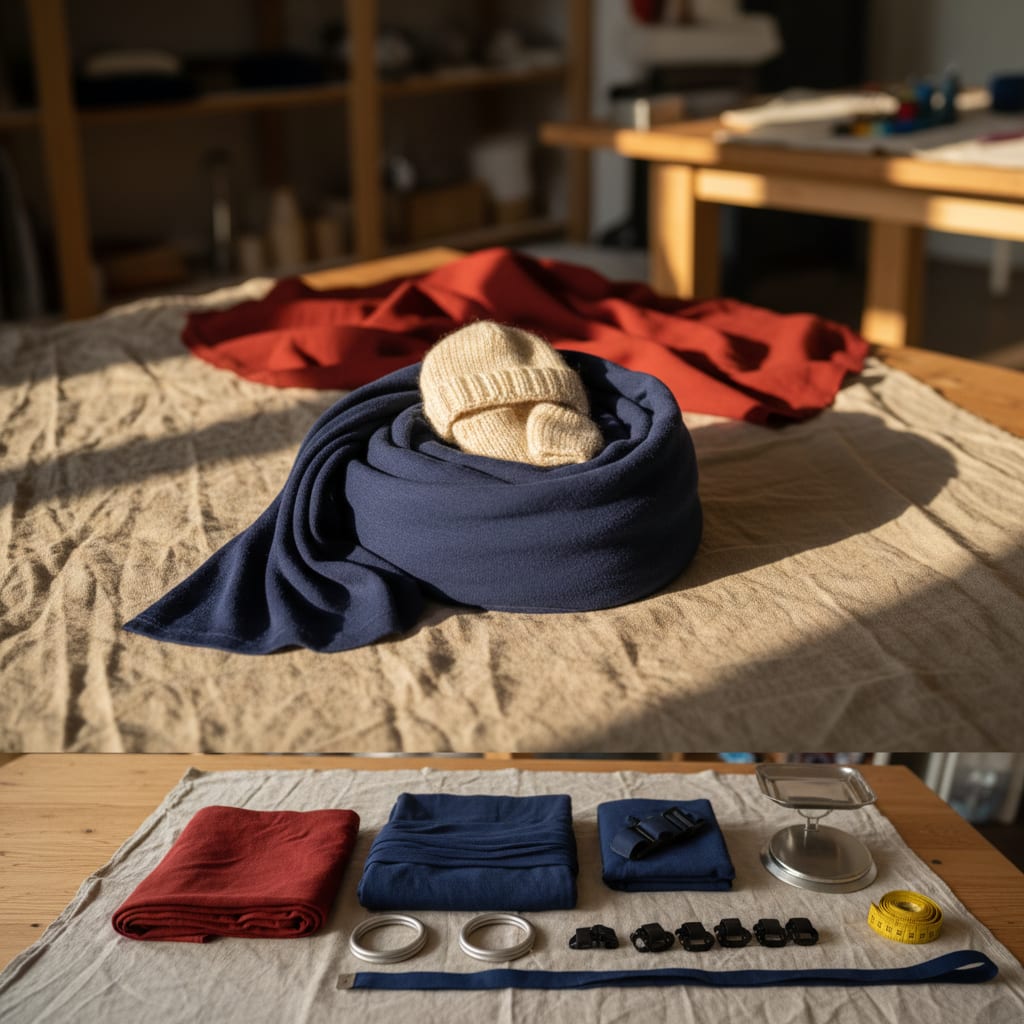
Knit fabric does this well in the newborn weeks because it moulds rather than frames — a stretchy wrap like the Boba Wrap (7–35 lb) wraps the trunk in even tension with a seat you set yourself. Its limits, including the hard front-carries-only rule, are in the stretchy wrap guide.
Arms in or arms out?
Newborns: arms in, hands up near the face, inside the fabric — the containment position. Two non-negotiable caveats. Nothing covers the face; the fabric sits below the chin with the face fully visible. And you never swaddle a baby inside a carrier — a swaddle plus a carrier means restrained arms in a position you can’t correct quickly, and it interferes with the airway checks that make carrier wearing safe. Containment comes from the carrier’s own fabric, not a second layer of restraint.
Around the time the reflex fades: babies start bringing hands to mouth deliberately. Arms out, over the panel or wrap rail, becomes the better option — a baby who wants their hands and can’t reach them will tell you.
Sleeping babies of any age: re-check after they drop off. They sag, and a sag is how a chin ends up on a chest.
Twitching, startling, or something else
Three night-time things get conflated. A Moro startle is a whole-body extension with arms flung outward, triggered by a change. Ordinary sleep twitching — small jerks of a hand, foot, or face — is separate and generally benign; Betteroo’s guide to twitching and jerking during sleep covers what’s typical. And the arms-up “starfish” posture — elbows bent, hands beside the head — is its own thing, unrelated to distress; Betteroo covers why babies sleep with their arms up if that’s the shape your baby holds all night.
Call your pediatrician if the startle appears on only one side, is absent altogether, persists well past six months, or the movements are rhythmic and come in repetitive clusters rather than as a single startle. None of those are babywearing questions.
The safety rules that don’t bend
A carrier settles a startly baby beautifully, and none of that changes the boundaries:
- A sleeping baby in a carrier is a supervised sleeper. You stay awake, upright, attentive. A carrier is never a substitute for a safe sleep surface, and a sleeping baby is never left in one unattended — not while you sit down, not for five minutes.
- Upright and high, always. No cradle carries, no bag-style slings, no positions that curl a newborn chin-to-chest. The reflex-damping benefit comes from containment, not from curling.
- Run TICKS on the sleeping baby, not just the awake one. Tight, in view at all times, close enough to kiss, keep the chin off the chest, supported back — the full check is in the safety guide.
- Hips stay hip-healthy. Thighs supported knee to knee, knees above the bottom, per the International Hip Dysplasia Institute.
- Duration is governed by position, feeds, heat, and your back, not by the reflex — the five limits are unpacked in how long a baby can stay in a carrier.
When the reflex fades, the carrier’s job changes
Once the Moro reflex retires, the startle-damping benefit goes with it — and something else takes its place. Babies who have outgrown startles still settle in carriers, now for motion, warmth, and proximity. The carrier doesn’t stop working; it stops working for that reason. It’s also when arms-out, hip, and eventually back carries start making sense.
Inconveniently, it’s roughly when nap timing starts mattering more than nap technique. If naps have stopped being a containment problem and started being a scheduling problem, Betteroo is a personalised sleep program built around a quiz about your baby and your parenting style — day-by-day nap windows and bedtimes that adjust as things change. The workbench verdict: a tool, not magic. It won’t damp a startle and no app repeals a developmental leap, but for around $20 a month it removes the “when should this nap even happen” guesswork.
FAQ: the Moro reflex and carriers
At what age does the Moro reflex go away?
Usually somewhere between three and six months, as the nervous system matures and voluntary movement takes over. Your pediatrician checks newborn reflexes at well-baby visits; a startle that persists well beyond six months, or appears on only one side, is worth raising there.
Does babywearing help with the startle reflex?
It reduces how often it fires and how much it disrupts sleep, because snug pressure and continuous contact remove the sudden-change inputs that trigger it. It doesn’t make the reflex go away — that’s developmental — and it only works when the carry is correctly fitted and supervised.
Should my newborn’s arms be in or out of the carrier?
In, with hands up near the face, during the newborn weeks — the containment position that lets a startle resolve. Move to arms out once your baby is deliberately bringing hands to mouth. The face stays fully visible and uncovered either way.
Can I swaddle my baby inside a carrier?
No. A swaddle plus a carrier restrains the arms in a position you can’t correct quickly and gets in the way of the airway checks that keep babywearing safe. Let the carrier’s own fabric do the containing.
Why does my baby startle awake the second I put them down?
Because being lowered feels like falling, the Moro reflex’s most reliable trigger — your warmth leaves, the pressure disappears, and the head tips back slightly on the mattress. Wait for deep sleep, lower bottom-first with your chest close, and keep a hand on the chest for thirty seconds before retreating.