Ring Slings Explained: Fabrics, Rings and Sizing
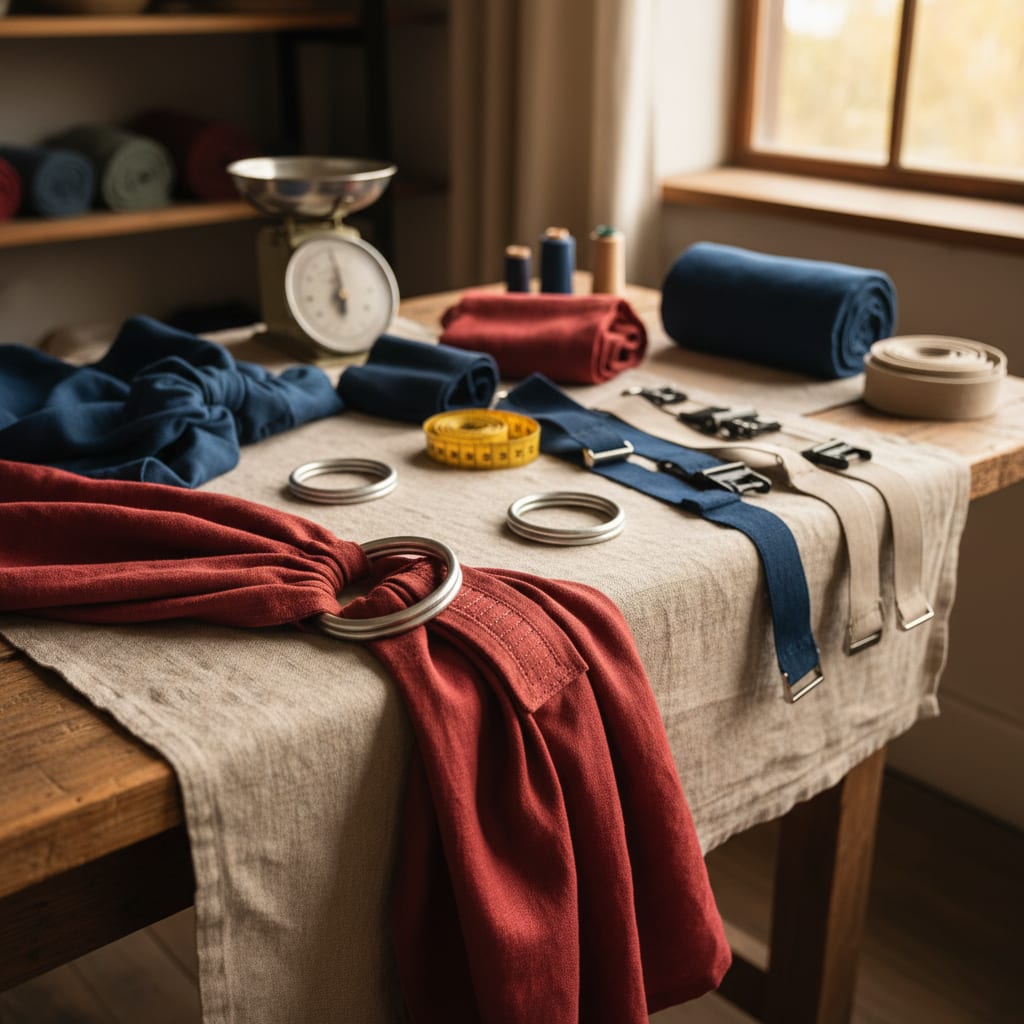
A ring sling is the simplest serious baby carrier: about two meters of woven (non-stretch) fabric, two rings sewn into one end, and a threading pass that turns the whole thing into an adjustable loop with a tail. That’s the entire machine. Baby sits in the pouch of the loop in an upright M-position; the rings act as a friction lock you can tighten one-handed; the tail is your adjustment slack. Ring slings are the fastest carrier to put on, the easiest to adjust mid-carry, and the most honest about their limit: one shoulder does all the work, which makes them sprinters, not marathoners.
The original quirkybaby.com sold ring slings for years — Maya Wrap among them, a brand still weaving today. This page brings the education back to the address.
The rings: small hardware, zero compromise
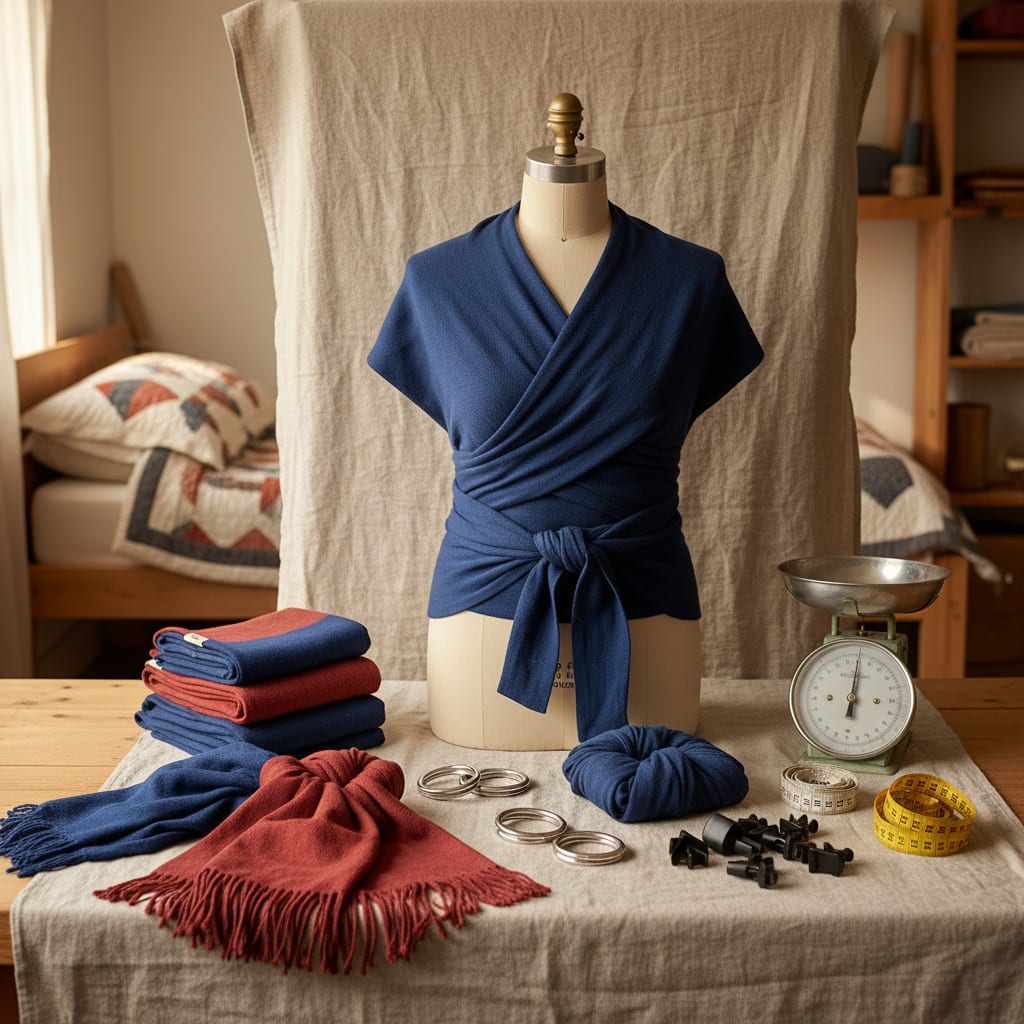
Everything hangs — literally — on two aluminum or nylon rings. Purpose-made sling rings are seamless (cast or machined as one piece, no weld) and tested for the job; craft-store rings and carabiner improvisations are how horror stories start. Buying from any established sling maker gets you tested rings by default; buying handmade from a market stall means you are the quality inspector. Look for smooth, seamless rings sized so the fabric moves through with friction but without force.
While you’re inspecting: the sewn junction where fabric meets rings should show dense, multi-row stitching. That seam carries your child.
Fabric: woven, always
Ring slings use woven fabric — the non-stretch kind — because the friction lock only holds fabric that doesn’t creep. Common options, in rough order of beginner-friendliness: cotton wovens (grippy, forgiving, machine-washable — the default first sling); linen and linen blends (cooler, stronger per weight, a favorite for summer and toddlers, slightly more careful care); silk and fancy blends (beautiful, occasion-wear pricing). Double-layer or padded designs trade a bit of adjustability for shoulder cushioning.
Worked examples, per house style without a ranking: the Moby ring sling is a canonical, widely available cotton starter; Maya Wrap remains the classic lightly padded lineage with a zippered tail pocket. Boutique makers abound and are largely interchangeable on function — you’re choosing fabric and shoulder style, not physics.
Shoulder styles and sizing, decoded
The “shoulder” is how the maker pleats or gathers the fabric where it crosses yours. Gathered (unpleated) shoulders spread widest and adjust most freely — the default recommendation. Pleated shoulders look tailored and cap the spread — fine on broad shoulders, dig-prone on narrow ones. Padded shoulders cushion but fix the fabric’s position; if the pad lands wrong on your frame, you can’t spread your way out of it.
Sizing is about the tail: most wearers do fine with a maker’s standard length; petite wearers just end up with more tail (trim-able, or tuck it), and larger wearers should check the maker’s long option. Unlike wraps, sling sizing is forgiving — the rings absorb the difference.
Threading and the seat, in brief
The tail goes up through both rings and back down through the bottom ring, and the seat runs knee to knee with the inner rail snug so your baby cannot lean away from you. The full step-by-step, from threading to taking baby out, is in how to use a ring sling; this page stays on the hardware.
What ring slings are for — and not
For: the up-down toddler era, quick errands, newborn snuggles at home, hip carries from six months (the sling’s signature position), and quick feeds out and back in — a sling is the fastest carrier to lift a baby from and re-seat, which is why the breastfeeding and babywearing guide leans on it. Not for: long hikes, all-day wear, or back carries (technically possible, practically an experts-only corner of the hobby). One shoulder is the whole load path; if your carries routinely pass the half-hour mark and your shoulder complains, that’s the format speaking, not your posture — the shoulder-pain clinic has the fixes that exist, and the honesty about the ones that don’t.
Airway and positioning rules are identical to every other carrier: upright, high, visible, chin off chest. The historic bad actor in the sling family — the deep “bag sling” that cradled babies horizontally, low and curled — is precisely what modern upright technique replaced. We describe it so you can recognize and avoid it; nothing here links to one.
FAQ: ring slings
Are ring slings safe for newborns?
Yes, upright and correctly positioned — high on the chest, chin off chest, face visible and uncovered, knees above bottom. The horizontal cradle carries in old instruction sheets are the risky pattern; keep newborns vertical and run the TICKS check every carry.
What age is a ring sling best for?
The format spans birth to toddler, with two peaks: the newborn months (fast, soft, adjustable) and the up-down toddler stage from about one year, where ten-second loading beats every buckle. The valley in between belongs to two-shouldered carriers for anything long.
Ring sling or stretchy wrap for a newborn?
Both are excellent newborn tools with opposite personalities: the stretchy wrap pre-ties and molds softest but heats up and retires early; the sling is faster on-off, cooler, and lasts into toddlerhood, at the cost of one-shoulder load and a small threading skill. Households often end up with one of each, acquired secondhand.
Why does my ring sling slip?
Three usual causes: fabric bunched in the rings instead of spread, a stretchy or slippery non-sling fabric, or rings too large for the cloth. Spread the fabric, re-thread carefully, and if it still creeps under load, retire the sling — the friction lock is the safety system.