Baby Will Only Sleep on Me? What the Sling Is Doing
A baby who settles in a sling and nowhere else is not broken, spoiled or badly trained — they are responding to five separate physical inputs that a flat mattress supplies none of. Stop treating “on me” as one thing and work out which of the five your baby is asking for, because two can be reproduced in a crib and the other three cannot be, not without breaking safe-sleep rules. Knowing which is which is the difference between a plan and a fortnight of guessing.
The five things a wrap supplies and a mattress does not
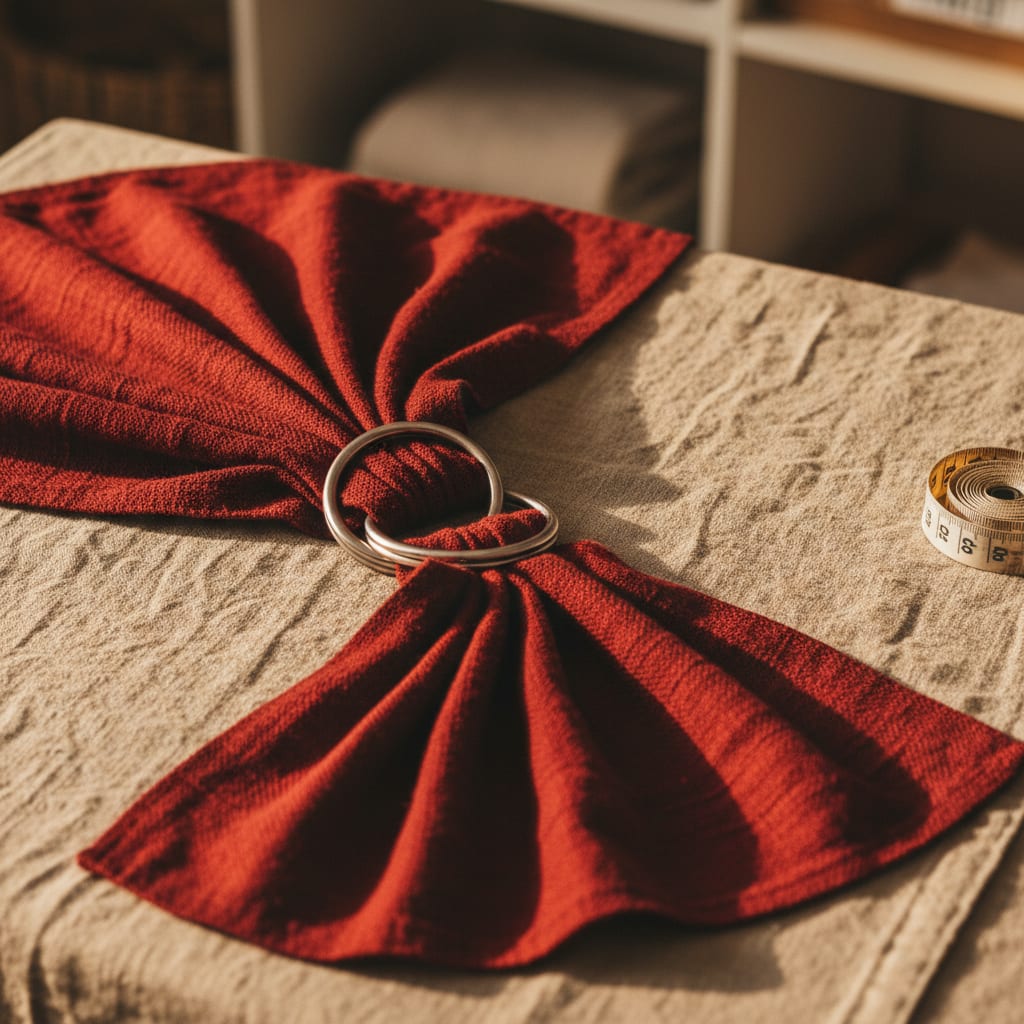
A stretchy wrap or a ring sling is a specific piece of engineering, and worth being precise about — a buckle carrier delivers a different set, a crib almost none of it.
- Even pressure, in the round. Cloth passed twice around two bodies and tensioned applies a low continuous load across the whole trunk. A panel carrier concentrates that at two straps and a waistband; a mattress loads one side only.
- A boundary. The fabric ends against the baby. In a crib there is nothing for a moving limb to find.
- Heat, skin-to-skin through one layer, with your body as the radiator.
- Upright, tummy-to-tummy position. Head above stomach, spine curled as it was a month ago.
- Your motion, heartbeat and voice, conducted through cloth rather than air.
Any one can be the load-bearing one. The dry version: your baby has not fallen for a rectangle of jersey, they have found a five-variable setup that arrives as a bundle.
Which input is your baby asking for
Run these over two or three days, one change at a time.
Test pressure. Hold your baby against you, firm flat hand across the back, two minutes, no walking and no talking. If that settles them, pressure is doing the work.
Test the boundary. Settle them in the sling, then loosen it by an inch. A baby who protests before you have moved is telling you containment is the point — that is also the fit fault behind most sling complaints, so re-tighten afterwards.
Test motion. If they settle only while you walk and stiffen when you stop, this is a motion problem rather than a contact one, with its own ladder in baby only sleeps in motion.

Two inputs you can copy, and three you cannot
This is the part that saves money: safe sleep rules out three of the five substitutes outright.
Pressure — available, with conditions. A correct swaddle is the one legitimate way to reproduce even pressure on a flat surface. The AAP’s swaddling guidance: “when done correctly, swaddling can be an effective technique to help calm infants and promote sleep,” using “only a thin blanket,” loose enough for “at least two or three fingers between the baby’s chest and the swaddle.” Hips stay loose — the AAP and the Pediatric Orthopaedic Society of North America promote hip-healthy swaddling “that allows the baby’s legs to bend up and out.” Stop “as soon as your baby shows any signs of trying to roll over,” possibly as early as two months.
Your presence — available, and underrated. Room sharing is not a compromise; the AAP recommends it because it “can decrease the risk of SIDS by as much as 50%.” A hand on the chest and your voice at the crib side deliver part of two inputs, for nothing.
Heat — not transferable. You cannot warm a crib to sling temperature. The AAP’s line is one layer more than you are wearing, plus a wearable blanket if you are worried, and explicitly: “don’t use weighted blankets, sleepers, swaddles or other weighted objects on or near your baby.”
Boundary — not transferable. Every product sold to reproduce it is either a soft object in the sleep space or an unregulated sleep product. The AAP’s safe sleep guidance is that “wedges, positioners, special mattresses and specialized sleep surfaces have not been shown to reduce the risk of SIDS,” and that a fitted sheet only goes in the crib. Nests and pods count.
Upright position — not transferable. “Any surface that inclines more than 10 degrees isn’t safe for your baby to sleep on” — which rules out propping the mattress and every inclined sleeper.
So: swaddle correctly, be present, accept a cooler flatter surface, and expect repetition rather than equipment to close the gap.
Working the plan without wrecking the day
Pick one nap — the one that already goes best — and leave the rest in the sling. Feed, settle in the wrap as usual, and once they are properly asleep run the put-down in the carrier-to-crib transfer, an order of operations rather than a knack. Swaddle for the transfer rather than after it, so pressure never lapses. Expect a fortnight, not an evening.
If it is worse in the late afternoon, that is not a surface problem. Betteroo’s rundown of the witching hour covers the daily crying peak that makes every carrier look magic and every crib look broken, and its guide to a baby who is fussy all day sorts hunger, tiredness and discomfort apart, at around $20 a month. Whether this becomes a lasting habit is answered in baby only naps in the carrier.
Sling rules get stricter here, not looser
Nothing above relaxes because your baby sleeps well in the wrap. A sling is not a sleep surface, and Ireland’s HSE puts it plainly on its carrier safety page: “if your baby falls asleep, remove them from the sling or baby carrier as soon as possible. Place them on their back to sleep.” The AAP says the same of a baby asleep in “a car seat, stroller, swing, infant carrier or sling”.
Soft carriers carry their own hazard, and it is age-graded. The AAP’s carrier safety list warns that “some sling carriers may curl your baby’s body into a C-shape, which greatly increases the risk of breathing problems,” and cites the CPSC’s suffocation warning for infants “particularly those younger than 4 months.” The requirements are exact: head up above the fabric, face visible, nose and mouth clear, neck straight, chin off the chest. The Lullaby Trust’s sling advice adds that accidents “usually happen when a baby’s airway is blocked, either because their chin is resting on their chest or their mouth and nose are covered by the parent’s skin or clothes,” and that hands-free feeding is unsafe — take them out to feed. Never wear a baby while you lie down, recline or doze. Full checklist: babywearing safety.
Fit is the other half. A ring sling tensions in one pull across a single shoulder; a stretchy wrap is pre-tied and holds tension by fabric recovery. Neither is better — they fail differently, and slack fabric is the commonest reason a baby who “loves the sling” abruptly does not.
FAQ: a baby who only settles on you
Is it bad that my baby will only sleep on me? No. It is the expected preference for a young baby and does not predict later sleep. The constraint is supervision, not habit: contact sleep is supervised sleep, and you have to be awake for it.
Will a swaddle really replace the sling? It replaces one of five inputs — often enough for one nap, rarely for all of them. Done correctly (thin blanket, two or three fingers of chest room, hips free to bend up and out, back to sleep, stopped at the first sign of rolling) it is the only pressure substitute safe sleep permits.
Are baby nests, pods or positioners a shortcut? No. They supply the boundary, the one input safe sleep will not let you supply, and positioners and specialised sleep surfaces have not been shown to reduce SIDS risk.
Is a sling safe for a newborn at all? Yes, with the age-specific rules held tightly: face visible and clear of fabric, chin off the chest, neck straight, back supported, frequent checks. Premature and low-birth-weight babies and babies with breathing problems need pediatrician sign-off first — the AAP says infants born prematurely or with respiratory problems should not be placed in upright positioning devices.
When is this a doctor question rather than a technique question? If your baby arches, cries or refuses to lie flat after every feed, if feeds are painful or slow, or if weight gain has stalled, book an appointment rather than buying another carrier. Upright holding is comfort, not treatment, and reflux and feeding problems are what a better wrap job will not fix.