Mei Tais and Onbuhimos: The Tie-On Carriers Explained
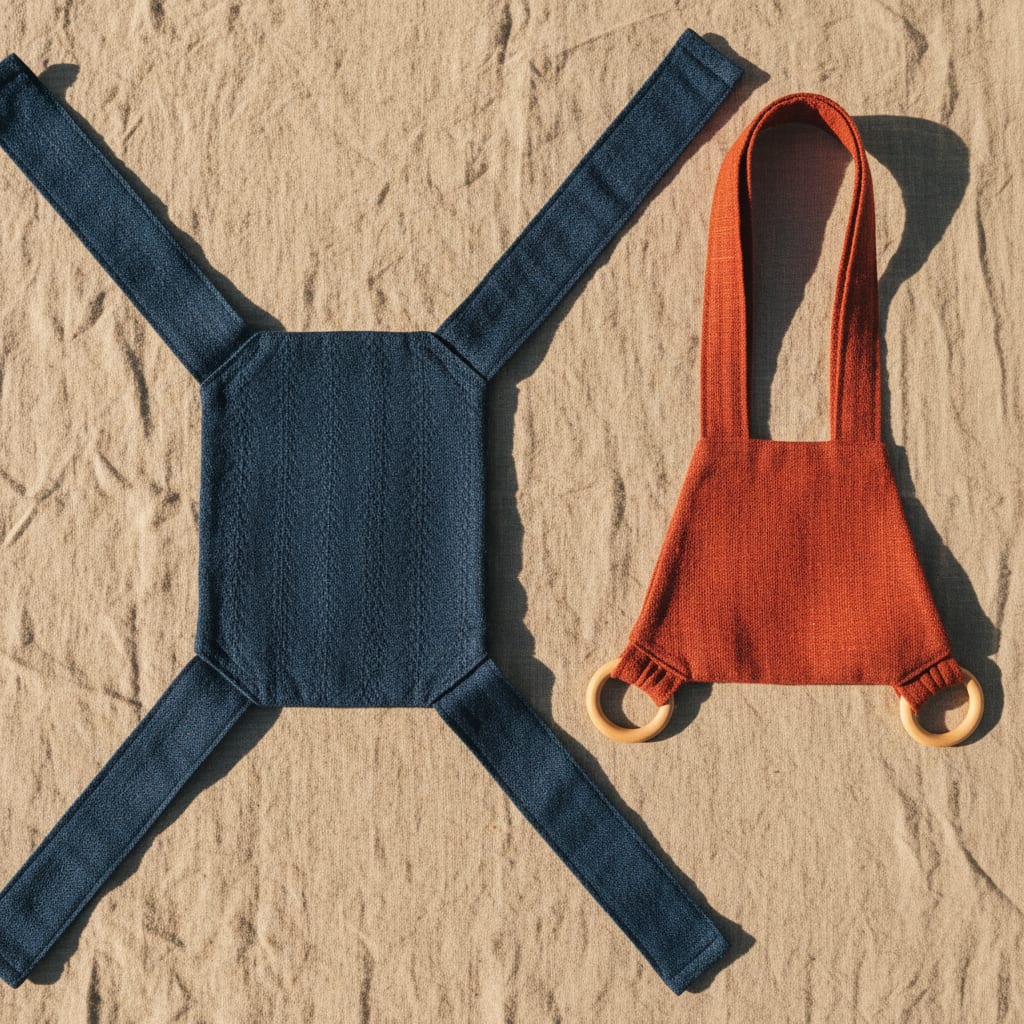
A mei tai is a rectangular fabric panel with four straps — two at the waist, two at the shoulders — that you tie on yourself. An onbuhimo is the same idea with the waist straps deleted: the shoulder straps thread through rings or loops at the bottom corners of the panel, so all the weight rides on your shoulders and upper back. Both sit between a woven wrap and a buckle carrier: more adjustable than buckles, far less fabric than a wrap, and no hardware to size wrong. Neither is a beginner’s default, and both solve problems the other carrier types genuinely cannot.
Where the designs come from
These are not new inventions with heritage styling. The mei tai — often written meh dai, closer to the Cantonese — comes from Chinese carrying traditions that predate every Western carrier brand by centuries. The onbuhimo comes from Japan, where onbu refers to carrying on the back. Korea’s podaegi is a related blanket-and-strap carrier with its own construction.
That history is worth stating plainly. No Western brand designed this shape; they adapted it. The traditional versions are still made by makers within those cultures, so “mei tai” names a living carrier type rather than a retro category, and a modern carrier borrowing the name is honestly described as mei-tai-style.
How a mei tai actually works
The panel goes against your baby’s back. The waist straps tie around your waist — usually a knot at the front or a knot behind, depending on the length and the carry. Then the shoulder straps go over your shoulders, cross behind your back or pass under your baby’s legs depending on the carry, and get knotted off.
What you gain over a buckle carrier is stepless adjustment. There is no strap ladder, no fixed seat width, no waistband click points. You tie a mei tai where your body wants it, which is why it suits torso lengths that fall between buckle-carrier settings, and why two adults of very different sizes can share one without renegotiating hardware.
What you gain over a woven wrap is speed and bulk. A mei tai has a defined panel, so you do not have to build a seat out of loose fabric, and the straps are short enough to keep off the floor of a car park. If you have read the woven wrap guide and thought “I want that adjustability without seven metres of cloth”, this is the shape you were looking for.
The straps are the whole comfort story. Wide wrappable straps, made of the same woven fabric as the panel, spread across your shoulder and can be twisted flat where they cross; narrow padded straps tie faster but concentrate load. Padding feels better in the shop and worse at hour two.
Worked example: a budget option is the Infantino Sash Wrap and Tie carrier, a mei-tai-style panel with straps rather than buckles — the cheapest honest way to test whether the tie-on format suits you. Small woven-fabric makers such as Fidella, Didymos, BabyHawk and Kokadi build the same shape in wrap fabric, at wrap prices.
How an onbuhimo differs, and who it is for
Delete the waistband and nothing presses on your abdomen or hips. That single change is why onbuhimos have a devoted following among pregnant wearers, people recovering from abdominal surgery, and anyone whose waistband triggers pain or nausea.
The trade is unavoidable. With no waist strap, every kilo of your baby hangs from your shoulders. That is fine for short carries and grocery runs, and it is tiring for a two-hour walk in a way a waisted carrier is not.
Onbuhimos also carry a readiness rule. Most are designed for back carries with a baby who can sit unassisted, because the design gives no support below the seat and no realistic way to check a newborn’s airway behind you. Some manufacturers state a minimum age or weight; follow theirs, not a forum’s. If a back carry is new to you, work through when and how to start a back carry before adding a carrier with no waistband to the experiment.
Half-buckles, and other hybrids
Between the two sits a family of hybrids. A half-buckle pairs a buckled waistband with tie shoulder straps, removing the fiddliest knot while keeping wrappable strap comfort. A full-buckle with a wrap-fabric panel is essentially a soft structured carrier made of wrap cloth. There are onbuhimos with buckled shoulders too.
None of this changes the fit rules. Whatever the closure, the panel spans knee to knee, the knees sit higher than the bottom in the M-position the International Hip Dysplasia Institute describes, and the fabric is snug enough that your baby does not slump. The buckle-carrier decoder covers what changes when hardware is involved.
Fitting a mei tai to your baby right now
The one adjustment people miss is panel width. A mei tai panel that is wider than knee-to-knee for a small baby will push their legs apart and drop them into the middle of the fabric. The traditional fix is a fold: bring the waist strap up and tie it higher, or roll the panel at the waist, so the effective panel is narrower and shorter. Many modern panels have a cinch or a snap for the same job.
Panel height is the other one. The top edge should reach roughly to your baby’s armpits for an alert older baby, and higher — mid-neck — for a newborn who still needs head support. A panel taller than your baby folds them forward, and that is where chin-to-chest trouble starts. The safety checks that catch it are the same ones as everywhere else on this site: TICKS, airway and position, every time.
Knots, briefly. A square knot holds and unties; a granny knot slips. Tie the waist knot where you can reach it one-handed, and tuck long tails rather than letting them trail — a trodden strap is the least dramatic and most common way to lose your balance while wearing a baby.
Where these carriers are the wrong answer
- You want to hand the carrier over at speed. Tying takes practice, and a car-park handover is where buckles win.
- You need front-facing-out. Tie-on panels are not designed for it.
- You want minimal learning. A mei tai is easier than a wrap and harder than buckles; if the goal is nothing to learn, buy buckles.
- You need an onbuhimo for a newborn. That is not what the design does.
If what you actually want is a “which one should I buy” verdict, that is not this site’s job — we decode formats and fix fits. Only Mom Reviews runs the ranked comparisons, including carriers that work for petite wearers, which is a common reason people land on tie-on styles in the first place.
FAQ: mei tais and onbuhimos
What is the difference between a mei tai and an onbuhimo?
A mei tai has waist straps and shoulder straps; an onbuhimo has shoulder straps only, threaded through rings or loops at the bottom of the panel. The mei tai puts part of the load on your hips, the onbuhimo puts all of it on your shoulders and upper back.
Is a mei tai good for a newborn?
It can be, if the panel is narrowed and shortened to fit a small body and the top edge supports the head and neck. Follow the manufacturer’s minimum weight, keep the carry high and snug, and check the airway constantly. A stretchy wrap is still the easier newborn option for most people.
When can a baby go in an onbuhimo?
Most designs assume a baby who can sit unassisted and are intended for back carries, because there is no support below the seat. Manufacturer guidance varies, so use the one printed on your carrier rather than a general rule.
Are mei tais comfortable for long carries?
Wide wrappable straps spread across the shoulder and are comfortable for hours once tied well. Narrow padded straps are faster to tie and concentrate the load, which shows up after the first hour. Waistless onbuhimos are the least comfortable for long walks by design.
Do mei tais fit different-sized adults?
Better than almost anything else with a panel. Because the straps tie rather than click, there are no fixed settings to compromise on, which makes tie-on carriers a sensible choice for a household where two very differently sized adults share one carrier.