Baby Wakes When the Crib Soother Stops? Timer Fixes
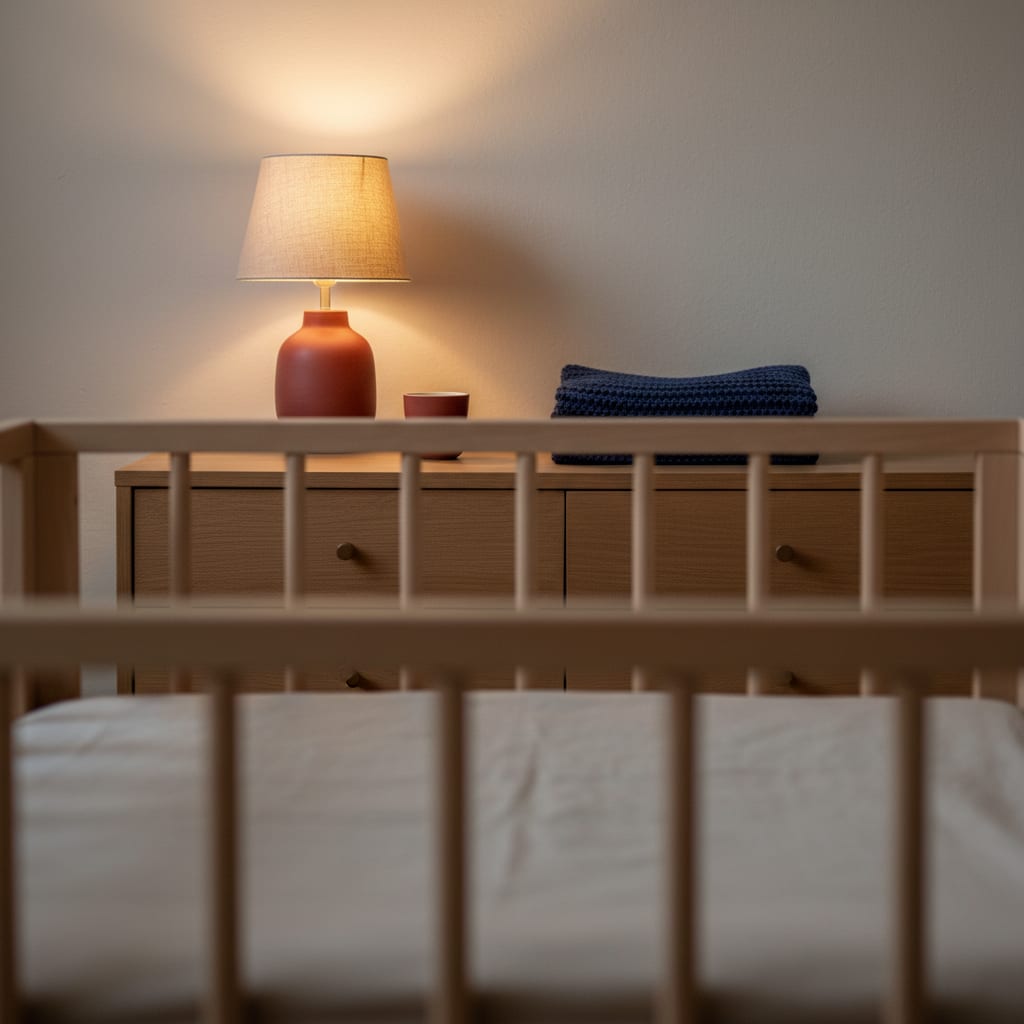
A musical crib toy on a timer can do both jobs: the tune helps a baby wind down, and the moment it cuts out can be what wakes them. Babies surface between sleep cycles, and a baby who fell asleep to a melody notices when it has gone. The fix is to change when the music happens, not to buy a longer timer. Let the music finish before your baby is asleep, so it is a wind-down cue rather than a sleep condition. If you want sound through the night, use steady sound from a machine across the room. And the toy never clips inside the crib.
None of this replaces your pediatrician. The safe-sleep rules below are the AAP’s, and they do not bend.
Why the tune ending can wake a baby
The AAP’s HealthyChildren page on getting your baby to sleep says it about rocking: “If you hold babies or rock them to sleep, they may struggle to go back to sleep if they wake up during the night.” The same page says brief waking is normal: “It is normal for a 6-month-old to wake up during the night and then go back to sleep after a few minutes.”
So: your baby falls asleep to a melody, then the timer ends. Later they surface between cycles, as they are built to, and the room no longer sounds like the room they fell asleep in. Some babies shrug that off. Some treat it like the end of rocking.
Honest scope: I found no study that tested crib-toy timers directly. What exists is that rule about falling-asleep conditions, plus the acoustics in the fridge-compressor post: a change in a quiet room disturbs sleep more than steady loudness does. A tune stopping is a change.
Babywearers know a version of this already. The carrier is the original soother on a timer: its soundtrack is your heartbeat and breathing, and it ends at the transfer. That is why the put-down has its own sequence in the carrier-to-crib transfer, and why fading motion in steps beats stopping it dead.
The two expert positions on timers
Here the sources genuinely disagree.
Turn it off once they are asleep. Children’s National Hospital’s page on sound machines and hearing says: “Turn off the machine once your baby falls asleep,” and “Consider a timer.” Its reason is hearing, not sleep. It cites the AAP’s advice to keep the volume “below 50 decibels (dB), similar to a soft conversation” and the machine “at least two feet away from baby’s crib.”
Leave it running. Betteroo’s pediatrician-reviewed white-noise guide takes the other side: continuous sound “tends to work better, because the sudden silence when a timer stops can itself wake a baby between sleep cycles.” Its distance is stricter: “at least seven feet, or about two meters,” and “rather than on the crib rail.”
Both keep the volume at about 50 decibels or lower and the sound off the crib. The AAP’s 2023 noise statement, summarised on healthychildren.org, shows how to choose between them. It treats noise as a dose: “the duration of exposure, not just the volume. As one increases, the other should decrease.” A timer is the hearing-cautious default; continuous sound means paying for the extra hours with less volume and more distance.
Music is not white noise. A crib toy usually plays a melody that rises, falls and loops with an audible seam. Betteroo’s guide to bedtime songs says not to leave lullabies playing all night: “Music that shifts and changes can disturb light sleep phases.” Songs for the wind-down, then “continuous white noise (or silence) for the night itself.” So even the continuous camp does not mean a lullaby loop.
 Waking at the same minute every nap? Check the clock, not just the toy.
An overtired baby surfaces at changes a rested one sleeps through. Betteroo turns a short quiz into wake windows and a daily plan for your baby's age.
Take the sleep quiz →
Where the toy is allowed to live
Nothing clipped to the crib slats or sides. The AAP’s Parent’s Guide to Safe Sleep lists what stays out of the sleep area: “pillows and pillow-like toys, quilts, comforters, mattress toppers, non-fitted sheets, blankets, toys, bumper pads or related products that attach to crib slats or sides.” A soother that clamps to the rail, or a plush that plays music, is in that sentence. The crib keeps a firm, flat mattress and a fitted sheet, and nothing else.
A mobile above the crib has an expiry date. The AAP’s page on making the baby’s room safe says a mobile must be “securely attached to the side rails, wall or ceiling,” hung “high enough so your baby cannot reach it,” and removed “when he is able to get up on his hands and knees, or is 5 months old, whichever comes first.” It adds that “crib gyms are not recommended.” The milestone is not new. The CPSC’s 1988 recall of a Chicco hanging crib toy said that “five-month-old infants can pull themselves up to a hanging crib toy,” and that the toy “should be removed when the child begins to push up on hands and knees.” Its packaging said birth to 18 months, which is why it was recalled: go by your baby’s milestone, not the box. Children’s Hospital of The King’s Daughters’ nursery safety checklist says the same.
Musical toys belong on the play mat, with an awake baby.
Test before you change anything
For four or five naps, write down two times: when the music stopped and when your baby woke. Wakes clustered within a few minutes of the cut-off make the timer your suspect. Wakes at the same point after falling asleep, whatever the music did, point to timing and tiredness instead.
Three setups that hold
1. Music as the last cue, finished before sleep. Play the tune, or better, sing it, in the final minutes of the wind-down, and stop while your baby is still awake. The lullaby guide makes the song “the final cue before the put-down” and says to “fade toward a hum.” For babies 4 months and older, the AAP asks for the same put-down: “Put babies to bed when they are drowsy. Do not wait until babies are asleep.” Your baby then falls asleep in a room that will sound the same in an hour. In a carrier this is easy: a slow sway in a stretchy wrap, a hummed verse, then the carrier comes off and the baby goes down awake. Your voice, unlike the toy, never needs batteries.
2. Steady sound across the room, all sleep long. If household noise is the real problem, join the continuous camp properly: a non-melodic sound from a standalone machine, such as the Hatch Baby sound machine, on a dresser well away from the crib, at the lowest level that takes the edge off. More hours means less volume.
3. A timer, kept, if your baby truly sleeps through it. If the log shows no wakes near the cut-off, the hearing-cautious default is working, and there is nothing to fix.
To drop sound later, the white-noise guide suggests lowering the volume over one to two weeks rather than stopping overnight. For what earns a place in the room at all, see the minimalist nursery.
FAQ: musical crib toys and timers
Is it safe to attach a musical soother to the crib?
No. The AAP keeps “toys, bumper pads or related products that attach to crib slats or sides” out of the sleep area. Put the sound source on furniture across the room.
When should a crib mobile come down?
At hands and knees or 5 months, whichever comes first, per the AAP. Until then, securely attached and out of reach.
Should a sound machine run all night or on a timer?
Experts disagree: Children’s National says off once your baby is asleep, for hearing; Betteroo’s guide says continuous, to avoid the wake a sudden silence can cause. Either way, keep it at about 50 decibels or lower, off the crib, and quieter the longer it runs.
Will my baby become dependent on the music?
They may expect whatever was playing as they fell asleep, which is the whole timer problem. End the music before sleep, and sing it yourself: that cue goes everywhere you do, including into the carrier.