The Minimalist Nursery: Sleep Gear You Can Skip
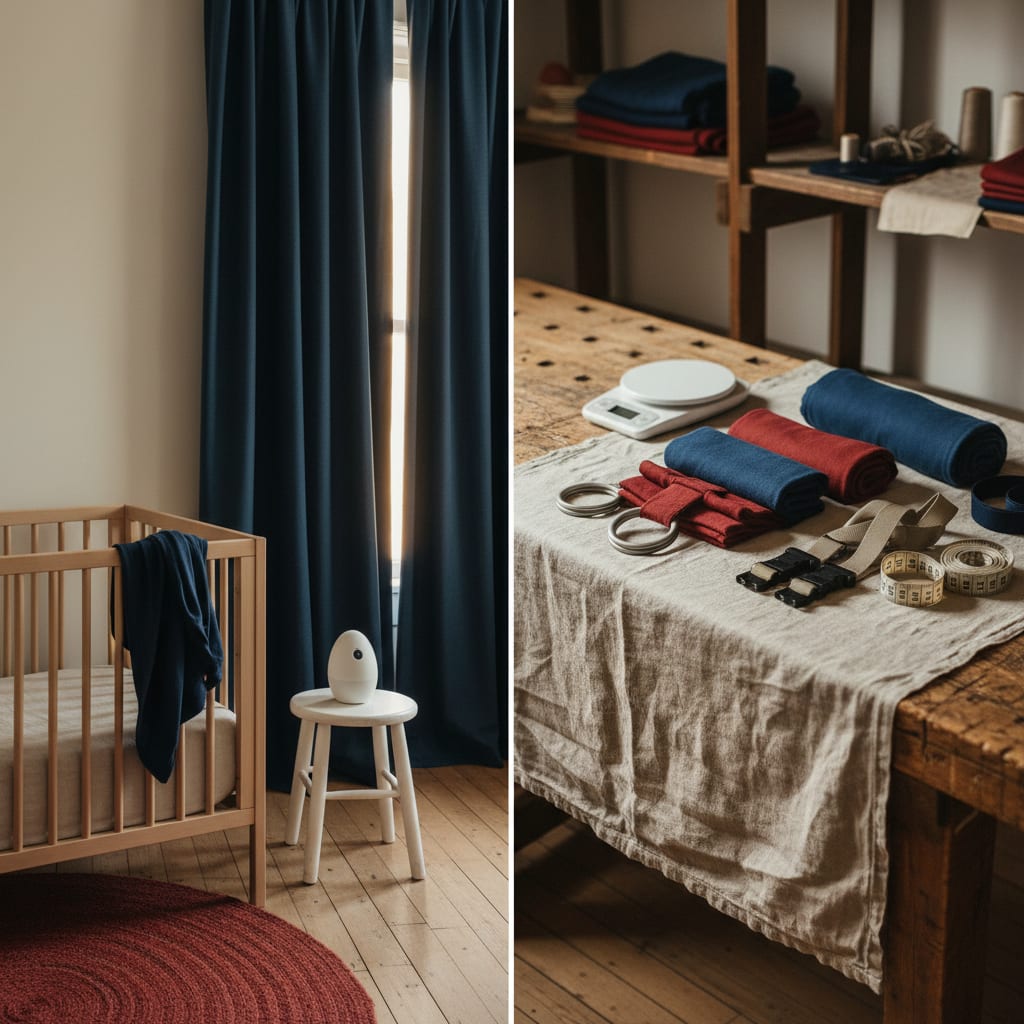
A baby’s sleep space needs four things: a firm, flat, empty surface, a dark room, steady sound, and a sensible temperature. Everything else in the nursery aisle is a convenience, a duplicate of something you own, or a solution to a problem babies don’t have. The reason a gear blog is telling you to buy less is arithmetic — one well-fitted carrier absorbs most of the daytime containment job that four separate plug-in devices are sold to do, and it does it hands-free.
None of this is medical advice. Safe-sleep guidance comes from your pediatrician and the AAP-affiliated healthychildren.org, and that’s the layer of this that isn’t negotiable.
What a sleep space actually requires
A firm, flat surface with a fitted sheet, and nothing else in it. No pillows, no loose blankets, no toys, no bumpers of any kind. This is the one item where “minimal” and “correct” are the same answer — the safest crib is the emptiest one.
Dark. Not dim — genuinely dark, for naps as well as nights. Blackout does more for daytime sleep than almost anything else you can buy, and it’s cheap; Betteroo’s rundown of what actually works for blackout is honest about the gap between expensive blinds and a well-taped panel.
Steady sound. Continuous, unchanging, low-volume sound masks the door-latch and the neighbour’s dog. The mechanically simple ones are still the best ones — the Yogasleep Dohm makes its noise with an actual fan rotor, so it never loops, never runs out of battery, and has exactly two settings.
A sensible room temperature, on the cool side, with your baby dressed for it rather than the room heated for them. Betteroo’s guide to room temperature for sleep covers the ranges and how to dress to them.
That is the list. Four items, one of which is free.
The gear a carrier quietly replaces
Here’s where the babywearing bias becomes useful rather than annoying. A large slice of the gear budget goes on devices whose entire function is hold the baby, upright, moving a bit, so the adult can do something else. The swing. The bouncer. The vibrating seat. The rocker. The second rocker, downstairs.
A carrier does that job with three structural advantages: it works in every room and outside, it stores on a door hook, and it doesn’t need a nap to end when you walk away — because you don’t walk away. For newborns the knit-fabric version is the one that does the most work: a stretchy wrap like the Boba Wrap moulds around a small body with even tension, ties once, and lets a baby go in and out all day without retying.
The honest cost side: a carrier occupies you, which is a real trade against a swing, which occupies nothing. But swings carry a hard rule that gets skipped in reviews — an inclined seat is not a safe sleep surface, and a baby who falls asleep in one gets moved to a flat surface, every time. The carrier version: a sleeping baby in a carrier is a supervised sleeper, so you stay awake, upright and attentive, and re-check the airway when they go floppy. All of it is in the safety checks.
The skip list
Things that reliably don’t earn their shelf space:
- Duplicate sleep surfaces. A bassinet and a Moses basket and a bedside sleeper and a crib is three too many. Pick the one that fits your room.
- The wipe warmer. A baby who objects to a room-temperature wipe will object to a warm one within a fortnight, at which point you own a small appliance for heating damp paper.
- Crib bumpers, of every description. Padded ones are banned from sale in the US under federal law, and mesh “breathable” versions add an object to a space whose whole safety case rests on being empty.
- Sleep positioners and wedges. The FDA has warned against infant sleep positioners over suffocation risk. Nothing goes in the sleep space to hold a baby in a position.
- Consumer wearable monitors sold as safety devices. Sock and band monitors that track oxygen or heart rate are consumer electronics, not medical devices, and the AAP has been clear they’re no substitute for safe-sleep practice. Buy one for reassurance if you like; not instead of the rules.
- Elaborate bedding sets. The quilt, pillow, crib skirt and coordinating cushion are decor, and none of it belongs in the crib. A fitted sheet is the product.
- A nursery-only glider, if the budget is tight. Any chair you can feed comfortably in is a feeding chair.
- Two dozen newborn-size sleepwear items. Babies leave that size fast and unevenly.
Notice what isn’t on the list: the boring things. Sheets. Sleep sacks. A thermometer. Minimalism in a nursery isn’t aesthetic; it’s declining the things sold on anxiety.
Where minimalism turns into a bad idea
Three places to spend without flinching. The sleep surface — firm, flat, correctly sized to its frame with no gap at the edges. Enough sleep sacks or swaddles to survive a laundry cycle, because the safe answer to a cold baby is more clothing, not a blanket in the crib. And a carrier that fits your body, since the one that hurts is the one that doesn’t get used — making it the most expensive item in the house per hour of use.
That last one deserves a sentence of self-criticism: babywearing culture has its own accumulation problem — the wrap stash, the third ring sling, the “summer” carrier. Our answer to how many carriers you actually need is a small number, and the registry guide is deliberately short. For the same treatment applied beyond carriers, Only Mom Reviews keeps a minimalist baby registry checklist.
The thing no purchase fixes
Every so often a parent gets to the end of the buying list — dark room, sound machine, excellent mattress — and the baby still won’t sleep in any of it. That’s not a gear failure. The most common reason a nap won’t transfer has nothing to do with the surface: the baby was asleep on a warm moving body and is now on a cool still one. That’s technique, and it’s covered in why some babies only nap in the carrier.
The other half is timing. A baby put down at the wrong point in their wake window will resist a perfect sleep space with real determination. If that guesswork is what’s grinding you down, Betteroo’s sleep program builds a personalised plan from a quiz about your baby and your parenting style, generating day-by-day wake windows and bedtimes that shift as they grow. Around $20 a month, and the workbench verdict is the usual one: a tool, not magic. It won’t make a room dark — it replaces the part no amount of nursery furniture was going to solve.
FAQ: minimalist nursery sleep gear
What do you actually need in a nursery for sleep?
A firm flat sleep surface with a fitted sheet and nothing else in it, a dark room, a steady low-volume sound source, and a comfortable cool temperature with your baby dressed to match. Sleep sacks and a few changes of bedding round it out. That’s the functional list.
Do you need a swing, a bouncer and a rocker?
No — they overlap almost entirely, and a carrier covers most of what all three are for while keeping your hands free. If you use one, remember that an inclined seat isn’t a safe sleep surface: a baby who falls asleep in a swing gets moved to a flat one.
Is a white noise machine worth it?
It’s one of the few nursery buys that consistently earns its place, because it masks the household noises that end short naps. A simple unit with continuous, non-looping sound at low volume does the job. Volume and placement rules are in when the fridge wakes the baby.
Can a baby carrier replace baby gear?
It replaces the containment gear — swings, bouncers, rockers, seats — for the hours you’re awake with your baby. It does not replace a safe sleep surface, and a sleeping baby in a carrier is always supervised: awake wearer, upright posture, airway re-checked when they go limp.
What should never go in the crib?
Pillows, quilts, loose blankets, toys, positioners, wedges and bumpers of any type, including mesh ones. The safety case for a crib rests on it being empty apart from a fitted sheet, and every object added subtracts from it.