Co-Sleeping to Crib: A Gradual, Safe-Sleep-First Exit
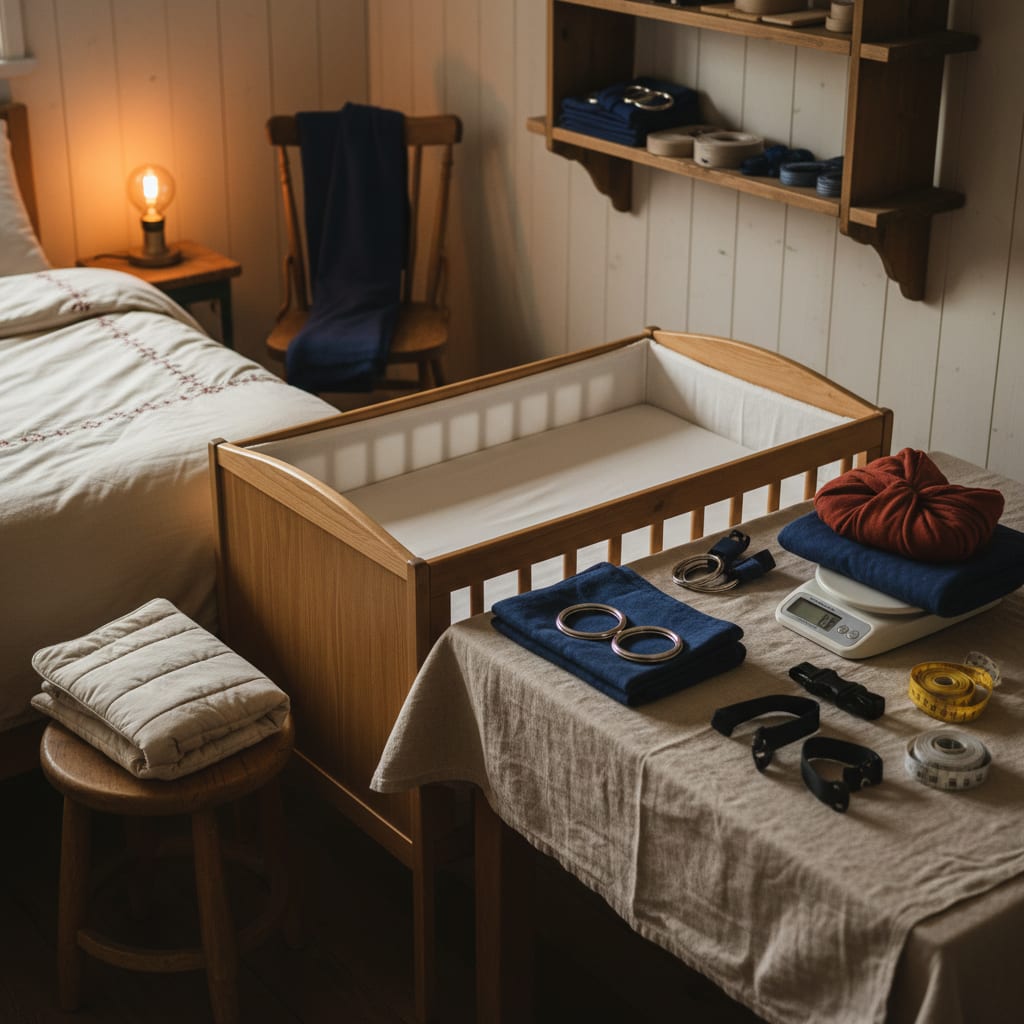
The exit from bedsharing to a crib has a fixed order: your baby gets their own firm, flat, empty sleep surface in your room first; naps move there before nights do; the settling routine gets gradually shorter rather than suddenly absent; and only then does the surface move further away or into another room. The American Academy of Pediatrics recommends room-sharing without bed-sharing — baby close to your bed but on a separate surface made for infants, ideally for at least the first six months. That target does not move while the routine changes around it.
Two things this post is not. It is not medical advice — safe-sleep guidance comes from your pediatrician and the AAP-affiliated healthychildren.org. And it is not a guide to bedsharing more safely. The AAP does not recommend bedsharing; if what you want is a setup to optimise, this is the wrong page. Most families who end up here did not plan it — they arrived at 3am, six weeks in, doing the only thing that let anyone sleep. That is a common story and not a character flaw. It is also the reason the exit needs to be a plan rather than a resolution.
The surface, before anything else changes
Get the sleep space right while nothing about your nights has changed yet. It needs to be:
- Firm and flat, not inclined. Federal law now bars the sale of inclined sleepers and padded crib bumpers in the US.
- Its own space — a crib, bassinet, portable crib or play yard meeting current safety standards, with a firm mattress sized to its frame and no gap at the edges.
- Empty, apart from a fitted sheet. No pillows, quilts, loose blankets, toys, wedges or positioners, and no bumpers of any kind, including mesh.
- Used for back sleeping, every sleep, until your baby rolls both ways reliably on their own.
Products designed to sit in the adult bed are not a step on this path; the AAP has not endorsed in-bed sleepers, citing insufficient evidence. If your worry is a cold baby without a blanket, the answer is clothing, not bedding — a wearable blanket such as the HALO SleepSack does the job a loose blanket cannot do safely. The rest of what a sleep space genuinely needs, and what it does not, is in the minimalist nursery.
Why “in your room” is the destination, not a compromise
Room-sharing on a separate surface is the recommendation itself, not a halfway house on the way to a nursery. The AAP’s position is that a crib, bassinet or play yard in your bedroom for at least the first six months is associated with a substantially lower risk of sleep-related death, while removing the suffocation, entrapment and overlay risks of an adult bed, its mattress gaps, its duvet and its pillows.
So the first move is not “baby goes to their own room”. It is “baby comes off the adult mattress”, with everything else — proximity, your smell, your voice, your hand — left in place. That is why this works as a gradual exit: you change one variable.
Naps first, nights later
Daytime is the practice ground, because a failed nap costs an hour and a failed night costs everyone. Start with one predictable nap in the new surface, in the same room, with the room dark and the same wind-down each time.
This is where a carrier does real work. A baby who spends daytime hours worn is getting the contact, the motion and the closeness that made your bed appealing in the first place, which takes pressure off the night. Carrier naps are legitimate naps — the case for that, and the reasons some babies will not nap any other way, is in why some babies only nap in the carrier.
Two hard lines, because this is the point in a co-sleeping conversation where they get blurred. A carrier is not a sleep surface. A worn baby is a supervised sleeper: you stay upright, awake and attentive, and you re-check the airway every time they go floppy. And you never wear a baby while you lie down, recline or sleep yourself — not on the sofa, not in bed, not for five minutes. The checks that catch the problem before it becomes one are the TICKS and airway rules, and the limits on time spent worn are in how long a baby can stay in a carrier.
Shorten the settling, don’t delete it
Once naps are landing, work on the amount of contact rather than its presence. A workable ladder, each rung held for several nights before moving on:
- Feed or rock to deep sleep, then transfer — bottom first, head last, chest close, one hand resting for thirty seconds before you retreat.
- Transfer slightly earlier, while sleep is lighter.
- Put down drowsy but awake, with a hand on the chest until settled.
- Hand off, then sit beside the crib.
- Sit further away, then leave.
Go down a rung whenever a stage stops working. Illness, teething and developmental leaps hand back ground; that is weather, not failure, and re-climbing takes days once the surface is familiar.
Distance, then the door
When nights in the room-shared crib are steady, what is left is geography: move the crib further from your bed, then — if and when you choose, and no earlier than the room-sharing window your pediatrician supports — into its own room. There is no prize for speed here, and plenty of families room-share well past six months.
When it stalls
Almost every stalled transition is one of four things: the room is not dark enough, the room is too warm, the routine is inconsistent between adults, or the timing is wrong — a baby put down under- or over-tired will fight a perfect crib with real conviction. If your baby refuses the crib specifically, Betteroo’s guide to a baby who will not sleep in the crib works through the usual causes in order.
The timing part is the one that is genuinely hard to eyeball, because the right window shifts every few weeks as your baby grows. That is the gap a personalised sleep plan fills: a quiz about your baby and your parenting style produces day-by-day wake windows and bedtimes that adjust as they change. The workbench verdict is the usual one — around $20 a month, a tool rather than magic. It will not make a room dark or hold your nerve at 2am; it removes the guesswork about when, which is most of what makes a transition feel unwinnable.

The dry aside: it will click on the night you have already given up. Take the win.
FAQ: moving from co-sleeping to a crib
How do I transition my baby from co-sleeping to a crib?
In one direction, one change at a time: put a firm, flat, empty crib or bassinet in your room, move naps there first, then nights, then gradually reduce how much contact settling takes, and only then increase the distance. Keep everything else — room, routine, darkness, your presence — constant while the surface changes.
Is bed-sharing safe if I follow certain rules?
The AAP recommends against bed-sharing and instead advises room-sharing with your baby on a separate sleep surface, ideally for at least the first six months. If you are currently bed-sharing, that is a conversation to have with your pediatrician, and the practical answer is to start the move to a separate surface rather than to optimise the adult bed.
How long does the transition take?
Days for some babies, several weeks for others, and it is rarely linear. Illness, teething and developmental changes cost ground temporarily. Holding one stage until it is genuinely steady is faster in total than jumping ahead and restarting.
Can my baby nap in a carrier during the transition?
Yes, and it often helps, because daytime contact reduces the pressure on nights. A carrier is not a sleep surface, though: a worn baby is a supervised sleeper with an adult upright, awake and checking the airway, and you never wear a baby while lying down or asleep yourself.
Should the crib go straight into its own room?
No. The recommended arrangement is the crib in your room, close to your bed, ideally for at least the first six months. Moving to a separate room is a later, optional step — and doing it early removes the protective part of the setup rather than the risky part.