How to Tie a Stretchy Wrap: PWCC Step by Step
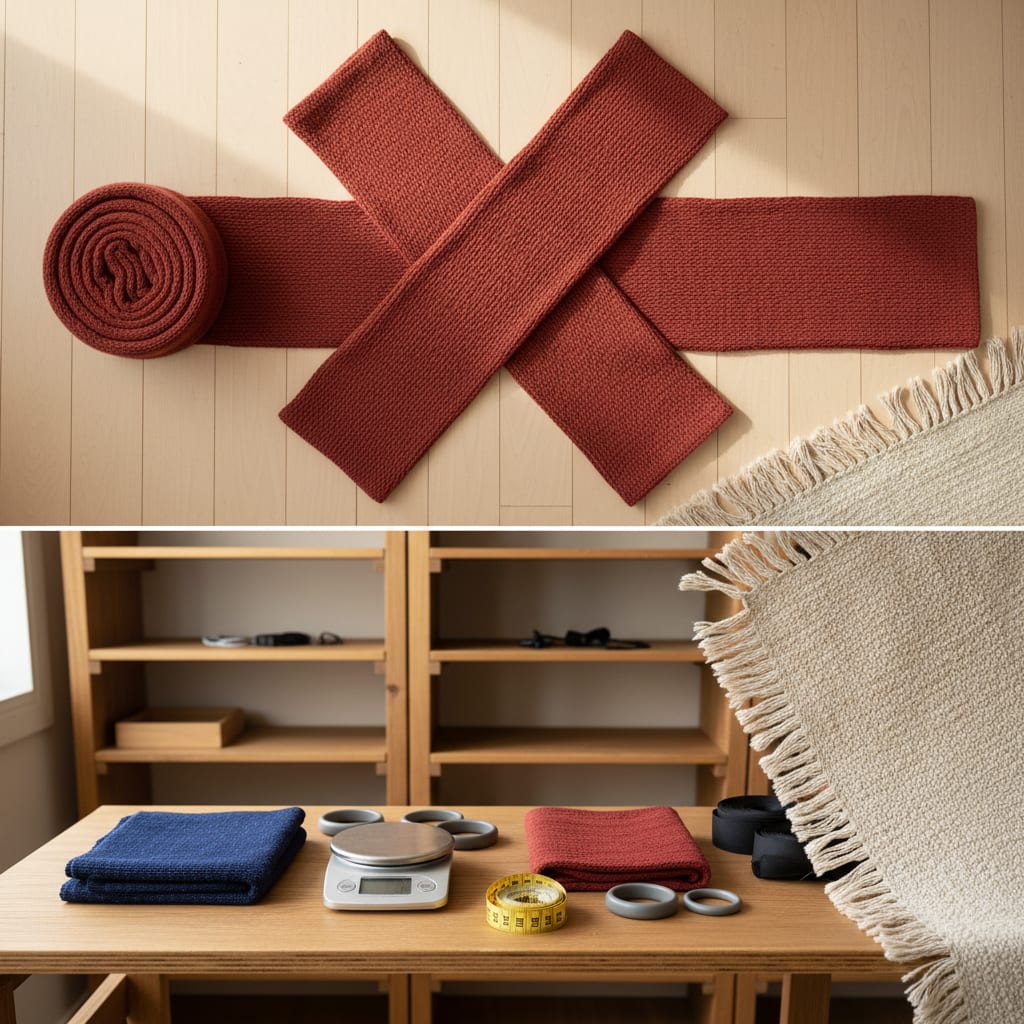
You tie a stretchy wrap before your baby goes anywhere near it. The carry is called the Pocket Wrap Cross Carry (PWCC), and the sequence is: find the centre, place it across your belly, take the tails behind you and cross, bring them over your shoulders, cross them at your chest, pass each tail under the belly band, and tie behind your back. Then your baby goes in leg by leg, into one cross pass at a time, with the horizontal band pulled up last. Tie it tighter than feels reasonable — knit fabric relaxes, and every problem people have with stretchy wraps is a tension problem in disguise.
First: the wrap itself
A stretchy wrap is one long piece of knit fabric, usually four-way stretch cotton with a little elastane — a classic like the Moby Classic wrap runs roughly eighteen feet and lists a range of around 8 to 33 pounds. Most have a centre marker or logo panel at the midpoint; if yours doesn’t, fold it in half and mark the middle with a safety pin.
The tails will touch the floor, so practise somewhere clean — and read your own manual, since brands differ on where the tails finish.
The Pocket Wrap Cross Carry, step by step
- Centre it. Centre marker against your belly, roughly at the navel, tails hanging evenly. Keep the fabric flat and untwisted throughout — a twist becomes a rope, and a rope digs.
- Cross behind you. Take both tails around your back and cross them, one over the other, at about mid-back height.
- Over the shoulders. Bring each tail up and forward over the opposite shoulder. Spread it flat across the shoulder rather than letting it bunch into a strap.
- Cross at the chest. Cross the tails over your chest into an X, sitting high around your sternum — that’s where your baby’s back will rest.
- Under the band. Pass each tail down and under the horizontal band across your belly, on the opposite side from the shoulder it came over.
- Tie it off. Take the tails around your back and tie a double knot. Long tails can come round the front and tie there; short ones tie at the side. A knot that doesn’t press into your spine is the only requirement.
Tension is the whole game
The most common mistake is tying a stretchy wrap at the tension that feels right for a scarf. Knit fabric has to hold a weight and stay against your body, and it stretches under both. Tie it slightly too snug empty and it lands correctly loaded.
The test: slide a flat hand between the wrap and your chest. It should take real effort. If your hand slips in easily, the wrap is loose, and once your baby’s weight arrives that looseness becomes a sag they slump into.
A stretchy wrap also relaxes over a few hours of wear, so a mid-day retie is maintenance, not a mistake — and a wrap that has been through the dryer a hundred times has less recovery than a new one.
Getting your baby in without undoing your work
Standing, over a bed or sofa for the first few attempts:
- Hold your baby against your chest with one hand, high, upright, over the shoulder on the side you’ll load first.
- First leg into the first cross pass. Take the pass closest to your body, hold it open, and slide one leg through so your baby is sitting in it.
- Spread that pass. From the back of one knee to the other, and up over the back to the base of the neck. Spread means spread — no bunched cords behind the knees.
- Second leg into the second cross pass, then spread it the same way.
- Horizontal band up and over. Pull the belly band up over both of your baby’s legs and their whole back, and spread it knee to knee.
- Knees above bottom. Sweep the fabric under the thighs so the seat is deep and the knees sit higher than the bottom — the M-position the International Hip Dysplasia Institute describes.
That’s three layers across your baby’s back — the point of the carry: load spread over three passes, not one.
Then the safety pass: face visible, chin off the chest with a gap beneath it, high enough to kiss the head without leaning. The full checklist is in babywearing safety, and it gets re-run every time they fall asleep, because sleeping babies sag.
When it sags, digs, or rides too low
It sags after twenty minutes. Tension, always. Retie tighter. If it happens within minutes rather than hours, you may be at the top of the wrap’s comfortable weight range.
It digs at the shoulders. The fabric is bunched rather than spread. Fan the passes out across the whole width of your shoulder — a spread pass distributes load over a hand’s width, a bunched one over an inch.
Baby rides too low. The X at your chest was tied too low. Redo it with the cross higher on your sternum. Low-riding babies are the leading cause of the slump described in why babies slump in carriers.
You can’t tell which pass is which. Extremely common on attempt one. Start again rather than unpicking it mid-carry, and practise a few times with a bag of rice — nobody is watching, and the rice does not report back.
What a stretchy wrap will not do
No back carries, no outward-facing carries. Knit fabric gives under load, and both positions ask it to hold weight somewhere you can’t see or can’t correct quickly. It also has a functional ceiling well before its stated maximum weight — for most people it starts feeling like a hammock somewhere mid-first-year.
That’s a specialisation, not a flaw. In the newborn weeks a knit wrap moulds around a small body better than anything with a buckle on it — which is, inconveniently, the same stretch where naps happen in fifteen unpredictable instalments. Betteroo’s week-by-week newborn sleep schedule is a useful reality check before you conclude something is wrong.
Retiring it, and what comes next
When the sag arrives faster than you can retie, the wrap has done its job. Next is either a woven wrap — same idea, no stretch, steeper learning curve — or a buckle carrier for speed; the trade-offs are in woven wrap vs stretchy wrap, and the full specs live in the stretchy wrap guide.
If naps only happen on you and the question has shifted from technique to timing, the Betteroo quiz feeds a personalised sleep program built around your baby and your parenting style, producing day-by-day wake windows and bedtimes that adjust as things change. Workbench verdict: a tool, not magic — around $20 a month, and it will not tie your wrap for you.
FAQ: tying a stretchy wrap
Do you tie a stretchy wrap before putting the baby in?
Yes. The carry is pre-tied on your body and your baby goes in afterward, leg by leg, into the cross passes. That’s the defining feature: tie once, and they can come in and out all day without retying.
How tight should a stretchy wrap be?
Tighter than feels natural. Tied empty, you should struggle to slide a flat hand between the wrap and your chest — knit fabric stretches under load, so anything merely comfortable when empty will be loose once your baby is in it.
Why does my stretchy wrap keep sagging?
Either it was tied too loosely or it has been worn long enough to relax; both are fixed by retying. Sagging that appears within minutes usually means your baby is near the top of what the wrap can hold — the signal to move to a woven wrap or a buckle carrier.
Can you back carry in a stretchy wrap?
No. Stretchy knit gives under load, and a back carry puts your baby somewhere you can’t see or quickly correct. Back carries belong in woven wraps, mei tais, onbuhimos, or buckle carriers that document a back-carry mode.
How do I know if my baby is positioned correctly in a wrap?
Face visible and uncovered, a gap under the chin, close enough to kiss the head without leaning, back supported by all three passes, and the seat spread knee to knee with knees higher than the bottom. Re-check whenever they fall asleep.