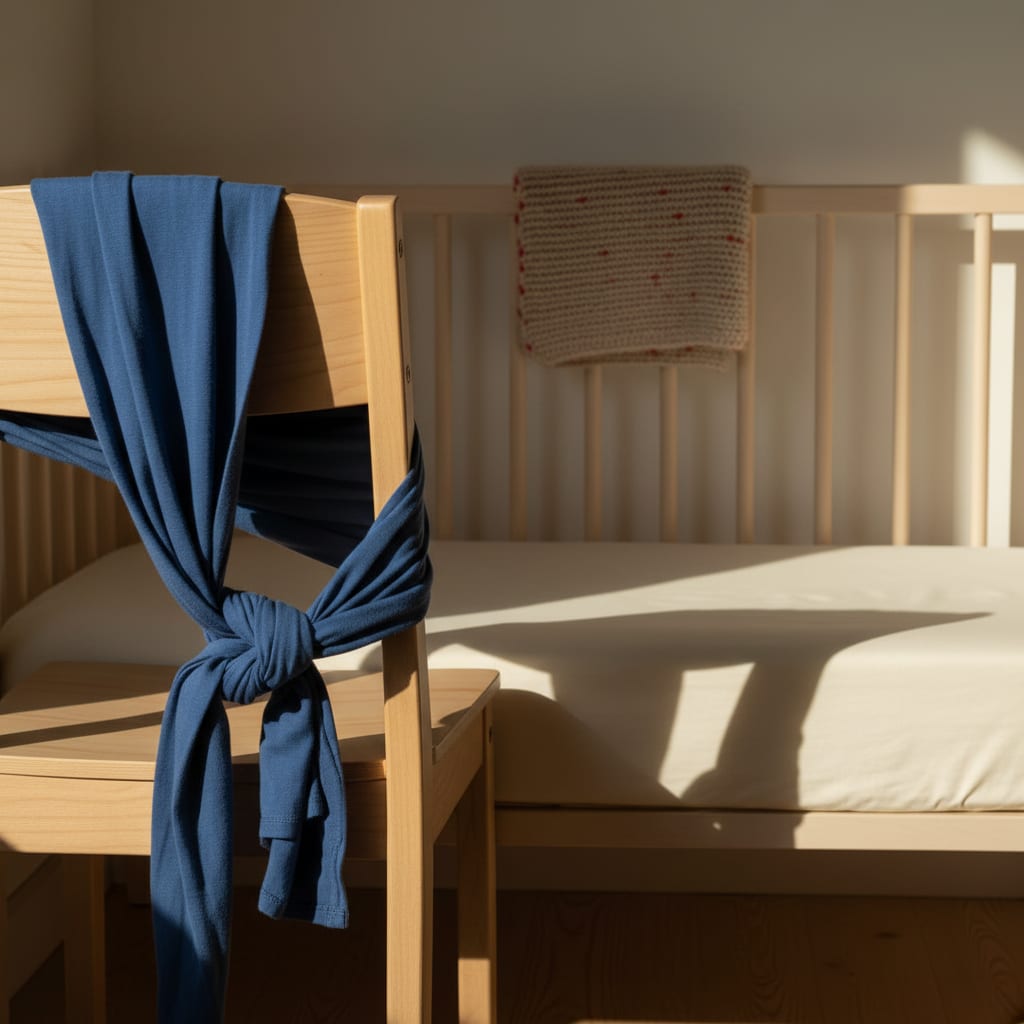
Toddler Climbing Into Baby's Crib at Night? What to Do
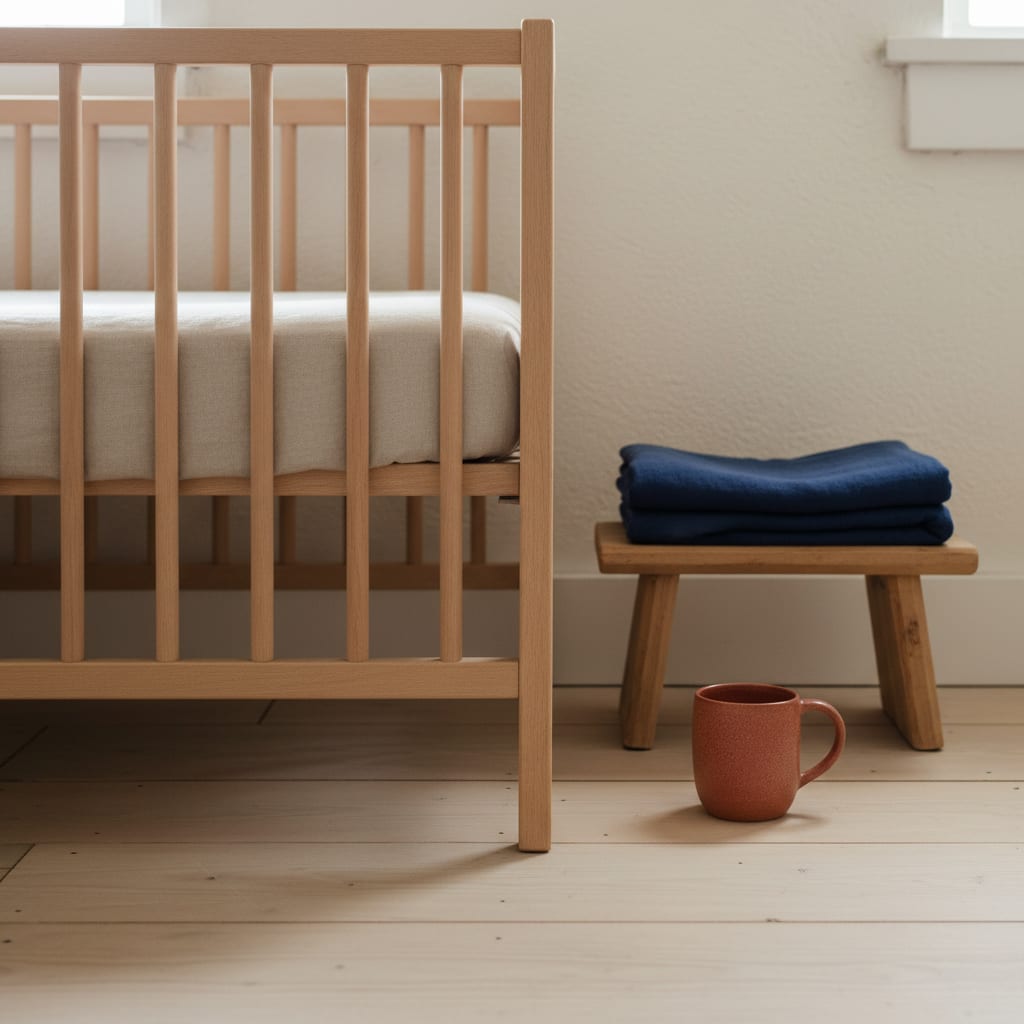
If you find your toddler in the baby’s crib at two in the morning, lift the toddler out first, then check the baby, then treat the whole thing as a containment problem rather than a discipline one. A crib is a one-child sleep space: the safe-sleep rules put a fitted sheet and one baby in it and nothing else, and a toddler arrives with weight, soft limbs and usually a blanket, on top of an infant who cannot move away from any of it. Make the climb impossible tonight; work on why your toddler is arriving over the next fortnight.
Why a crib holds one child and only one
The American Academy of Pediatrics’ safe sleep guidance is explicit about what belongs on the mattress: “Use a fitted sheet only—nothing else should be in the crib with your baby.” It is equally explicit about sharing a surface — the AAP “doesn’t recommend bed sharing with your baby under any circumstances,” and adds, in the sentence that answers the sibling question, “This includes twins and other multiples.” If two babies of the same size and age should not share a surface, a three-year-old and a five-month-old are not a special case.
The NIH’s Safe to Sleep campaign agrees on its safe sleep environment page: “Even though a crib with nothing in it except a fitted sheet covering the mattress may seem bare, it is the safest option for baby.” Its list of what makes an object dangerous there reads like a sleeping toddler — soft, squishy, on top of the baby, not fitted, heavier than the baby.
The mechanics are the argument. An infant under a year cannot reliably shift an arm, a leg or a duvet off their own face, and a sleeping toddler does not wake because the weight underneath them changed. Toddlers also do not climb in empty-handed — the blanket, the stuffed rabbit and occasionally a cup come too, each an item the crib is meant to be free of.
What your toddler is actually after
Almost never mischief, which is why punishing it works so badly. A child who has just worked out how to get over a rail will test it the way they tested stairs — the AAP describes the newly promoted toddler as having “a heady sense of freedom.” A new sibling holding the room, the attention and, visibly, the old crib is worth checking on at 3am. And a toddler who wakes alone and heads for the nearest other human is doing something normal in the worst available place. “Stop being naughty” addresses none of that; a gate addresses most of it tonight.
The 2am sequence
- Toddler out first. They can be lifted, led and told; the baby cannot move at all.
- Clear the crib and check the baby. Fitted sheet, baby, nothing else — take out whatever came in with the toddler, and check breathing and colour before you leave.
- Boring re-settle. The AAP’s line on staying in a big-kid bed is to “calmly and quietly lead them back and tell them they must stay in bed,” keeping it “brief and boring,” because “children tend to feel, as many advertisers do, that any attention is better than none.” Expect repetition; twenty farewell appearances in an evening “is by no means an unusual number.”
- Do not solve it by moving the baby into your bed. That trades one non-recommended sleep surface for another. Move the crib instead.

Making the climb impossible tonight
Containment first, understanding second: the risk does not wait for the insight.
Separate the sleep spaces, even temporarily. Wheeling the crib into your own room is the fastest fix in the house, and no compromise: the AAP recommends room sharing — baby’s own crib, same room as you — for at least the first six months anyway, because it “can decrease the risk of SIDS by as much as 50%.”
Gate the toddler’s door, not the baby’s. A gate on the child who moves beats a barrier on the child who does not. The AAP’s suggestion for a climber is that “you may need to install a safety gate across your toddler’s bedroom door to keep them from wandering when you are not awake,” plus one at the top of the stairs.
Delete the footholds. Clear furniture and large toys a child could fall against, and “install childproof latches on chests of drawers or tape drawers shut so they can’t be pulled out and used as steps.” Then look inside the crib: per the AAP’s crib guidance, “keep large toys and stuffed animals out of the crib, as your baby may use them to get a leg up and over the rail” — as true in reverse. Mattress support at its lowest setting, no bumper pads.
Skip the aftermarket crib tent or rail cover. Do not add an unregulated soft product over a sleep space to solve a behaviour problem: the AAP’s standard is a crib meeting Consumer Product Safety Commission standards, and it warns against sleep products not marketed for infant sleep. Betteroo’s rundown of what a compliant safe sleep environment holds is a fair sanity check on anything you are tempted to add — a tool, not a rule, and it does not fit the gate for you.
Where a carrier honestly helps, and where it does not
The limit before the use: a carrier does not stop a toddler climbing a rail, and it is not a night-time answer for either child. It is never a sleep surface, and you never wear a baby while you lie down, recline or doze — the rule set is in babywearing safety, and none of it relaxes because the night was long.
It does two things at the edges. First, daytime contact for the displaced child: a toddler whose 3am destination is the baby is asking for contact in the only window left, and twenty minutes on your back on the school run spends that currency in daylight. Carrying a toddler, check the weight range first — the Ergobaby Omni 360 is my worked example only because it is rated to 45 pounds, so a two- or three-year-old sits inside its range rather than at the end of it. Whether the idea earns its keep at that age is answered in is a toddler carrier worth it.
Second, hands. Resettling a baby with a toddler attached to your leg is a two-hand job done with none; a baby upright and secured on your front frees the hand that was holding a head. Logistics, not a sleep intervention — the difference is the point of babywearing and sleep habits.
When the toddler should be out of a crib anyway
If your climber is still in a crib, the climb is a signal. The AAP’s nursery safety checklist sets the threshold plainly: “the most common falls occur when a baby tries to climb out, so move your child to another bed when he is 35 inches (89 cm) tall, or when the height of the side rail is less than three-quarters of his height (approximately nipple level).” Head-first over a rail is a fall of roughly their own height onto a hard floor. If the new bed has not arrived, the AAP’s stopgap is the crib mattress on the floor. Getting the baby into a crib is its own transition: co-sleeping to the crib. Betteroo’s guide to keeping a toddler in their own bed covers the repetition side at around $20 a month; the boring walk back is still yours.
FAQ: toddlers, cribs and a sleeping baby
Can siblings share a crib if they’re close in age? No. The AAP declines to recommend sharing a sleep surface “under any circumstances,” and says specifically that this “includes twins and other multiples.” Two children of different sizes is a bigger version of the same problem, not an exception.
My toddler says they’re looking after the baby. Do I punish this? Treat the motive as good and the action as non-negotiable: state the rule in one sentence, fit the gate, and give the helping instinct a daytime job instead.
When is this a pediatrician question rather than a gate question? If you found the baby with anything over their face, or their breathing, colour or responsiveness looked wrong afterwards, call the same day. Toddler night waking that escalates over a fortnight is worth raising too — a fit clinic is not the right desk for it.