Does Teething Cause Night Waking? What Actually Does

Teething is real, and it is a poor explanation for weeks of broken nights. The prospective research keeps landing in the same place: tooth eruption brings local, short-lived signs — sore gums, drooling, chewing, a grumpier baby — clustered into a few days around each tooth rather than spread across a season. Fever, diarrhoea, vomiting and coughs are not part of it. So when the nights fall apart for a fortnight, teething is usually the coincidence rather than the cause, and something else is doing the waking.
What follows is decoding plus carrier technique — not medical advice, no remedies. Your pediatrician and AAP-affiliated healthychildren.org are the sources for anything clinical.
What tooth eruption actually does
Duration · a few days per toothSigns · gums, drool, chewing, moodNot teething · fever, diarrhoea, vomiting
The meta-analysis published in Pediatrics found eruption does produce signs, and the consistent ones are local: irritation of the gum over the tooth, drooling, general irritability. It also found eruption can bring a rise in body temperature which was specifically not characterised as fever.
The large prospective study behind much of that, Macknin and colleagues in 2000, tracked infants day by day through hundreds of tooth emergences. Two findings matter at 3am. Symptom elevations were confined to a narrow window immediately around each emergence — days, not weeks. And no symptom was reliably present, while high fever, vomiting, loose stools, cough and congestion were not associated with eruption at all.
So budget a couple of rough days per tooth. A baby with a genuine fever — 100.4°F (38°C) or above, urgently so under three months — has an illness to be assessed, not a tooth. The real cost of blaming teething is not lost sleep. It is the ear infection unlooked-at for three days because everyone agreed it was a molar.
What is usually waking your baby instead
Six things do most of the real waking in the months teething gets blamed for.
- Sleep reorganisation. Around four months, sleep architecture matures into adult-like cycles with a light surfacing point between them. Developmental and permanent, not a phase that reverses.
- Timing drift. Wake windows lengthen faster than routines get updated, and a baby put down under- or overtired wakes exactly like a baby in pain. The fix is arithmetic, not sympathy.
- New motor skills. Rolling, sitting, pulling to stand and cruising get rehearsed at 2am with enthusiasm — the most under-credited cause of a suddenly awful week.
- Separation anxiety. From roughly six months it shows up at bedtime and at the 1am wake, not only at daycare drop-off.
- Actual illness. Ear infections pair pain with lying flat, which looks precisely like the teething story parents already believe.
- The room. Too warm, not dark enough — neither improves when a tooth finally cuts.
Teething takes the blame because its calendar overlaps everything else’s. First teeth typically arrive in the second half of the first year — the same stretch holding the six-, eight- and nine-month wobbles, separation anxiety, several new motor skills, solids, and a first real exposure to other people’s viruses. Teething is the only one you can confirm with a finger, so it collects the credit for all of them. Betteroo’s rundown of the ages sleep regressions actually cluster at is a useful cross-check, and their teething and sleep guide covers the overlap more clinically than a babywearing site should attempt.
Comfort that is safe, and what to leave alone
For genuine gum soreness the FDA and AAP guidance is unglamorous and short. Rub the gums firmly with a clean finger. Offer a firm rubber teether — chilled in the fridge, never frozen solid, because frozen hard enough to hurt is frozen hard enough to bruise. A natural-rubber classic like Sophie la girafe is the worked example: one piece, firm, no liquid filling, nothing to detach.
What to leave alone, per the FDA’s guidance on safely soothing teething pain:
-
Benzocaine gels, sprays and ointments. The FDA has moved against over-the-counter benzocaine teething products over the risk of methemoglobinemia, a rare but sometimes fatal reduction in the blood’s oxygen-carrying capacity. They also wash out of the mouth in minutes.
-
Homeopathic teething tablets and gels, separately warned about; liquid-filled teethers bound for the freezer; anything small enough to break off.
-
Amber necklaces and any teething jewellery. The FDA has reports of strangulation and choking deaths, including a toddler strangled by an amber necklace during a nap. HealthyChildren’s note on teething necklaces and beads is blunt, and so am I: nothing goes around a baby’s neck.
Pain-relief medication, if any, is a pediatrician conversation.
Where a carrier genuinely helps
A carrier is not an analgesic and I will not pretend otherwise. It is the most efficient delivery system for the four things that reliably settle an uncomfortable baby — contact, warmth, steady pressure and motion — with your hands free to rub a gum or hold a teether.
On a day already gone wrong that is worth a lot. A worn contact nap is not a habit you are building; it is a nap you managed to get, and the evidence sits in whether carrier naps create bad sleep habits. If only the carrier will do, why some babies only nap on you is the longer answer.
Fit-wise, a miserable baby wants what a newborn wants: high on your chest, upright, knees above bottom, back in a gentle curve, close enough to kiss. If that drifted at the last growth spurt, the settings by stage are in carrier positions by age.
Drool, chewing and your straps
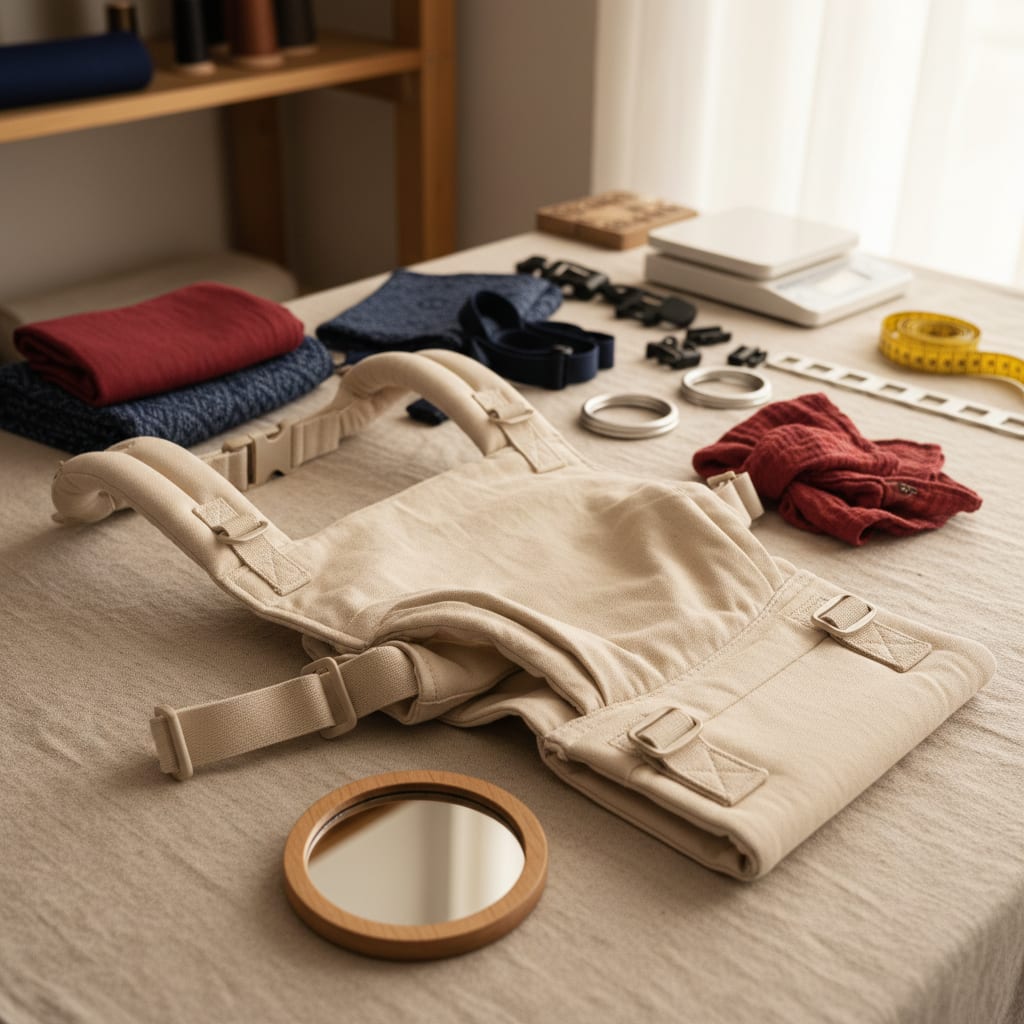
Teething reaches your carrier before it reaches your sleep. Shoulder straps get soaked, then gnawed, and padding holds moisture a surprisingly long time.
Reversible cotton suck pads that wrap the shoulder straps are the standard fix: they take the chewing and the drool, and come off to wash while the carrier stays in service. Two checks beyond hygiene — inspect chewed webbing and stitching every few weeks, because a strap that has been a chew toy for two months is load-bearing gear quietly abraded, and keep the chewing away from buckles and adjusters.
Wearing a teething baby safely
The airway rules do not relax because you are exhausted and the baby is finally quiet.
- Chin off chest — two fingers’ clearance under the jaw, checked every time you adjust.
- Face visible and clear of fabric and of your body, close enough to kiss.
- Nothing around the neck. No jewellery, no cord, no loose fabric loop — and in a carrier the hazard doubles, because textile already sits at throat height.
- A teether goes in only when you can see the mouth. That rules it out for a back carry and any position where the face is out of your sight line.
- A carrier is not a sleep surface. A worn baby is a supervised sleeper: an adult upright, awake and attentive. You never wear a baby while lying down, reclining or asleep — not on the sofa, not for five minutes.
For sleep you are not supervising: a firm, flat, empty crib, on the back, nothing in it but a fitted sheet. The full airway routine sits in babywearing safety.

The dry aside: every baby I know cut a tooth in a week nobody blamed teething for, then got blamed for a month with no tooth in it.
FAQ: teething and broken nights
How long does teething actually disrupt sleep?
Days per tooth, not weeks. The prospective research confines symptom elevations to a short window around each emergence, so a rough couple of nights either side of a tooth fits the evidence. A fortnight of deteriorating nights does not.
Can teething cause a fever?
Eruption can bring a slight rise in temperature, but the meta-analysis in Pediatrics found it does not amount to fever. A reading of 100.4°F (38°C) or above is illness for your pediatrician to assess — urgently under three months — not a tooth.
Are amber teething necklaces safe if I supervise?
No. The FDA has reports of strangulation and choking deaths linked to teething jewellery, including a child strangled during a nap. Supervision does not remove a strangulation hazard, and it is worse in a carrier, where fabric already sits at throat height.
Will a carrier nap fix a teething night?
It will not treat sore gums or repair a night already gone. It lets an uncomfortable baby get daytime sleep they would otherwise lose, which stops overtiredness stacking on top of the discomfort and wrecking the next night.