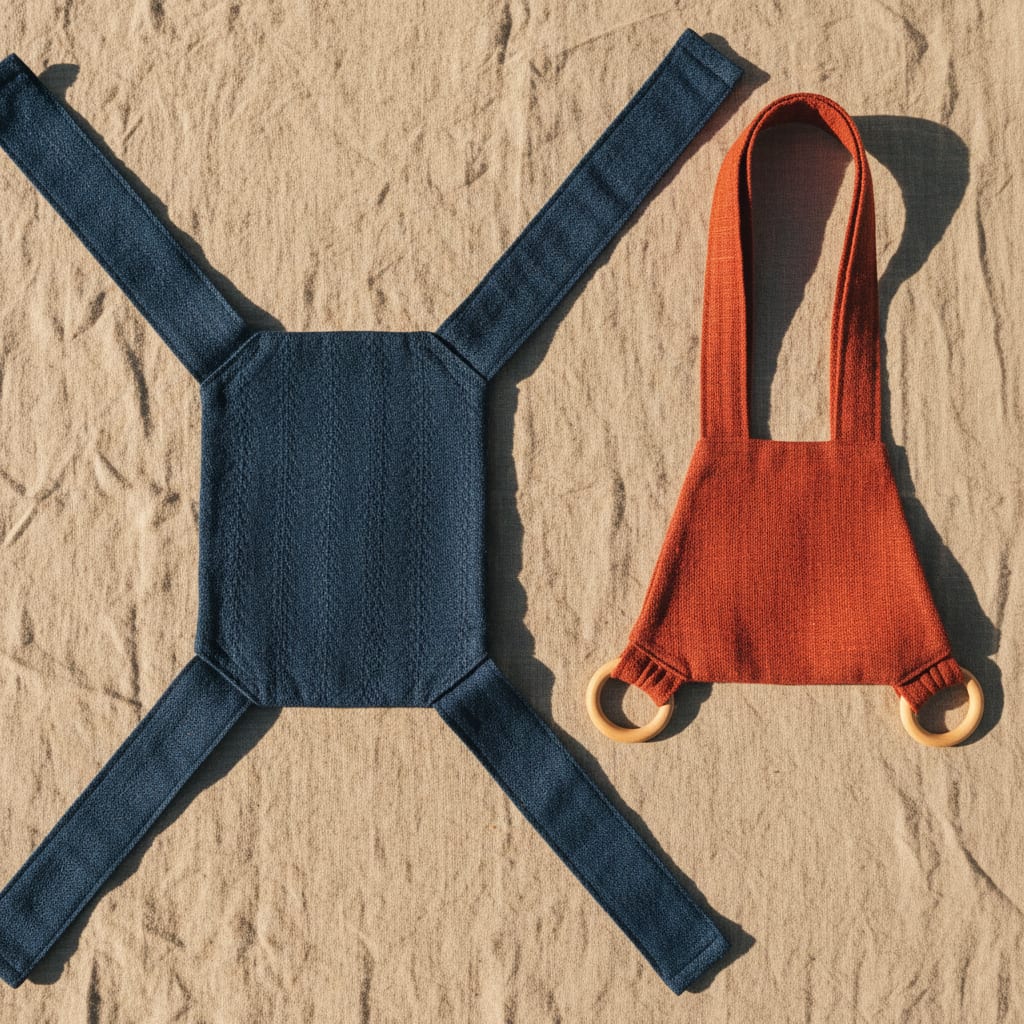
You can walk the dog with your baby in a carrier, and an evening loop can be a calm wind-down before bed. Two conditions decide it: the dog walks on a loose lead without lunging, and you keep both carrier rules and dog rules for the whole walk. Use a front carry so you can see your baby’s face. Hold the lead in your hand, never wrapped around it or clipped to your waist. Bend at the knees for every pickup, and carry a light. Then plan the last few steps, because a dog, a door and a sleeping baby all arrive together.
I found no safety body with rules for this exact combination, so what follows is AAP and HSE carrier and dog advice, applied to one walk.
Who this works for, and who should do two trips
The real risk is a fall. A front carry hides the ground in front of you, and a dog that suddenly pulls is the likeliest thing to take you off your feet. So the first question is about the dog:
- Good fit: an adult dog who walks beside you on a slack lead and stops when you stop.
- Two trips, or two adults: a puller, a lunger, a dog who reacts to other dogs, or a puppy still learning the lead. Walk them separately, or let one adult hold the lead while the other wears the baby.
The AAP’s dog bite prevention tips make a point worth keeping: “Most dog bites affecting young children occur during everyday activities and while interacting with familiar dogs.” A baby on your chest is at the height of an excited dog jumping up to greet you, so teach “four paws on the floor” on walks without the baby first.
Why the dog walk now happens at dusk
Clocks in most of the US went back on Sunday, November 1, so the dog’s evening walk now happens in the dark or near it, often in the fussy stretch before bed. Betteroo has a pediatrician-reviewed guide to what the clock change does to a baby’s rhythm. It says “Fall back often causes earlier wake-ups” and that “Light is the strongest regulator of circadian rhythm.” So morning light, not the evening walk, settles the shift. Your dog has not been told about the clock change either.
Whether “fresh air” helps a baby settle is taken apart in the evening walk post. Short version: a dusk walk gives motion and closeness, not much light, so treat it as a calm transition rather than a sleep fix.
Before you clip the lead on
Feed first. The HSE says “Do not feed your baby in a carrier or sling” (HSE).
Front carry, buckled or tied snug. TICKS asks that you “always be able to see your baby’s face by glancing down”, which a front carry gives you. The trade-off is your feet, so walk a route you know, not a new one in the dark.
Dress for shared heat, not for the stroller. The HSE warns “It’s easy to overheat because of the body heat shared between you and your baby.” Your coat goes over both of you, so your baby needs fewer layers than you think. Layering is covered in winter babywearing.
Light yourself and the dog. A headlamp keeps both hands free and points at the path, not into your baby’s eyes. The Black Diamond Spot 400-R is rechargeable, dimmable and has a red mode for the hallway at the end. Clip a light to the dog too, such as the Nite Ize SpotLit XL, so you can see where the lead is going.
Pockets, not hands. Bags, keys and treats go in a coat pocket, so nothing needs fumbling for.
On the walk
Lead in the hand, loop around nothing. Hold the handle loop in your palm. Never wrap it around your hand or wrist, and skip the waist leash. With a baby on your chest, the right response to a hard lunge is to let go of the dog, and you can only do that if the lead is not tied to you.
Bend at the knees for every pickup. This is the AAP’s own carrier rule, written for exactly this: “bend at the knees, not the waist, if you need to pick something up. Otherwise, the baby may tip out of the carrier, and you may hurt your back” (HealthyChildren.org). Poop bags included. Put one hand on your baby’s back as you lower, and come up the same way.
Glance down at every corner. The HSE says to “Regularly check your baby’s breathing”, adding that babies “can be in distress without making any noise or movement.” A dozy baby slumps faster than an alert one, so recheck chin and airway at every road crossing. The full TICKS run-through is in babywearing safety.
Other people’s dogs. Step aside, let them pass and keep moving. A carried baby is not the moment for introductions.
Keep it short. Fifteen to thirty minutes is plenty. The HSE advises against keeping a baby “in a secured position for more than an hour at a time.”
 The clocks moved. Bedtime can move on purpose.
Betteroo turns a short quiz into nap and bedtime timing for your baby's age, so the dog walk lands before the overtired window, not inside it.
Take the sleep quiz →
The transfer indoors, with a dog in the house
Your baby often drops off on the last stretch home. The AAP says a baby who falls asleep in a carrier should be moved “to a firm sleep surface on their back as soon as possible” (HealthyChildren.org). The dog adds a lead, paws and a dinner request, so set the order before you leave.
- Ready the room first. Crib clear, lights low, nursery door open, before you put your shoes on.
- Stop outside the door. Check your baby’s face, then decide: asleep, or awake and calm.
- Unclip at standing height. Fit a hook by the door at hip height so you can unclip without bending. Paws can wait. If they cannot, squat at the knees with a hand on your baby’s back.
- Give the dog a job. Send the dog to its bed or crate with something to chew.
- Into the nursery and close the door. The AAP’s bringing-baby-home guidance says to “never leave your dog or cat unsupervised near your new baby,” and that “Keeping your pet out of your baby’s sleeping area” may help keep fur and dander away from the baby’s breathing passages. The dog stays out of the room for the put-down and the sleep.
- Carrier off, baby down. Loosen in stages, lower bottom first and head last, on the back. The full sequence, and what to do if your baby wakes, is in the carrier-to-crib transfer.
Never sit down on the sofa with a sleeping baby still in the carrier while the dog settles. If you might doze, the carrier comes off first. And if your baby is wide awake and fussing by the door most nights, the walk was too late or too long: go out earlier, or shorten the loop.
FAQ: walking the dog while babywearing
Is it safe to walk my dog while wearing my baby?
It can be, with a calm dog on a loose lead, a snug front carry checked against TICKS, and a route you know. If your dog pulls or lunges, walk the dog and the baby separately.
Can I use a hands-free leash with a baby carrier?
I would skip it. A waist leash ties the dog to your center of gravity, where you cannot let go in a lunge, and its belt competes with a buckle carrier’s waistband. Hold the lead in your hand.
Can the dog sleep in the nursery?
The AAP suggests keeping pets out of the baby’s sleeping area and never leaving a dog unsupervised near a new baby. Close the nursery door for naps and nights.
What if my baby falls asleep on the dog walk?
Head home and move your baby to a firm, flat sleep surface on their back as soon as possible. Send the dog to its bed on the way through, and close the nursery door.
More from the Babywearing Life shelf.