When Can Baby Face Forward in a Carrier? The Rules
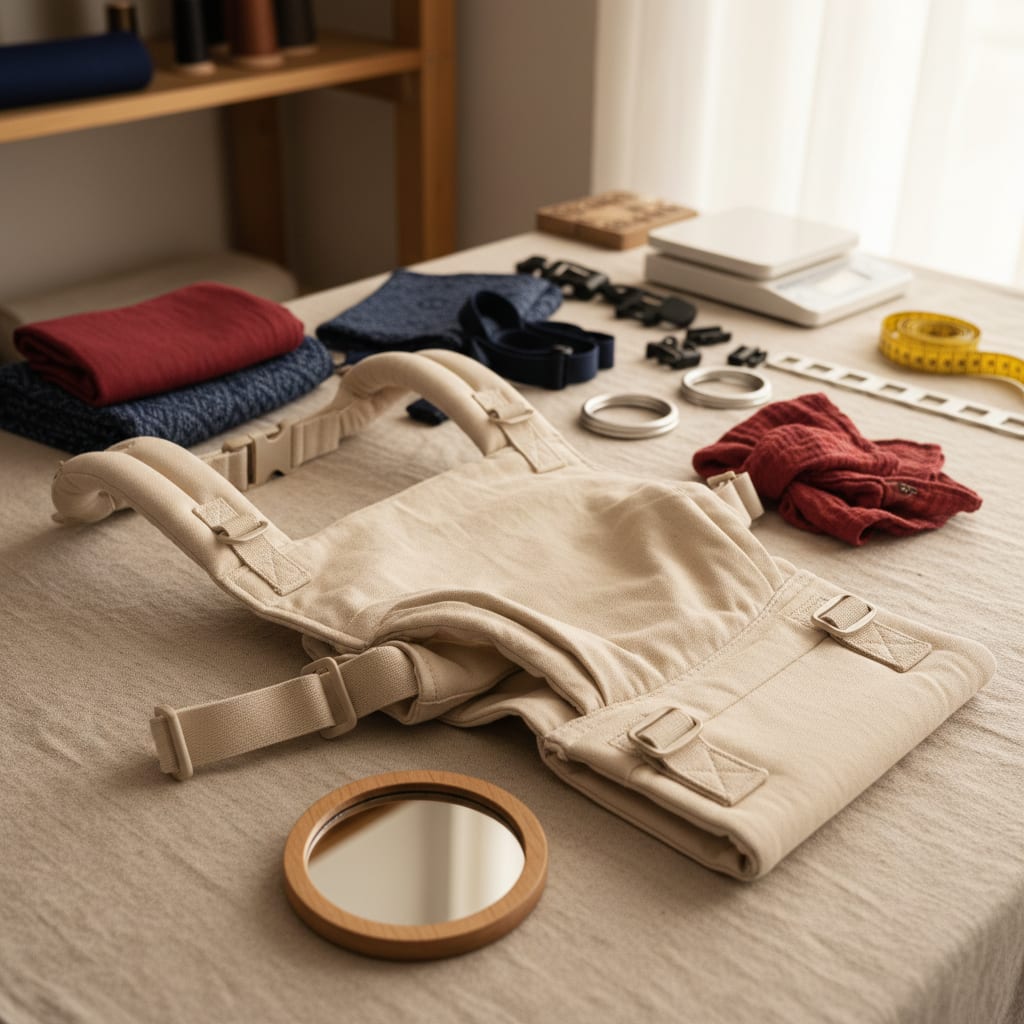
A baby can face forward in a carrier once three conditions are all true: sustained, unwobbly head and neck control (commonly somewhere around four to six months, but check the baby, not the calendar), a carrier that has a documented facing-out mode with a seat that still supports the thighs, and an awake, alert baby who is up for it. Facing out is also the one position with a time limit — short sessions, never for sleep, and turned back in at the first sign of overload. It’s a fun position, not a milestone, and nothing goes wrong if you skip it entirely.
The readiness checklist, not the birthday
Ages in carrier manuals are averages wearing a lab coat. Run these four checks instead, in your living room, before the carrier comes off the hook:
- Head control holds under motion. Sitting supported in your lap, your baby keeps their head steady through a full minute of gentle bouncing and side-to-side movement — no bobbing, no lag when you shift.
- They turn to look deliberately. Head-turning toward a sound or a face, not just random drift.
- Trunk tone is there. Held at the ribs, they hold themselves reasonably upright rather than folding.
- The mood test. Facing out is a stimulation-heavy position. A baby who’s already fussy is not a candidate.
If the first check is the one you’re unsure about, Betteroo’s guide to the head-control timeline lays out what to expect month by month. Premature babies, or any baby with tone or breathing concerns, get their pediatrician’s answer rather than a checklist’s.
What “solid head control” actually looks like from behind
Here’s the mechanical reason head control is the gate. Facing in, your chest is the backstop — a tired head lands on you. Facing out, there is nothing behind that head at all. A carrier’s hood or headrest is for facing in; in outward mode it’s usually folded away, and it isn’t a neck support in any case. So the baby’s own neck is the entire system, and it has to be able to hold up unaided for the whole session, including the moment you bend to pick something up.
This is also the reason a sleeping baby never stays facing out. Asleep, the head drops forward and the chin heads for the chest, which is precisely the airway position the TICKS safety checks exist to prevent — and facing out, you can’t see it happening without a mirror. Baby falls asleep, baby comes out and gets turned in.
Your carrier needs a real facing-out mode
Not all carriers have one, and “you can physically point the baby outward” is not the same thing as a designed mode. Two things distinguish a real one:
A narrowing seat. Facing in, the fabric should span knee to knee. Facing out, the anatomy changes: legs come forward, and a seat that stays at inward width forces them wider than is comfortable. Carriers with an outward mode narrow the seat deliberately — the Ergobaby Omni 360 uses button adjusters to switch between inward and forward settings, and adjustable-panel carriers generally document their outward configuration in the manual.
A documented weight and stage range. Manufacturers publish minimums for outward facing separately from the carrier’s overall range. Use theirs, not a blog’s — including ours.
What doesn’t qualify: a stretchy wrap. Knit fabric stretches under load and the passes can’t hold an outward-facing baby’s weight in a controlled position, which is why stretchy wraps are a front-inward tool and stay that way — the limits are in the stretchy wrap guide. Ring slings can do a forward-facing “kangaroo” position in skilled hands, but it’s an advanced carry, not a starting point.
Why sessions stay short
Manufacturers commonly suggest keeping outward-facing sessions to something on the order of fifteen to twenty minutes. Three reasons, all real:
- Stimulation. Facing in, a baby regulates by turning their face into you when the world gets loud. Facing out, there is no off switch — the whole visual field arrives at once and they can’t opt out of it.
- Posture. Outward facing straightens the baby’s spine and rotates the pelvis differently than the tucked, knees-up inward position. Fine in doses; not the position to spend an afternoon in.
- Your body. An outward-facing baby’s weight sits further from your centre of gravity, so the same baby feels heavier and pulls your lower back into a lean. You’ll notice before they do.
The signs that mean turn them back in
Babies telegraph overload, and the tells are consistent: a glazed, fixed stare; arching or pushing away; a sudden burst of fussing that seems to come from nowhere; head-turning away from whatever’s in front of them; or the yawn-and-hiccup combination that reads as tired but is usually overwhelm. Any of those, and you turn them in. Facing your chest is the reset — dim, warm, familiar, and it works within about a minute.
Hips, spines and what we can honestly say
Facing out gets described online in fairly apocalyptic terms, and the evidence doesn’t support most of it. What’s fair to say: the International Hip Dysplasia Institute recommends carriers that support the thigh and hold hips in the spread-squat position, and outward facing generally leaves the legs less supported than an inward carry does. In a healthy baby, brief periods in a well-designed outward mode aren’t considered a hip risk. Babies with diagnosed hip dysplasia, or in a harness or brace, are a pediatrician-and-orthopedist conversation — not a checklist one, and healthychildren.org is the AAP-affiliated place to read up first.
The honest summary: facing out is safe within its rules and not required for anything. Plenty of babies never do it.
Once they want the view, there are better positions
Around the time a baby demands to see the world is around the time two better options open up. A hip carry gives them a sideways view with the option to burrow back into you — all of the view, none of the trapped feeling. A back carry, once they sit independently and your carrier permits it, gives them your eyeline over your shoulder and is dramatically kinder to your lower back. Both are mapped against readiness signs in carrier positions by age.
If you’re mid-decision on which carrier to buy for this stage, the seat-width and panel-adjustment mechanics that make outward mode work are covered in the soft structured carrier guide.
FAQ: facing forward in a baby carrier
What age can a baby face forward in a carrier?
There isn’t a fixed age. Most babies are ready somewhere around four to six months, but the actual gate is sustained head and neck control that holds steady under motion, plus a carrier with a documented outward-facing mode. Check the baby and the manual, not the birthday.
How long can a baby face out in a carrier?
Keep it short — many manufacturers suggest roughly fifteen to twenty minutes per session. Turn them back in sooner if you see a glazed stare, arching, or sudden fussing, and always if they fall asleep.
Is forward facing bad for a baby’s hips?
For a healthy baby in a carrier with a proper outward mode, brief sessions aren’t considered a hip risk. Outward facing does support the thighs less than an inward carry, so it’s a limited-dose position — and any baby with diagnosed hip dysplasia needs their doctor’s guidance instead.
Can a baby sleep facing outward in a carrier?
No. Asleep, the head drops forward and the chin can fall to the chest with nothing behind it to catch — the airway position babywearing safety rules exist to prevent. Turn a sleeping baby inward, or move them to a safe sleep surface.
Can you face a baby out in a stretchy wrap?
No. Stretchy knit fabric gives under load and can’t hold an outward-facing baby in a controlled position. Stretchy wraps are front-inward carriers; if you want outward facing, that’s a job for a buckle carrier with a documented facing-out setting.