A baby who stares at the ceiling fan or the lamp instead of falling asleep is usually doing exactly what young eyes are built to do: lock onto light, contrast and movement. The AAP says newborns “can see light, shapes and faces” and “can also detect movement,” and a turning fan against a pale ceiling is all three at once. The stare is normal. The fix is not to stop it; it is to make the last view before sleep boring. Dim the room, put the bright or moving thing out of their line of sight, and finish the wind-down facing your chest, where the view is mostly fabric.
I am a carrier nerd, not a clinician. Everything medical below is quoted from pages loaded on November 15, 2026, and your pediatrician outranks all of it.
Why the fan wins every staring contest
Start with what a young baby can actually see. The AAP’s page on infant vision development says a newborn’s “distance vision is pretty blurry,” and that they see best at “about 8 to 12 inches (20 to 30 cm) away,” roughly the distance to your face during a feed. A ceiling fan is several feet further away, so your baby is not admiring the blades in detail.
What still gets through the blur is contrast and motion. The American Optometric Association’s infant vision page says that from birth to 4 months, babies “may look intently at a highly contrasted target,” and that they start “tracking moving objects” with their eyes in the first months. By 3 months, the AAP adds, babies “should also be able to follow a moving object with their eyes.”
A fan is dark blades sweeping across a light ceiling, over and over. A lamp is the brightest patch in a dim room. Either one is the most interesting thing in view. Betteroo’s pediatrician-reviewed guide on what babies see and when puts it plainly: newborns are drawn to “high contrast (black and white, light and dark edges), to movement, and above all to faces.”
When staring is fine and when it is overload
The calm gazer. Quiet, soft face, slow blinks, gaze drifting between the fan and you. This baby is often winding down already. A few minutes of this is a baby settling, and it needs no fix.
The wired gazer. Eyes wide and fixed, arms going, refusing to look anywhere else, and then fussing when you move them. That reads more like overload. Texas Health Resources’ page on signs your baby is overstimulated lists a baby who “looks away as if upset,” “cries or fusses and becomes more difficult to distract or please,” and “makes jerky movements, clenches fists or waves arms and legs.” Its advice: take the baby “to a quiet, darker room and sit with or rock him or her,” and turn the TV or music off.
I wrote about the carrier version of these tells in when a baby can face forward: a glazed, fixed stare is on that list too. A baby facing out cannot opt out of the view. Neither can a baby lying on their back under a spinning fan.
Give them a duller view
Dim first, and early. Lights down for the whole wind-down. Betteroo’s guide on the light that bothers sleep least recommends a dim red or amber light for night feeds rather than a white overhead bulb. If you want one, a plug-in like the YUNLEX red night light plugs into a wall outlet, usually low, so it lights the floor for you rather than becoming the bright spot your baby fixes on. The AAP’s page on making your baby’s room safe says to “keep night-lights away from drapes or bedding where they could start a fire.”
Take the target out of the line of sight. A baby on their back looks straight up. If the crib sits directly under the fan, moving the crib a few feet so the blades are off to the side often does more than anything else on this list. One rule from the same AAP page: “don’t place a crib—or any other child’s bed—near a window,” because of falls and blind cords.
Turn the fan off for the settle. If the fan is on for comfort, try switching it off for the wind-down and back on once your baby is asleep. A still fan is just a shape on the ceiling.
Do not fight the fan with a better mobile. The AAP’s rules are strict: a mobile must be fixed securely and out of reach, and you should “remove it when he is able to get up on his hands and knees, or is 5 months old, whichever comes first.” A bare crib is the goal under 12 months, so the answer is less to look at, not something different.
Finish the wind-down in the carrier, facing in
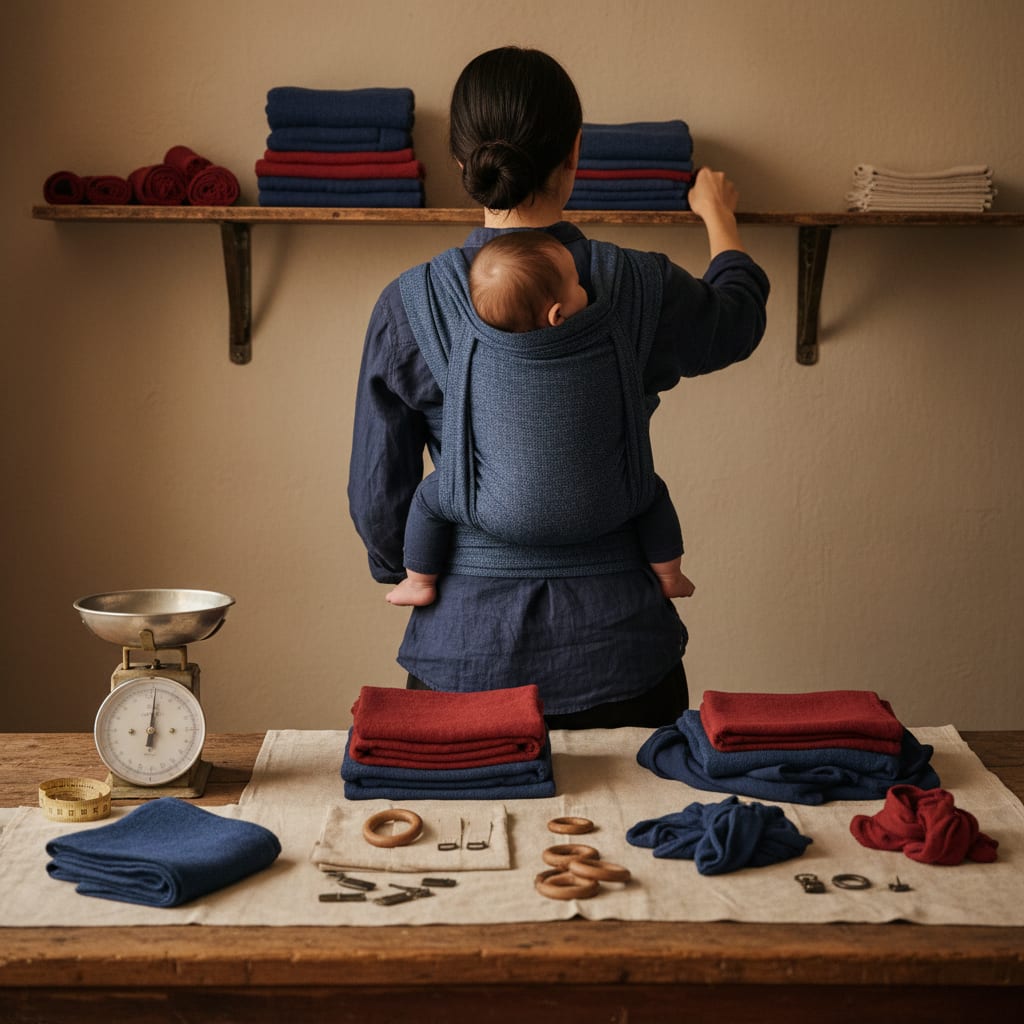
Facing in on your chest, your baby’s view is mostly your shirt and the inside of the carrier panel: soft, close and dull. Your face is in the 8-to-12-inch zone the AAP describes, and your baby can turn into your chest when the room is too much. That is the opposite of the wide, bright, moving view from flat on their back under a fan.
A practical sequence:
- Dim the room and turn the fan off.
- Carry facing in for the last few minutes, with a slow walking lap in the hallway or a dim room. The rhythm is a sleep cue in itself, as the post on babies who only sleep in motion covers.
- Transfer when the gaze goes soft, onto their back in a bare crib. The steps are in the carrier-to-crib transfer.
- Lay them down where the view is boring. If their eyes open after the transfer, the first thing they should see is a dim, still ceiling.
If the staring only happens at bedtime and your baby also seems wired, the timing may be the real issue. A long evening can give a tired baby a second wind. An earlier, quieter evening walk in the carrier can move the wind-down outside the bright living room altogether.
 Wide awake and staring at bedtime? Check the clock before the ceiling.
An overtired baby often looks wired, not sleepy. Betteroo turns a short quiz into wake windows and a daily plan for your baby's age.
Take the sleep quiz →
When to ask about the eyes, not the fan
Staring at a fan is not a vision warning sign by itself. The AAP says a newborn’s eyes may “wander,” cross or move randomly, and that this “should be going away by 2 to 3 months of age.” The AOA lists signs that need prompt attention from an eye doctor, including “constant eye turning,” “extreme sensitivity to light,” and “the appearance of a white pupil.” It also recommends a baby’s first full eye exam at about 6 months. If you see any of those, raise it with your pediatrician; do not wait for a sleep fix to work.
FAQ: babies, fans and lamps at bedtime
Why does my baby stare at the ceiling fan?
Because it combines the things young eyes notice first: contrast and movement. The AAP says newborns can see light and shapes and detect movement, and the AOA says babies under 4 months may look intently at a highly contrasted target.
Is staring at lights bad for my baby’s eyes?
Neither the AAP nor the AOA page cited here warns about an ordinary room lamp or fan. The AOA does list “extreme sensitivity to light” as a sign to see an eye doctor, so mention it if your baby squints or turns away from ordinary light.
Should I turn the ceiling fan off so my baby can sleep?
For the settle, it often helps, because moving blades hold attention. You can turn it back on once your baby is asleep. Moving the crib out from under the fan works too, as long as the crib stays away from windows.
More from the Safety & Comfort shelf.