Babywearing Without Back Pain: Load Mechanics 101
If babywearing hurts your back, the cause is almost never that your baby is too heavy. It is that the weight is sitting in the wrong place. A carried load belongs on your hips, carried by a firm waistband, with your baby’s centre of mass pulled in close to your own — because every inch of gap multiplies the force your spine has to resist. Four fit errors produce nearly all of it: a waistband too low or too loose, a panel held away from your body, uneven shoulder straps, and a chest clip sitting too low. Fix them in that order.
The lever, in one paragraph
Hold a bag of flour against your chest and it feels like a bag of flour. Hold it at arm’s length and it feels like three. Nothing about the flour changed; the distance did. Your lower back works the same way — the further a load sits from your spine, the longer the lever arm, and the harder the muscles along your back have to pull to keep you upright.
That one fact explains almost every babywearing ache, and why the fixes are all versions of the same instruction: get the weight closer, and get it onto bone rather than muscle. A leaning-back posture is the tell — if you are counterbalancing by arching backwards, your lumbar spine is paying for the gap.
Where the weight is supposed to live
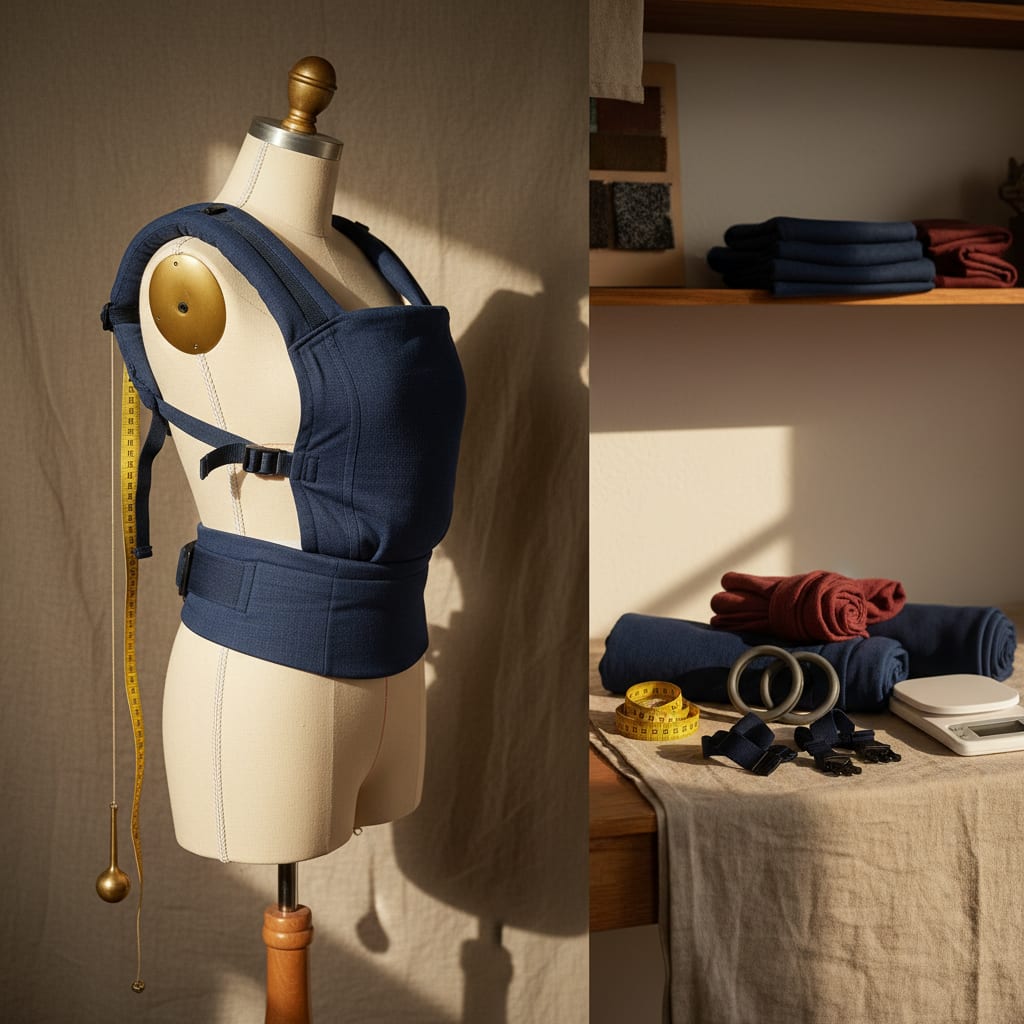
Waistband · on the hip bonesPanel · close, no gapStraps · matched length
In a soft structured carrier the waistband is the load-bearing component and the shoulder straps are stabilisers. Get that the right way round and a carrier that felt punishing becomes ordinary. The waistband should sit on the iliac crest — the hard shelf of the hip bones — and be tightened to the point where it does not slide down when you let go. If you can slip a flat hand between the band and your body with room to spare, it is too loose.
Carriers with a genuinely structured lumbar section make this easier to get right, because the band holds its shape instead of folding into a strap. A carrier such as the Lillebaby Complete All Seasons is a canonical worked example of the design; the whole category is decoded in the soft structured carrier guide.
Wraps and slings distribute differently — a woven wrap spreads across both shoulders and the waist as one continuous surface, a ring sling loads a single shoulder — but the principle survives translation. Close beats far; spread beats concentrated.
The four fit errors that cause back pain
Waistband too low or too loose. The most common by a distance. Worn on the soft belly rather than the hip bones, the band cannot transfer weight into your skeleton, so it migrates onto the shoulder straps and from there onto your upper back.
A gap between panel and body. If you can see daylight between your baby’s bottom and your stomach, the lever arm is longer than it needs to be. Tighten the shoulder straps top-down with your free hand taking the weight, then check again.
Uneven shoulder straps. Almost everyone tightens their dominant side harder, which pulls the load off-centre and produces one-sided pain that then gets blamed on the carrier. Tighten in alternating small increments, then run a finger under each strap and compare.
Chest clip too low. The clip stops the straps sliding off your shoulders. At mid-back height it does that; set low, the straps splay outward and the panel drifts away from you. The shoulder-side failures are worked through in baby carrier hurting your shoulders.
Front, back and hip: what each does to your spine
Front carry puts the load in front of your centre of gravity, so you counterbalance by leaning back. It is the most demanding position for your lower back and the one to limit as your baby gains weight.
Back carry is the answer nobody tries early enough. The load sits over your spine rather than in front of it, which is why hikers have carried weight on their backs for as long as there have been hikers. It is gated behind strong, sustained head control and a carrier rated for back use — criteria and safe learning method in the back carry guide.
Hip carry is asymmetric by design and fine in short stints. Alternate sides, and treat it as a twenty-minute tool.
If your back hurts specifically in a front carry with a heavier baby, moving to back carries is usually a bigger improvement than any adjustment on this page.
Postpartum bodies, and the honest hedge
A postpartum abdominal wall and pelvic floor are the deep stabilisers this whole system leans on, and they are not the same structures they were. Abdominal separation, pelvic girdle pain and recovery from a caesarean all change what load you can carry comfortably, sometimes for months.
This is where a babywearing educator should stop talking. If you are early postpartum, have had abdominal or pelvic surgery, or have pain that a fit fix does not touch, that is a conversation with your own clinician or a pelvic-health physiotherapist. General postnatal guidance sits on AAP-affiliated healthychildren.org, and none of it substitutes for someone examining you.
Your side of the maintenance
The carrier is half the system; you are the other half.
- Load and unload at hip height. Bending at the waist to pick up a baby is where a surprising number of backs go, and it has nothing to do with the carrier.
- Break the carry up. A worn baby is a static load, and static loading fatigues postural muscles. Standing still is harder work than walking.
- Alternate. Sides on a ring sling, front to back where the carrier allows it, and — if two of you share one carrier — between adults, resetting the waistband and strap lengths at every handover.
- Watch the total. Time worn compounds. The five limits that actually cap a wear are in how long a baby can stay in a carrier.
The dry aside: the single most effective back intervention in babywearing is learning back carries, which is also the one everybody puts off for four months.
When it is not the carrier
Some pain is a signal rather than a fit problem. Stop wearing and speak to a clinician promptly if you have pain that shoots or radiates down a leg, numbness, tingling or weakness anywhere, pain that wakes you at night, pain after a fall, or any loss of bladder or bowel control. No amount of strap-tightening addresses those.
FAQ: babywearing and back pain
Why does my back hurt when I use a baby carrier?
Nearly always because the load is too far from your body or too high on your torso. Check the waistband is on your hip bones and tight, that there is no gap between your baby and your stomach, and that both shoulder straps are the same length. Those three account for most of it.
Is babywearing bad for your back?
Not inherently. A well-fitted carrier spreads weight across the hips and shoulders, which is generally easier on your back than carrying a baby in your arms on one hip. Badly fitted and worn for hours, it can absolutely cause pain — a fit and duration problem rather than a verdict on babywearing.
Is a back carry better for back pain than a front carry?
Usually, yes, and increasingly so as your baby gets heavier. A back carry puts the load over your spine rather than in front of it, which shortens the lever arm. It requires strong sustained head control and a carrier rated for back carrying, so it is not a newborn option.
Should the carrier waist strap sit on my hips or my waist?
On the hip bones for most people, because that is where there is a bony shelf to carry weight. Some torsos are comfortable with it higher, at the natural waist, and that is fine if the band still holds without sliding. The test is whether it stays put when you stop holding it, not where a diagram says it goes.
Can I babywear if I have diastasis recti?
Ask the clinician managing it. Many people do, often with an emphasis on back carries, shorter stints and a well-supported waistband — but how much load an individual abdominal wall tolerates is not something to guess from a website.