Buying a Secondhand Baby Carrier: The Safety Check
Buying a carrier secondhand is normal and mostly sensible, because the things that wear out on a carrier are visible if you know where to look. Clear three gates in order. First, is it recalled, or is it a design class that was never safe? Second, was it made before US soft carriers had a mandatory federal standard to meet? Third, does the hardware and stitching pass a hands-on inspection? A carrier that clears all three is a good buy. One that fails the first two is not worth inspecting.
Gate one: recalls and the design classes to skip
Check the model against the CPSC recall database before you agree a price. It takes a minute and it is the only gate you can clear from your phone in the driveway.
The case that shaped this whole category is the 2010 Infantino recall. Around a million SlingRider and Wendy Bellissimo slings were recalled in March 2010 after being linked to three infant deaths the previous year, two weeks after CPSC issued a general warning about sling-style carriers and suffocation risk in babies under four months. The mechanism was geometry, not manufacturing: a deep fabric pouch curls a small baby into a C-shape with the chin pressed toward the chest, and fabric can settle against the nose and mouth.
That geometry is the design class to skip regardless of brand or price — bag-style slings with a deep unstructured pouch, and anything that puts a young baby horizontal and curled rather than upright with an open airway. I am not linking examples. If a listing shows a baby lying curled in a fabric bag at hip level, walk.
Gate two: check the manufacture date
Rule · 16 CFR part 1226Standard · ASTM F2236Line · Sept 2014
This is the check almost nobody makes, and it is the reason a date on a care tag matters more than a price. Soft infant and toddler carriers sold in the US are regulated under 16 CFR part 1226, which incorporates the ASTM F2236 standard by reference. Carriers made after 29 September 2014 had to meet ASTM F2236-14; carriers made after 22 February 2025 must meet the newer F2236-24.
The standard is not decorative. CPSC lists the performance requirements as leg openings, dynamic and static load, unbounded leg opening, and fastener strength and strap retention — precisely the failures that drop a baby, plus labelling and flammability requirements on top.
So a carrier manufactured before autumn 2014 was never held to a mandatory federal standard. That does not automatically make it dangerous; plenty of pre-2014 carriers from serious manufacturers were built well above the voluntary standard of their day. It does mean you are relying entirely on the maker’s own diligence, with no floor underneath it. Look for the manufacture date printed on the care or safety tag inside the waistband or panel. If there is no tag at all, you cannot date it, cannot check its recall status reliably, and cannot read its weight limits — that alone is a decline.
Gate three: the hands-on inspection
Do this in daylight with the carrier in your hands, not from photos.
- Webbing at every adjuster. This is the highest-load, highest-abrasion point on the carrier. Run a thumbnail along it. You are feeling for furring, thinning, a glazed or melted patch, or a texture change against the rest of the strap.
- Bar tacks. The dense rectangular stitch blocks where shoulder straps meet the panel and where the waistband joins. Every thread should be intact. One pulled tack is the start of a zip failure, not a cosmetic flaw.
- Buckles, both directions. Click each one. It should snap positively, not mush. Then pull it apart the way a load would — hard. Look into the plastic for hairline cracks and for the chalky, dulled surface that means UV embrittlement, usually from a carrier that lived on a car parcel shelf.
- Fabric, held to the light. Thin spots and pinholes show up instantly backlit and are invisible flat. Pay attention to the panel where a baby’s weight has concentrated and to the seat edges.
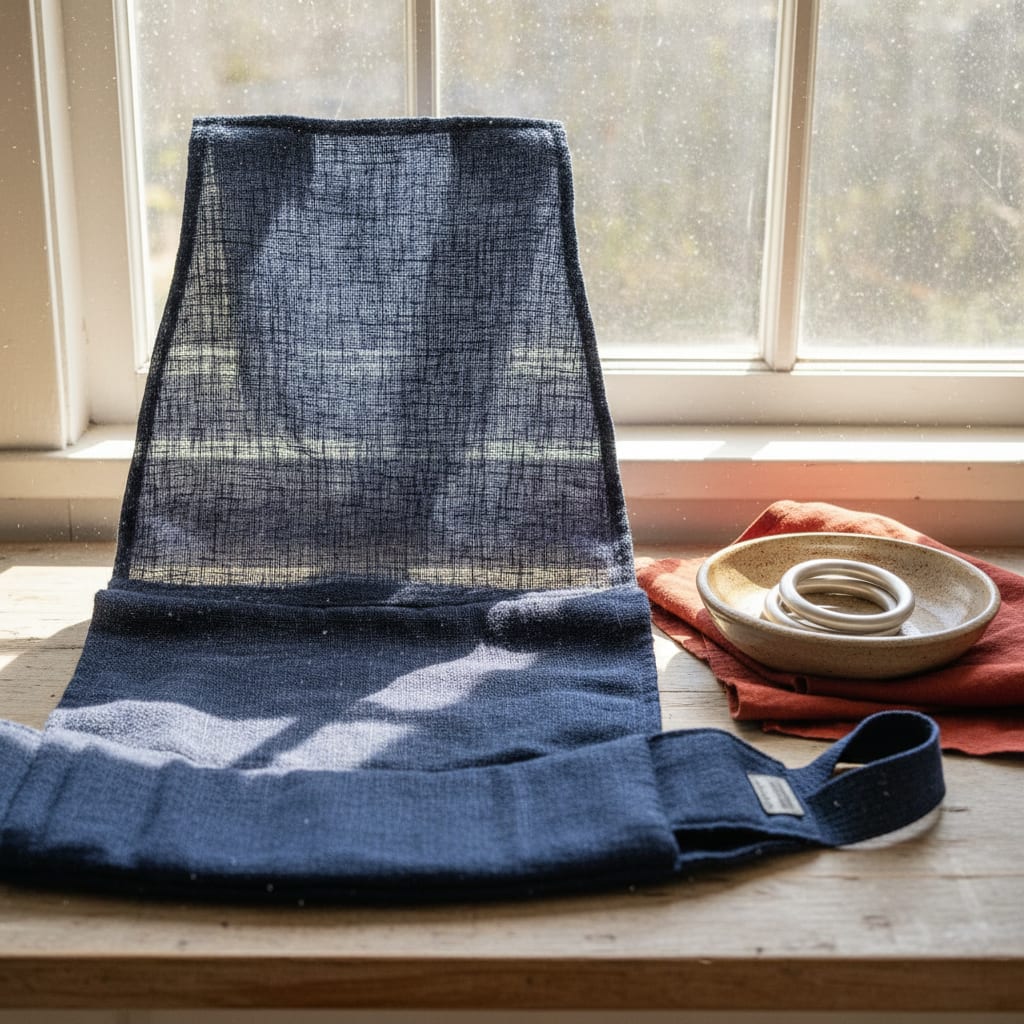
- Rings, on ring slings. Sling rings should be smooth, weld-free and unmarked. SlingRings note that their nylon rings are individually tested and their aluminium rings batch tested plus independently lab tested — that is the standard of provenance you want. Rings with a visible weld seam, a casting line, pitting or a paint chip are craft-store or hardware rings, and those are not load-rated. Decline the whole sling; do not plan to swap them.
- Elastic, on stretchy wraps. Stretch a section and let go. It should snap back to its original length. Dead elastic means the wrap will sag under load an hour into wear, which is exactly when you have stopped watching.
- Smell. Mildew means it was stored damp, and damp storage degrades both fibre and thread. It also does not wash out.
Provenance questions worth asking
Ask whether the original manual exists, whether the carrier was ever returned or repaired under warranty, and whether anything has been modified. A home-modified carrier is an automatic decline — restitched straps, replaced buckles from a haberdashery, added padding, a shortened waistband. The load path was engineered and tested as a unit, and a domestic sewing machine cannot reproduce a bar tack’s strength. This applies to carriers you might modify too: if yours needs work, the fixable-versus-finished line is drawn in carrier repair and lifespan.
Ask what it was used for. A carrier worn daily for two years has had a different life from one used for six weekend outings, and the webbing tells you which.
What is a good secondhand buy
Wovens are the best value in used babywearing by a distance — no hardware to fail, and they improve with washing and wear. Ring slings are excellent provided the rings check out. Buckle carriers are fine within date and inspection, and are also where the money is, so it is worth being fussy.
Discontinued models are their own category, and knowing which current carrier replaced which dead one saves guesswork on a resale listing — that map is in discontinued carriers and what replaced them. For a modern in-standard reference point, a current Baby Tula Free-to-Grow is a fair benchmark for what an intact load path feels like in the hand.
Trying before committing money is the other route, and babywearing libraries exist for exactly this — see try before you buy. Whatever you end up with, the positioning checks on the first wear are in babywearing safety.

The dry aside: the listing always says “used twice”. The webbing always disagrees.
FAQ: used baby carriers
Is it safe to buy a baby carrier secondhand?
Usually yes, for wovens, ring slings and buckle carriers that clear a recall check, carry a manufacture date from late 2014 onwards, and pass a hands-on inspection of webbing, bar tacks, buckles and fabric. Decline anything undated, modified, mildewed, or of a deep-pouch bag-sling design.
How do I find the manufacture date on a baby carrier?
It is printed on the care or safety label, usually sewn inside the waistband or along the panel edge alongside the weight range and country of manufacture. If every label has been cut out, you cannot verify the date, the weight limits or the model — treat that as a decline rather than a bargain.
What should I check on a used carrier before using it?
Webbing at each adjuster for furring or thinning, bar tack stitching at the strap and waist junctions, every buckle for a positive click and for hairline cracks, fabric held up to the light for thin spots, and rings for weld seams or pitting. Then wash it before first use.
Are old baby slings dangerous?
The deep unstructured pouch design is the problem, not age by itself. CPSC warned in 2010 that sling carriers can pose a suffocation risk to babies under four months, because the shape curls the chin toward the chest and fabric can settle over the face. Modern ring slings worn upright and high do not share that geometry.
Should I buy a carrier that has had its buckles replaced?
No. Replacement hardware fitted outside the manufacturer changes a tested load path, and household stitching cannot match a factory bar tack. If a carrier needs new load-bearing hardware, that is a job for the maker’s warranty service or the end of the carrier’s working life.