Baby Only Naps in the Stroller? Rules and Real Fixes
If the only reliable nap of your day happens in the stroller, start with the rule that outranks convenience: a stroller is not a sleep surface. The AAP’s safe-sleep guidance is blunt — “if your baby falls asleep in a car seat, stroller, swing, infant carrier or sling, you should move them to a firm sleep surface on their back as soon as possible.” That gate does not soften because the nap was hard-won. The rest of this is the walk itself: why it works, the rules specific to strollers, and how to move the nap onto something flat.
What the walk is actually supplying
A stroller nap is four inputs at once, and only one is the wheels: low-frequency motion over pavement; a sound floor of traffic and footfall that masks what a quiet house does not; daylight and shade moving over the canopy, giving a tired baby nothing to fight; and you, behind the handle instead of in front of the eyes.
That last one matters more than parents expect. A baby in a stroller cannot see you, reach you or negotiate — a settling condition the same way a dark room is, which is why the stroller sometimes beats the crib after a contact nap has already failed. The vestibular half is covered in naps that only happen while you’re moving. None of it is a personality trait; it is a package of physics, and packages can be unbundled.
Three different things get called a stroller nap
This is where stroller advice goes wrong, because the word covers three pieces of hardware with three different geometries.
A carrycot or bassinet attachment is the only one close to a sleep surface: flat, firm-ish, baby on their back, airway neutral. The Lullaby Trust is specific about sleep away from home — “make sure the base of the buggy or pram is flat, not sloping or tilted.”
A reclining pushchair seat is not flat even at its lowest setting, and most sit well past the ten-degree line the AAP uses to define a safe sleep surface: “any surface that inclines more than 10 degrees isn’t safe for your baby to sleep on.” Fine for a sleeping baby you are watching as you walk. Not where a nap gets parked.
An infant car seat clicked onto a stroller frame is the one to watch. A travel system changes nothing about the seat’s geometry — still a semi-reclined bucket holding a young baby’s chin toward the chest, still a car restraint with wheels under it. Everything in our car seat naps piece applies unchanged.
What the sitting-device numbers actually say
Proportion is owed here, because the honest version is more useful than the scary one. Liaw and colleagues reviewed nearly 12,000 sleep-related infant deaths reported in the US between 2004 and 2014 for Pediatrics in 2019. Around 3% — 348 — happened in sitting devices: car seats 62.9%, bouncers and swings 122 (35.1%), strollers seven, about 2% of the 348. Nearly two-thirds occurred while the device was not being used for its intended purpose.
So the stroller is not the high-risk device in that group, and a walk that puts your baby to sleep is not an emergency. What the data points at is misuse — devices used as beds, indoors, with nobody looking. Which is what grows out of a nap you are afraid to interrupt.
Stroller rules that are specific to strollers
These are neither car seat rules nor crib rules.
- Keep them visible. The AAP’s stroller guidance: “if they fall asleep in their stroller, make sure you can see them at all times.” A canopy pulled down to the bar is a baby nobody is watching.
- Never cover the stroller. The Lullaby Trust: “don’t cover the pram or buggy. For example, don’t put a blanket over the top of it to keep out the light.” Red Nose Australia gives the mechanism — even muslin significantly reduces airflow and traps heat around a baby — and Australia’s consumer regulator advises against any fabric over a pram that could restrict airflow. Use shade you walk into, and let air move.
- Watch heat from the sides. Padded carrycot walls trap warmth. Check the chest or back of the neck, not hands or cheeks; sweaty or clammy means a layer comes off.
- Indoors, undress the setup. Hood down, apron off, baby out. A padded pram in a warm hallway is a heat trap.
- Harness on, brake on, nothing hanging. Five-point harness every ride, brake whenever you stop, no bags on the handles — a loaded handle is how a stroller tips backward.
Where the carrier changes the problem
This is the swap I make on a bad day, and not out of loyalty. A worn baby’s airway is at your eye level: you can see the face, feel the breathing and check chin clearance without stopping, none of which is true of a baby lying eighteen inches below the handle behind a canopy. Same motion, same sound floor, same daylight, plus hands free. On hips, the International Hip Dysplasia Institute is reassuring about the scale of the question: their opinion is that “periodic short-term use of a baby carrier unlikely to have any effect on hip development,” the healthy position being hips that “fall or spread (naturally) apart to the side, with the thighs supported and the hips and knees bent.”
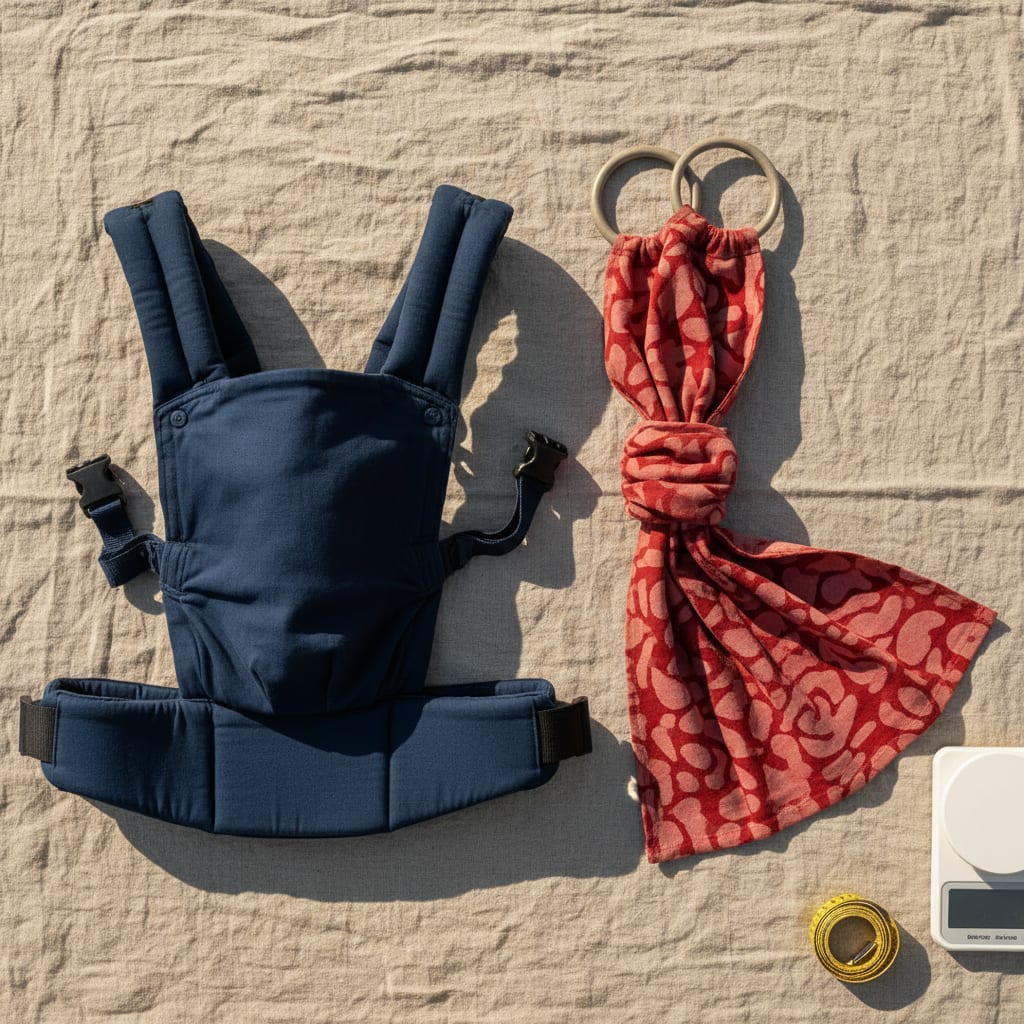
Any structured carrier supporting thigh-to-knee does this; the Ergobaby Omni 360 is the one I hand people at meetups because the panel adjusts down small and the waistbelt survives a two-adult day. Wear it out of the house rather than packing it, or it stays in the basket.
The line that never bends: a carrier is not a sleep surface either. A worn nap is a supervised nap — upright, awake, re-checking the airway whenever the baby goes floppy, never while you lie down, recline or doze. The check routine lives in babywearing safety.

Getting the nap off the wheels
Don’t attack the walk. Attack its last five minutes.
- Leave before the sleepy signs. A nap started at the front of the window costs less motion than one rescued from an overtired baby.
- Walk in, then stand still. Come home asleep and stop moving for two minutes. That test alone tells you whether motion or the stroller is doing the work.
- Shorten the moving portion. Ten minutes walking, then park somewhere quiet, stroller still, your hand on the chest. Then eight. Then five.
- Transfer while they are deep. Floppy arm, slow breathing, no eye movement under the lids. Bottom first, head last, hand resting thirty seconds — our carrier-to-crib method is the same sequence and works out of a carrycot.
- Swap one walk a week, not all of them. If contact naps are the bridge, take them — the destination is a flat surface, not a route.
If the carrycot has quietly become the default sleep space at home too, make that move deliberately rather than by drift; Betteroo’s bassinet-to-cot changeover covers the sequencing. Roughly $20 a month, a planning tool rather than magic — the walking is still on you.
FAQ: stroller naps
Is it OK to let my baby nap in the stroller at all? Yes — while you are out, walking, able to see them. The rule is about where a nap gets parked, not whether a baby may fall asleep on a walk. At home, move them to a firm, flat surface on their back.
How long can a baby sleep in a stroller? There is no published number I would defend, and anyone quoting one precisely is guessing. The rule that works: the sleep lasts as long as the walk.
Can I put a muslin over the canopy to block the light? No. Even thin fabric cuts airflow and traps heat over the space your baby is breathing in, which is why safe-sleep organisations and Australia’s consumer regulator advise against covering a pram at all. Walk into shade instead.
My baby only sleeps in the car seat on the stroller frame. Is that different? Yes, and not in a good way — the geometry does not change when it clicks onto wheels. Use the pushchair seat or carrycot, and keep the car seat for the car.
Would a carrier fix this? It changes the problem rather than solving it: same motion, airway where you can see it, hands free. It does not make a baby who needs motion stop needing it.