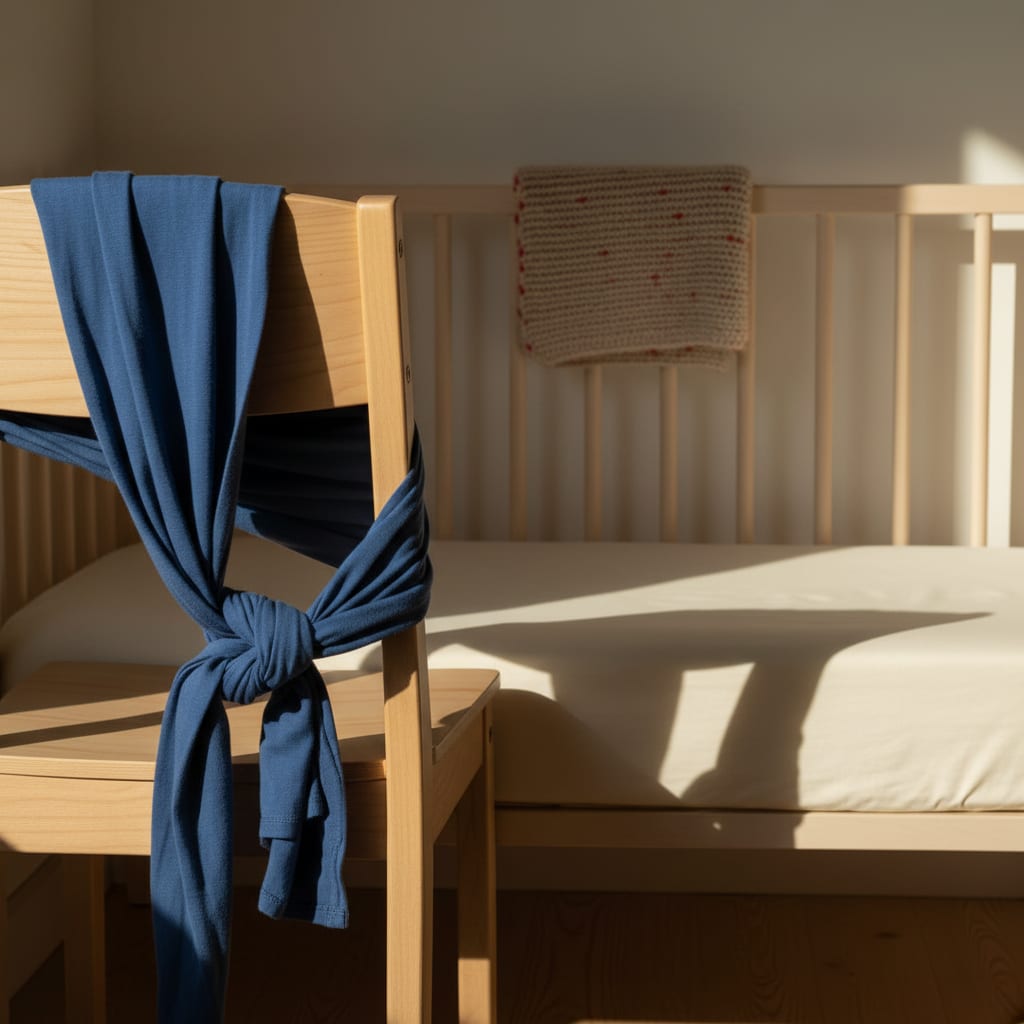
Baby Room Next to a Gas Station? Light, Noise and Crib Fixes
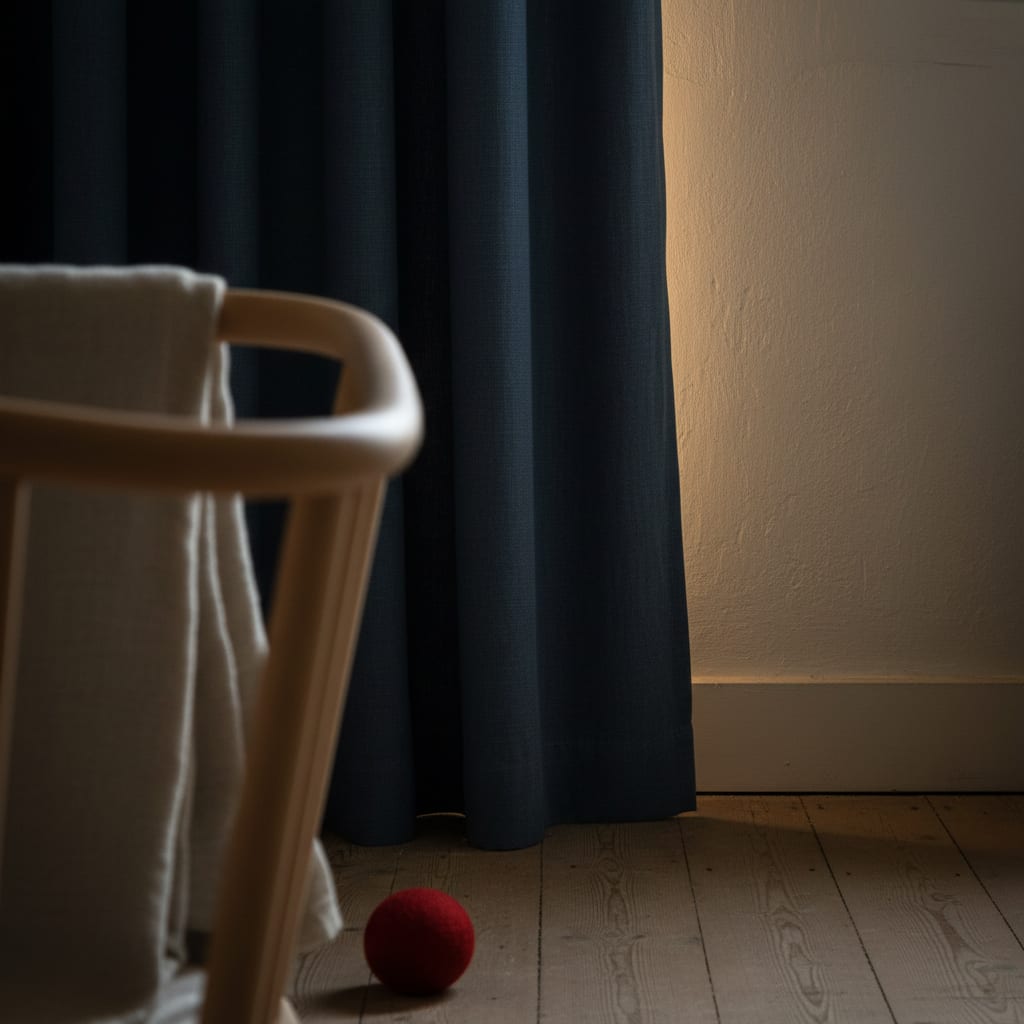
When the room your baby sleeps in backs onto an all-night gas station, treat it as a light problem first and a noise problem second. The canopy puts a steady glow on the window all night, and every car that swings in throws a moving beam across the wall. The fix has three parts: blackout fabric that genuinely stops light, then closing the gaps around its edges, which is where most of the light actually gets in; a low, steady sound floor so car doors and engines are smaller steps; and moving the crib off the window wall and out of the line the leaks throw.
Why the forecourt is harder than a streetlight
A streetlight is one fixed glow. A forecourt is two layers: the canopy, on from dusk to dawn, and the traffic, which is not. Headlights turning in sweep across the curtains, and any crack that lets them through becomes a stripe travelling across the ceiling. A moving light may well be more noticeable than a fixed one, but that is an analogy, not a measured finding about babies. What is measured is how sensitive small children are to evening light at all.
In a University of Colorado study (Hartstein et al., J Biol Rhythms, 2023), 33 healthy preschoolers aged 3 to 4.9 sat in front of a light for one hour before their usual bedtime, each at a randomly assigned brightness between 5 and 5,000 lux. Their body clocks shifted later by an average of 56 minutes, and brightness made no measurable difference to how far. The authors conclude “that some young children may be highly sensitive to light exposure in the hour before bedtime.” Honest scope: awake preschoolers facing a light, not a sleeping baby. It says only that small children are not reliably “fine in a little light”.
Color matters too. Look at the glow on your wall at night: crisp white or bluish light is the kind most associated with suppressing melatonin, while warm amber and red are the least disruptive. Betteroo explains which colors of light protect sleep and which work against it, which is also the rule for your own night light: dim, warm, and low.
Blackout fabric that actually blocks
“Blackout” on a label is a claim, not a result, and “room darkening” often means dimmer rather than dark. The test takes one minute: at night, with the room lights off, hold the fabric flat between your eye and the brightest point of the canopy glare. If you can see a glow through the weave, headlights will get through it too.
What passes that test is usually a panel with a sewn-in black liner, or a separate blackout liner hung behind the curtain you already own. A worked example is the NICETOWN blackout panel with black liner. Any panel that passes the hold-it-up test does the same job, so test what you own first.
The edge gap: where most of the light gets in
This is what defeats most setups. Betteroo’s walkthrough of blackout setups that deal with the gaps puts it plainly: “Gaps at the top, sides, or bottom of a window often matter more than whether something is labeled ‘100% blackout.’” A headlight aimed at a gap makes it worse than daylight does.
Work around the frame one edge at a time:
- Sides. Mount the rod wider than the window frame so the fabric overlaps the wall on both sides, or use a wraparound rod that curves back to the wall so light cannot slip in sideways.
- Top. Mount the rod higher than the frame and close to the wall; a rod standing off the wall leaves a slot that throws light onto the ceiling.
- Middle. Where two panels meet, overlap them and clip them together, because the center seam drifts open.
- Bottom. Floor-length panels that just touch the sill or floor, rather than hanging short above a lit sill.
- Layering. A blind inside the window recess with a lined curtain over it covers what each misses on its own.
Then check it the way the light will: room lights off, stand where the crib goes, wait for a car. Wherever a stripe appears, that edge still needs work.
One safety rule comes with any new window covering. HealthyChildren’s baby-room checklist notes that “the Consumer Product Safety Commission recommends using cordless window coverings if possible” (AAP, HealthyChildren.org). If a blind has a pull cord, it goes cordless or it goes somewhere the crib is not.

Raising the noise floor for car doors and engines
A forecourt at night is not loud so much as punctuated: an engine, a door, voices, the engine leaving. The WHO’s systematic review on environmental noise and sleep (Basner and McGuire, 2018) notes that night noise is often “intermittent (i.e., discrete noise events rather than a constant background noise level)”, and that whether it disturbs sleep depends partly on the “background noise level.” A quiet room makes each car door a bigger step.
So you raise the floor rather than chase silence. Children’s National summarizes the AAP position as keeping a sound machine below 50 decibels (“similar to a soft conversation”), at least two feet from the crib, and switched off once your baby is asleep (Children’s National). A fan-based unit such as the Yogasleep Dohm gives a steady sound with no loop point; keep its power cord well away from the crib too. The full reasoning on steps versus levels is in the post on babies who wake when the fridge turns on, and it applies here unchanged.
Where the crib goes
Placement fixes light, noise and safety at once. HealthyChildren’s guidance is to place your crib “well away from any windows” (AAP, HealthyChildren.org), partly to keep children away from blind and drapery cords. It suits a forecourt too:
- Off the window wall, and off the forecourt-side wall if you can. An interior wall puts the room between the baby and the source.
- Out of the line the edge gaps throw. Leaked light lands in predictable stripes. Put the crib where the car test showed none.
- Head end away from the window, so whatever gets through lands at the foot rather than across the face.
- Check from the mattress, not from the doorway. Crouch to crib height at night; a glow you cannot see standing up is often obvious from below.
Remember that the AAP advises room-sharing for at least the first six months (HealthyChildren.org), so this may be your bedroom rather than a nursery. The same rules apply, and your side of the room can take the window.
Where the carrier fits, and where it stops
A carrier does not fix a forecourt. It helps with the resettle after a headlight or car door ends a nap: two free hands, a dim hallway, a slow walk. Then the limit that never moves: per AAP guidance on HealthyChildren.org, if your baby falls asleep in an “infant carrier or sling, you should move them to a firm sleep surface on their back as soon as possible.” The put-down has its own method in the carrier-to-crib transfer, and a short list of room gear that actually earns its place is in the minimalist nursery.
FAQ: gas station light, noise and baby sleep
Can I drape a blanket over the crib to block the light?
No. Fix the window, not the crib. AAP guidance is to keep soft objects and loose bedding, including blankets, out of your baby’s sleep area. Darkness has to come from the room.
Do blackout curtains block noise as well?
Do not count on it. Buy them for light; the sound floor and the crib position do the noise work.
Will my baby get used to the lights and the cars?
Partly, maybe. The noise research above finds that people get used to repeated noise events but not completely, and most of it was done in adults. A light that reaches a baby’s eyes is not something to wait out. A dark room is cheap and it works from the first night.
Should we move the baby into another room?
If a room facing away from the forecourt still fits room-sharing guidance, that is often the simplest fix. If not, closed gaps, a steady sound floor and a well-placed crib make the room you have workable.