A babywearing workout is safe when it stays low-impact and upright. Use a snug buckle carrier with your baby facing in, high enough to kiss, chin off chest, and keep to standing moves: squats, lunges, side steps, marches and walking. Bend at the knees, never the waist. Skip running, jumping, and anything that puts your baby between your body and the floor, such as planks, push-ups or crunches. Start only once your own recovery allows it: after a cesarean or a complicated birth, your ob-gyn sets that date.
I run a carrier table, not a gym class. The exercise points below come from pages I loaded on November 27, 2026, and your own provider outranks every one of them.
When you can start, and what “start” means
The American College of Obstetricians and Gynecologists’ exercise after pregnancy FAQ says that after a healthy pregnancy and a normal vaginal delivery, “it is safe to begin exercising a few days after giving birth—or as soon as you feel ready.” After “a cesarean birth or complications, ask your ob-gyn when it is safe to begin exercising again.” Its long-run target is “at least 150 minutes of moderate-intensity aerobic activity every week,” which it notes can be split into 10-minute sessions, and it adds a plain rule: “Stop exercising if you feel pain.”
That is the timeline for exercise. A worn baby is extra load on top of it, about the same as a bag of shopping strapped to your chest, and it is moving. So the honest order is: walking first, unloaded body-weight work next, then the same moves with the baby on. If the post-birth part is still raw, the babywearing after a C-section guide covers where a waistband can and cannot sit over a healing scar.
Betteroo’s phase-by-phase return to exercise lists the stop signs worth taping inside a cupboard door: “pain, leaking, vaginal heaviness, abdominal doming or heavy bleeding.” Any of those ends the session, carrier or no carrier.
The carrier and the carry
This is where the work is, and it is the part a fitness video usually skips.
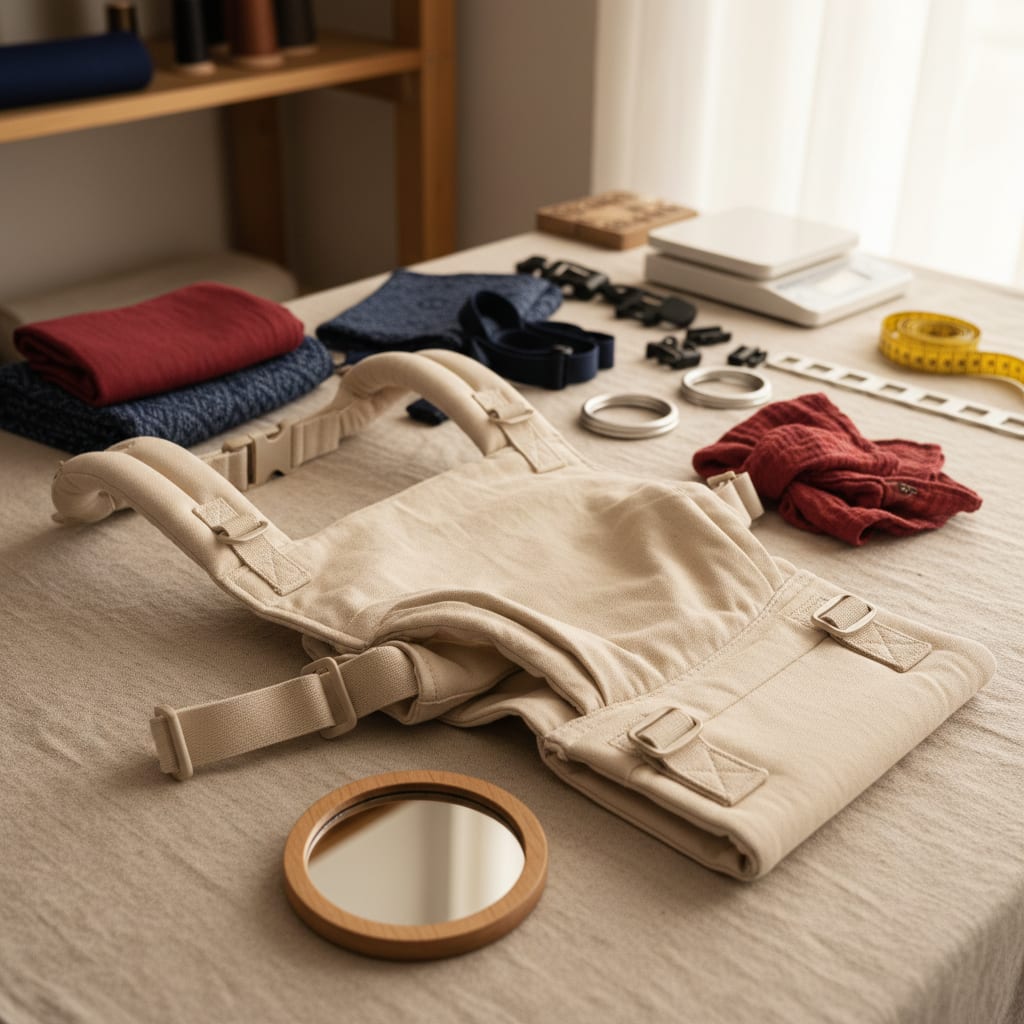
Use a buckle carrier with a real waist belt. FIT4MOM, which runs babywearing classes, says in its workout safety guide to look for “a soft-structured carrier that provides firm, non-stretchy support” that can be tightened “at multiple points.” A stretchy wrap is lovely for a newborn on the sofa, but its whole design is to give a little, and a squat is exactly where you do not want give. The Lillebaby Complete All Seasons is the worked example: its listing names lumbar support in the waist belt. Any well-fitted buckle carrier with a firm belt does the same job.
Face in, always. FIT4MOM recommends two carries for exercise, a front carry with the baby facing in and a back carry with the baby facing you, and a front, facing-in carry only for babies under 6 months. It skips facing out for workouts entirely. Back carries also have their own entry requirement: the positions-by-age map explains why a back carry waits until a baby can sit unassisted.
Tighten before the first rep. A carrier that is fine for a slow walk can sag by the third squat. Run TICKS before you start: Tight, In view at all times, Close enough to kiss, Keep chin off the chest, Supported back. Ireland’s HSE carrier safety page spells it out and adds the rule that matters most under load: “Make sure there is always a space of at least a finger width under your baby’s chin.” The full check, letter by letter, is on the babywearing safety page.
Moves that work
The common thread is that you stay upright and your baby stays still relative to you. Bounce is the enemy, not effort.
- Squats and sit-to-stands. The American Academy of Pediatrics’ carrier guidance says to “bend at the knees, not the waist, if you need to pick something up. Otherwise, the baby may tip out of the carrier, and you may hurt your back.” A squat is that same movement on purpose. Keep the chest lifted and stop at a depth where your back stays neutral.
- Reverse lunges and split squats. Stepping back keeps your weight over your front foot and is easier to control than a forward lunge with extra weight on your chest.
- Side steps and marches. FIT4MOM lists “squats, side steps, and standing cardio moves” as the low-impact options. A brisk march gets the heart rate up without any airborne moment.
- Standing core work. Gentle standing or kneeling core activation, not crunches (see below).
- Walking, including hills. The most underrated babywearing workout there is. Hills add effort without adding bounce.
Moves to skip
- Running and jumping. FIT4MOM: “Skip the jumping or running. High-impact moves can jostle your baby.” No jump squats, no skipping rope, no jogging with a worn baby.
- Anything that puts your baby between you and the floor. FIT4MOM’s rule of thumb is “Never position Baby between your body and the ground”: no planks or push-ups in a front carry, no crunches or sit-ups in a back carry.
- Bands anchored where a snap would hit the baby. FIT4MOM says to avoid front-anchored band moves like rows with a front carry and rear-anchored moves like chest presses with a back carry. Do the body-weight version instead.
- Bending forward from the hips. Deadlift-style hinges and toe touches tip the baby forward. The AAP line above is the reason.
- Anything with a falling problem. Balance boards, step platforms, ladders, bikes. If you could fall, the carrier comes off.
Between sets
Treat each rest as a carrier check. Look down: can you see the whole face? Is the chin still a finger off the chest? Is the carrier still high, or has the baby slid towards your belly? Retighten if so. The HSE page warns that babies overheat easily “because of the body heat shared between you and your baby,” and exercise adds to both sides of that. Dress the baby a layer lighter than you would for a walk, and feel the back of the neck: sweaty means a layer off and a break.
Keep sessions short. The same HSE page says to avoid keeping a baby “in a secured position for more than an hour at a time.” A 20-minute set of squats and marches sits well inside that, and a baby who has had enough will let you know.
Feeding and naps both mean a pause. The HSE says not to feed a baby in a carrier, so take them out to feed. If your baby falls asleep mid-session, that is fine while you walk calmly. Stop the squats, though: a sleeping baby slumps, and the carrier-to-crib transfer method is the next step if you want the nap to continue.
The dry aside: a babywearing workout is the only training plan where the added weight goes up every single week without you choosing it.
FAQ: babywearing workouts
When can I start a babywearing workout after birth?
ACOG says exercise can usually start a few days after an uncomplicated vaginal birth, or when you feel ready, and that after a cesarean or complications your ob-gyn sets the date. Start with walking and unloaded moves, and add the baby once those feel easy.
What is the best carrier for a babywearing workout?
A soft-structured buckle carrier with a firm waist belt that you can tighten in several places. FIT4MOM recommends firm, non-stretchy support. Stretchy wraps and ring slings are not built for squats.
Can I run or jump with my baby in a carrier?
No. Keep every move low-impact. Running and jumping jostle the baby, and a trip or fall is far more serious with a baby on your chest.
Can I do squats while babywearing?
Yes, slowly and upright. The AAP says to bend at the knees rather than the waist with a baby in a carrier, which is exactly what a squat does. Keep your back neutral and stop at a comfortable depth.
Can my baby face out during a workout?
FIT4MOM says no: it recommends facing in, on the front or back, for exercise, and a front facing-in carry for babies under 6 months.
More from the Babywearing Life shelf.