Try Before You Buy: Carrier Rentals and Libraries
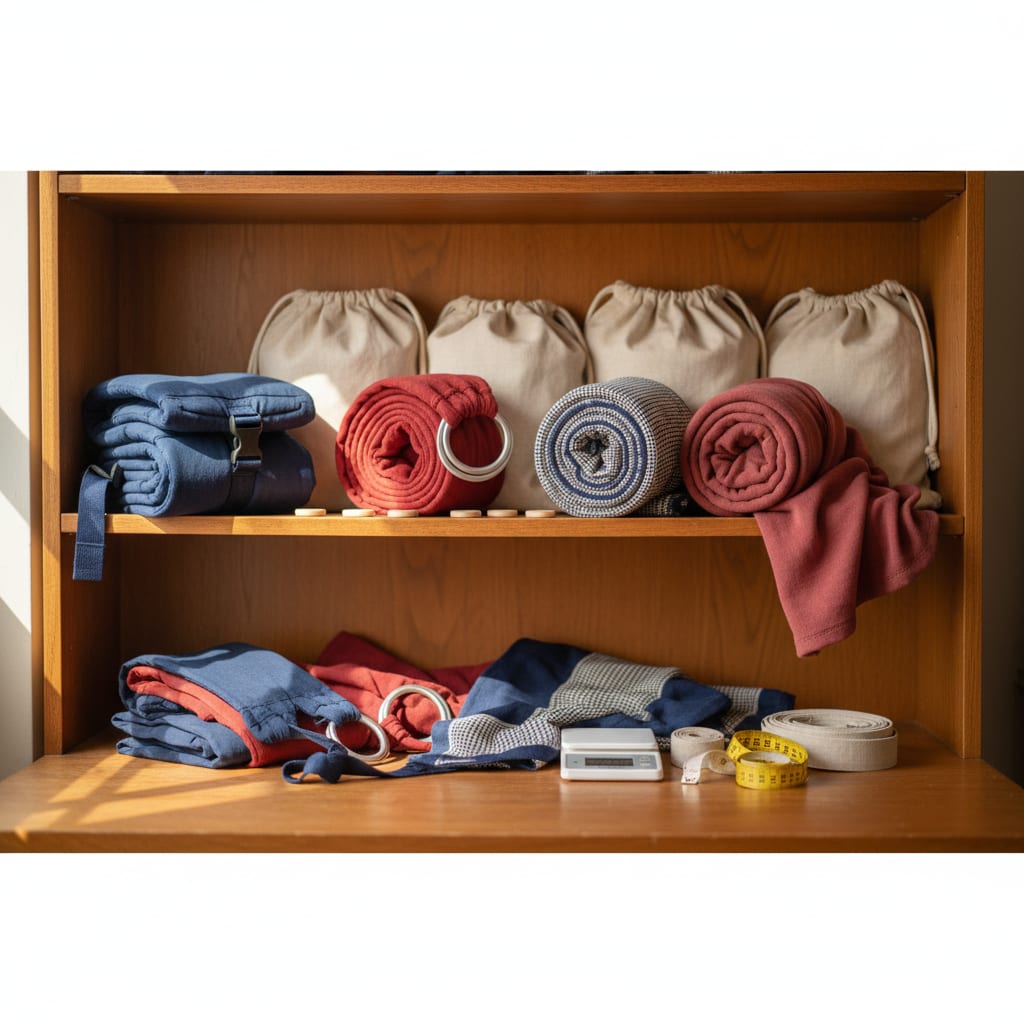
You can almost always try a carrier before you buy one, and four routes exist: a local babywearing lending library (borrow for a few weeks for a small membership fee), a rental from a specialist retailer or brand, an in-store try-on with a demo doll or your own baby, and buying secondhand or refurbished with the intent to resell if it doesn’t work. Libraries are the best of the four because you get the carrier at home, on your body, for long enough to hit the second week — which is when most fit problems actually show up.
Why a twenty-minute showroom fit tells you almost nothing
Carriers fail in the second hour, not the second minute. A panel that feels fine at the store starts sawing at your neck on a grocery run; a waistband that sat neatly over your hips migrates upward and parks on your ribs; a wrap that seemed complicated becomes muscle memory by day four, or doesn’t. None of that is visible in a showroom.
What you’re really testing is the intersection of three variables: your torso, your baby’s current size, and the specific carry you’ll do most. Change any one and the answer changes. That’s why the how many carriers do you actually need answer is usually “fewer than you think, but not the one you bought first.”
Babywearing lending libraries: the option most people never hear about
Local babywearing groups run lending libraries — a stock of carriers, checked out to members like books. Typical shape: a small annual membership, a modest per-carrier deposit or rental fee, and a two-to-four-week loan, renewable if nobody’s waiting. Many groups also run monthly meetups where volunteer educators will thread a ring sling on you and fix your seat by hand.
Finding them takes a specific search. The national US organisation that used to charter these chapters wound down, and most local groups carried on independently under new names — so search your metro area plus “babywearing” (group, library, or meetup), not the old national brand. Local parenting groups, lactation consultants and independent baby stores usually know where the nearest one meets.
What makes libraries worth the hassle: you can borrow a woven wrap, discover in ten days that you’ll never have the patience for it, and swap it for a buckle carrier. That sequence costs a rental fee; bought new, it costs a few hundred dollars and a shelf of guilt.
Rentals, demos and brand programs
Specialist babywearing retailers — the small independent shops, online and physical — often rent carriers by the week or run a try-at-home window. Terms vary enormously, so read two things before you pay: whether the rental fee is credited toward a later purchase, and who eats the shipping both ways.
In-store try-ons are worth exactly one thing: checking whether a waistband closes comfortably on your body and whether you can reach the buckles behind your own neck. Bring your baby if the store allows it, because a weighted demo doll sits very differently than a squirming eight-month-old.
Manufacturer programs are the quiet third option. Ergobaby, for instance, runs a buyback-and-resale program (Everlove) that takes in used carriers, inspects and deep-cleans them, and resells them refurbished at a discount — so a carrier like the Ergobaby Omni 360 can often be bought used-but-vetted rather than new, and passed back into the program later. Details and eligible models live on Ergobaby’s Everlove pages. That’s the closest thing to a risk-free trial that exists in this category.
Secondhand as a deliberate test drive
Buying used at roughly half retail and reselling at roughly what you paid is a legitimate strategy, and it’s how most of the carrier-nerd population operates. Woven wraps in particular hold value well; buckle carriers depreciate more but still resell. Dedicated babywearing swap groups are calmer and better-informed than general marketplace listings.
Three rules keep it safe. Check the model against the manufacturer’s recall page before money moves. Buy only from listings with clear photos of the hardware and stitching, not just the print. And never buy a carrier whose model you can’t identify — counterfeit buckle carriers exist, and a counterfeit is a load-bearing product with unknown webbing.
The twenty-minute fit test, in order
Once a carrier is on your body, run this sequence. It’s the same one you’d run on a carrier you own:
- Waistband first. Sits where it’s comfortable for you — high waist, low hips, wherever the weight feels carried by bone rather than muscle. Snug enough that it doesn’t slide when you walk.
- Baby high and close. Close enough to kiss the top of the head without leaning. If you’re craning, the carrier needs to come up.
- Knee-to-knee support. Fabric spans thigh to thigh, knees higher than the bottom, the M-position the International Hip Dysplasia Institute describes.
- Airway check. Chin off chest, face visible, nothing across the nose or mouth.
- Straps and load path. Shoulder straps flat, no gapping at the armpit, weight felt across shoulders and hips rather than hanging off your neck.
- Then walk for fifteen minutes. Up stairs, around a shop, with a bag. That’s the actual test.
If step six is where it falls apart, it’s usually a fit problem rather than a carrier problem — strap and waistband adjustments come before you conclude the model is wrong.
What borrowing can’t tell you
A two-week loan tells you about right now. It can’t tell you whether the carrier will still work when your baby is fourteen months and eleven pounds heavier, and it can’t tell you how the fabric behaves after forty washes. Adjustable-panel carriers age better than fixed-panel ones for that reason.
It also can’t solve a body-fit mismatch that no adjustment fixes — very short torsos, very broad shoulders, a waistband that won’t close. If that’s your situation, borrowing is still useful, but you’re screening for a category of carrier, and the shortlists in Only Mom Reviews’ best baby carriers for petite moms will get you to candidates faster than trial and error.
Safety checks on anything borrowed or used
Before a borrowed carrier takes weight, look at it the way you’d look at climbing gear:
- Webbing and stitching at every load point — no fraying, no pulled threads, no sun-bleached, chalky-feeling straps.
- Buckles click positively and don’t release under a firm tug. Cracked plastic means retire it.
- Rings on a ring sling should be seamless and rated for babywearing; hardware-store rings are not.
- Fabric with a thin or worn patch is done, however good the print is.
- Then run the full TICKS safety check on the first carry, exactly as you would with a new carrier.
If you’re deciding what to test in the first place rather than how, the carrier decision quiz narrows it to two or three candidates by use-case — and if the answer is “ask other people to buy it,” the registry guide covers that.
FAQ: renting and borrowing baby carriers
How much does a babywearing lending library cost?
It varies by group, but the usual structure is a small annual membership plus a per-carrier fee or refundable deposit, with loans running a couple of weeks. It’s designed to be low-cost — these are volunteer-run community groups, not rental businesses.
Can I rent a baby carrier online?
Some specialist babywearing retailers run rental or try-at-home programs, and terms differ on whether the fee applies toward a purchase and who pays return shipping. Check both before booking. Brand buyback-and-resale programs are the other online route to a low-risk carrier.
Is it safe to buy a used baby carrier?
Yes, with checks. Confirm the model isn’t recalled, inspect webbing, stitching, buckles and rings at every load point, and buy only carriers you can positively identify — counterfeits of popular buckle carriers circulate. Skip anything with worn fabric or cracked hardware.
How long do I need to try a carrier to know?
Give it about two weeks of ordinary use. The first day tells you whether you can get it on; the second week tells you whether you’ll keep reaching for it, which is the question that matters.
Do baby carriers hold their resale value?
Woven wraps generally hold value best, ring slings hold reasonably, and buckle carriers depreciate more but still resell — especially popular models in good condition. That’s what makes buy-and-resell a workable way to test one at home.