How to Survive Cluster Feeding Evenings With a Carrier
Cluster feeding is a run of short feeds bunched close together, and in the early months it often lands in the evening, so a baby who fed every few hours all day wants to feed again and again from late afternoon into the night. It is normal. The carrier helps most between those feeds, not during them: feed seated with your baby out of the carrier, then wear them through the fussy gaps so your hands are free for dinner and your feet can walk. Set the evening up before it starts, and plan for your own tiredness, because the real risk of these nights is a parent nodding off on the sofa.
Why the feeds bunch up in the evening
Cleveland Clinic describes it as a baby having “several short feeds spaced closer together than you’d expect,” and gives a biological reason for the evening timing: prolactin, the hormone that tells your body to make milk, is “usually lowest in the evening, causing a slight drop in your milk supply,” so a baby may feed more often to get the same amount. Comfort is part of it too. Feeding is closeness, and a baby at the end of a long day wants plenty of both.
Two things are worth knowing before the first marathon evening:
- It usually runs in days, not weeks. Betteroo’s pediatrician-reviewed guide to the evening feeding marathon and when it becomes a problem puts it that way, and adds that frequent feeding is not a reliable sign of low supply.
- The evening is when parents doubt themselves most. The same guide notes that supplementation risk peaks between 7pm and 9am, “precisely the cluster window,” and that evening fussiness alone is not a reason to supplement. The checks that actually tell you something are in the red-flags section below.
The carrier’s job: between feeds, not during them
Here is the part most babywearing advice skips. The guidance from the UK’s Lullaby Trust and Ireland’s HSE is plain on feeding in a carrier during these early months:
- The HSE heads its feeding advice “Do not feed your baby in a carrier or sling,” and continues: “If your baby needs to be fed, take them out of the carrier or sling” (HSE).
- The Lullaby Trust says hands-free feeding, “where the wearer moves around and does other jobs while the baby is feeding, is unsafe,” and that this “is especially true for babies under four months old” (Lullaby Trust).
Evening cluster feeding is mostly a newborn pattern, so that is exactly the age this applies to. A feeding position is low and curled; a carrying position is high and upright with the airway open. On a marathon evening you will be switching between the two a dozen times while tired, which is the worst moment to blur them.
So give each job to the right place. Feeds happen seated, with your baby out of the carrier. The carrier takes the gaps: the twenty minutes of fussing between feeds, the pacing, the dinner you would otherwise not eat. The Lullaby Trust’s own sequence is the one to follow: when your baby has finished feeding, “either return them to the sling or put the baby down in a safe space.”
Set the evening up before five
Cluster evenings are easier to run than to improvise. An hour before they usually start:
- Build the feeding seat. One chair with good back support, water and a one-handed snack within reach, burp cloth, phone charger. An upright chair beats a deep sofa, for a reason covered below.
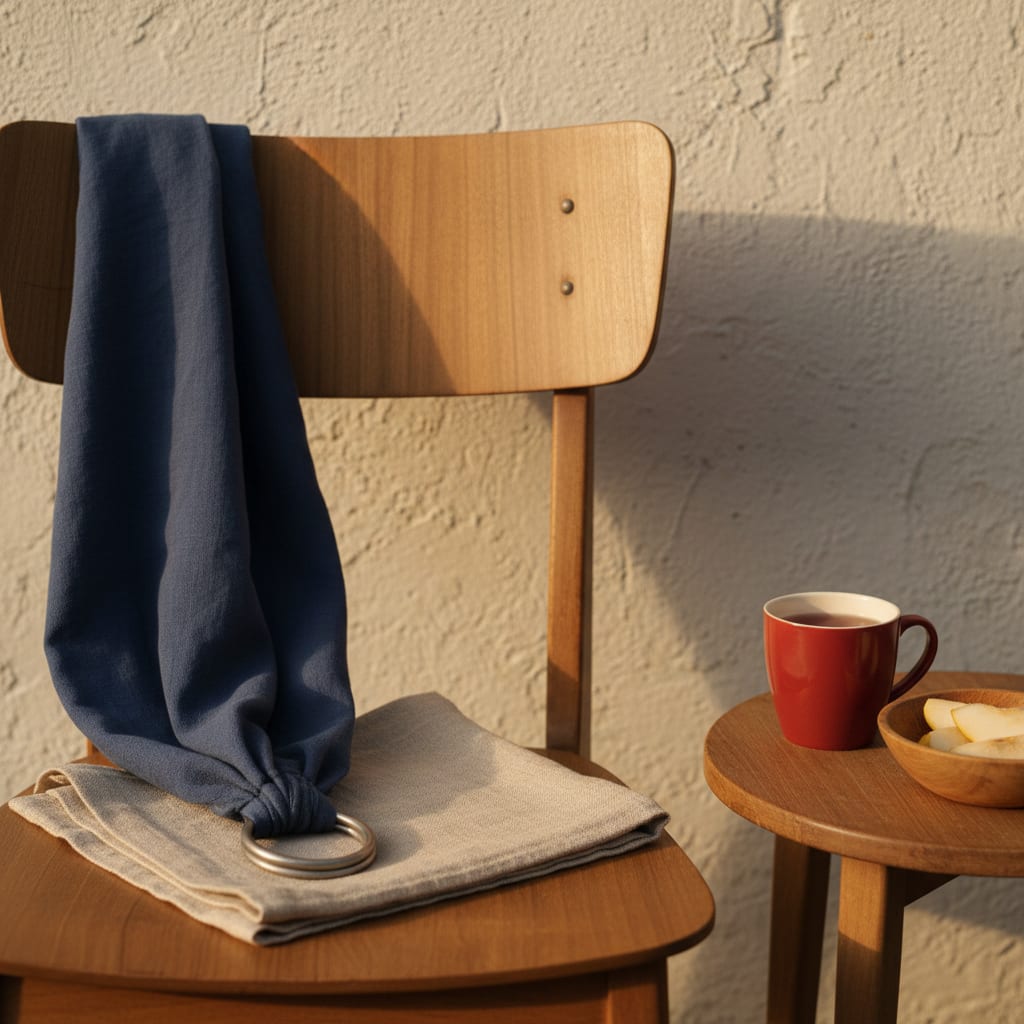
- Pre-adjust the carrier and leave it on. You will be on and off many times, so choose the fastest carrier you own and have it set to your baby’s size before the first feed. A ring sling is the quickest on-off format there is: loosen at the rings, lift your baby out, feed, and pull the tail back up after. A widely available worked example is the Moby ring sling. A pre-tied stretchy wrap works too, as long as you retighten it properly each time rather than tucking your baby back into loose fabric.
- Cook dinner early, or make it something you can eat with one hand while walking. The carrier gives you two hands for the gaps between feeds. That is the whole point.
- Plan the handover. If another adult is home, decide now who takes the between-feeds walking shift while the feeding parent eats and rests.
The on-off loop, feed by feed
- Baby comes out, feed happens seated. Unhurried, supported, both of you comfortable.
- Burp and check. A few minutes upright on your shoulder.
- Back in, and run TICKS. The HSE’s version: tight enough to hug your baby close, in view at all times, close enough to kiss, keep the chin off the chest with “at least a finger width under your baby’s chin,” and a supported back. A milk-drunk baby slumps faster than an alert one, so check the airway again five minutes later. The full routine is in babywearing safety.
- Walk, sway, or get on with dinner until the next feeding cue.
- If your baby falls asleep in the carrier, the AAP guidance is to move them “to a firm sleep surface on their back as soon as possible” (HealthyChildren.org). The put-down is its own skill, and the carrier-to-crib transfer walks it step by step.

The sofa is the risk, not the sling
The most dangerous moment on a cluster-feeding evening is not in the carrier at all. It is the parent who sits down on the sofa with a feeding baby at ten o’clock, exhausted, and closes their eyes for a second. The AAP is blunt about it: the risk of sleep-related infant death “is up to 67 times higher when infants sleep with someone on a couch, soft armchair or cushion” (HealthyChildren.org).
The carrier has a matching rule: never wear your baby while you lie down, recline or doze. So plan for the tiredness rather than hoping to beat it:
- Feed in the upright chair, not the deep sofa, especially late in the evening.
- Know your tell. When your eyes start closing, the baby goes into the crib on their back, even if they protest, and you sit down without them.
- Hand over. If another adult is home, the late walking shift is theirs.
If your baby has also started refusing to settle anywhere but on you, that is a separate pattern with its own fixes, covered in the post on a baby who only sleeps on you.
When the marathon is not normal
Cleveland Clinic draws the line clearly: call your pediatrician “if your baby is older than 1 week and cluster feeding 24/7.” Evening clusters are normal; feeding around the clock every day beyond the first week is not, and it can point to a latch or supply issue that a lactation consultant can help with.
Betteroo’s guide lists the signs to get help for: fewer than 3 stools and 6 wet diapers by day 5, continued weight loss after day 5, or a painful latch. After the first week, 6 or more wet diapers a day and a return to birth weight by day 10 to 14 are the reassuring signs. Output and weight tell you whether feeding is working. How often your baby asks to feed does not.
FAQ: cluster feeding and babywearing
Can I breastfeed my newborn in the carrier during cluster feeding?
The HSE and the Lullaby Trust both advise taking your baby out of the carrier to feed, with the Lullaby Trust flagging babies under four months as the group this matters most for. Feed seated, then put your baby back in the carrier, or down in a safe sleep space, when the feed ends.
How long does cluster feeding last each evening?
It varies from baby to baby and night to night. Betteroo’s guide describes cluster feeding as running in days rather than weeks, most often in the evening.
Does cluster feeding mean I don’t have enough milk?
Not usually. Evening clusters have a normal explanation in the daily rhythm of prolactin. Judge supply by diapers and weight, and talk to your pediatrician or a lactation consultant if those checks worry you.