Wrap vs Ring Sling vs Carrier: Trade-Offs Explained
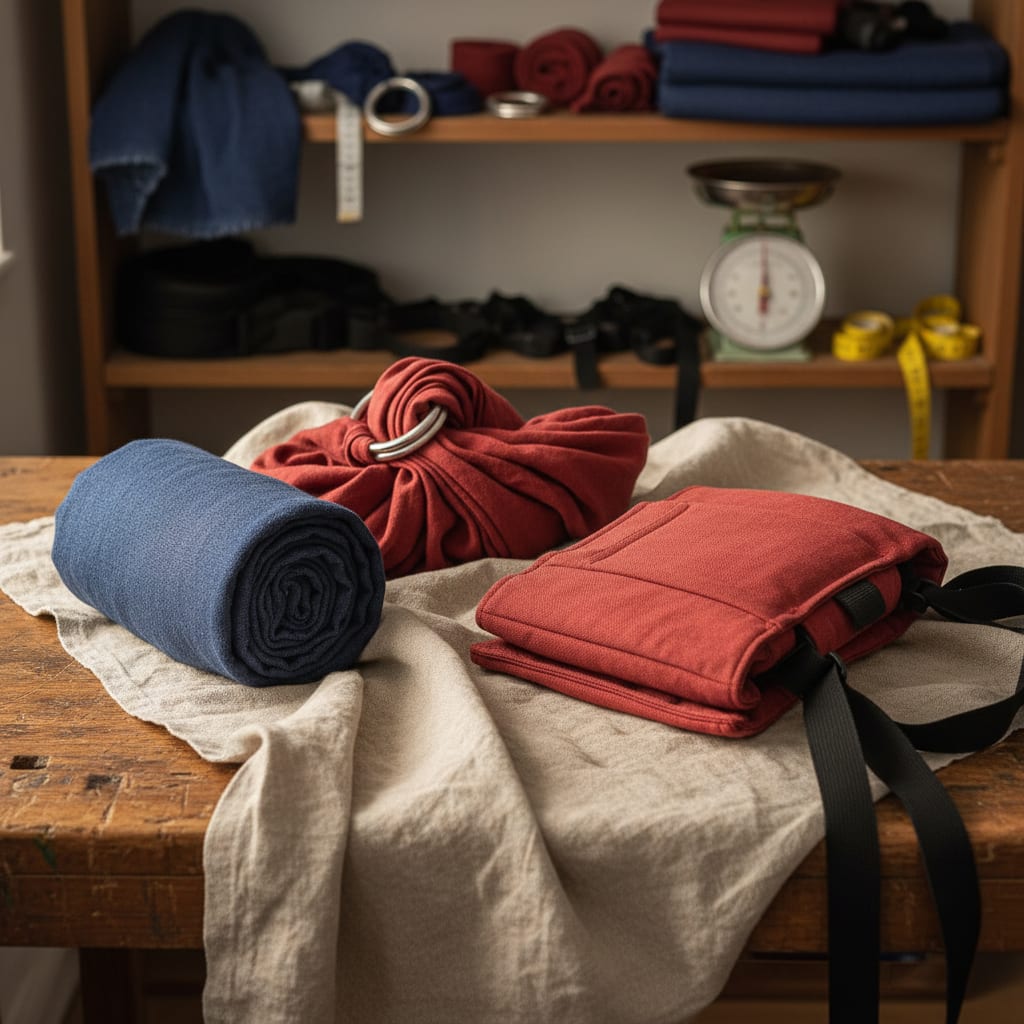
Every baby carrier trades the same three currencies: how long it takes to put on, how well it spreads the load, and how much you have to learn. Wraps spend learning to buy adjustability and load-spreading. Ring slings spend load-spreading to buy speed. Buckle carriers spend adjustability to buy a high floor — anyone can get a safe fit in a minute. No type wins; the type that matches your day wins, and that’s a question about your errands and your shoulders, not about the product.
The three currencies
Setup time — how long from “carrier on the hook” to “baby safely in it.” Ring sling: seconds. Buckle carrier: under a minute once adjusted. Wrap: one to three minutes, or zero if you pre-tied a stretchy.
Load distribution — where the weight lands. Two shoulders plus a hip belt beats two shoulders, which beats one shoulder. This currency determines how long a wear stays comfortable.
Learning curve — the hours between owning the thing and trusting it. The currency people underestimate, then quietly resent.
Wraps: maximum adjustability, maximum learning
A wrap is a long piece of cloth you tie to your body and your baby, every time. That sounds primitive and is actually the most adaptable option available: because you set the fabric tension and seat width yourself, a wrap fits every torso, every belly, every shoulder slope, and every baby size without a single adjuster.
Stretchy wraps (knit, pre-tie-able, front carries only) are the newborn specialists; woven wraps run the full range including back carries. The trade-off is skill: a badly tied wrap is genuinely loose rather than mildly imperfect, which puts responsibility for a safe position squarely on you.
Worked example, newborn end: the Boba Wrap, a one-way-to-tie stretchy wrap rated 7–35 lb. Named because it’s canonical and well-reviewed, not because it “wins.” If you’re weighing knit against woven specifically, that’s its own decision — see woven wrap vs stretchy wrap.
Ring slings: fastest on and off, one shoulder
A ring sling is a short length of cloth threaded through two rings, worn over one shoulder with the baby seated in the pouch. Its superpower is transitions: on in seconds, off in seconds, stuffs into a nappy bag, and lets a toddler go up-and-down twelve times in a supermarket without wrecking your afternoon.
The cost is anatomical. One shoulder carries the entire load, so a ring sling is delightful for twenty minutes and tiring for ninety, particularly at toddler weight. It’s also the type most dependent on adjustment technique — tail pulled in sections, fabric spread rail to rail across your back, seat deep from knee to knee. Get that wrong and it digs, slips, or lets the baby slide low.
Worked example: the Moby ring sling, rated 8–30 lb. The full threading-and-tightening walkthrough is in the ring sling guide.
Two safety notes specific to the type: a newborn goes in a ring sling upright, chest to chest, high enough to kiss — never in a cradle or bag-style position that curls the chin toward the chest. And hip carries wait until head and trunk control are solid.
Buckle carriers: the highest floor
A soft structured carrier is a shaped panel, a padded waistband, two shoulder straps, and adjusters. Its genuine advantage isn’t a higher ceiling than a wrap — a beautifully tied woven beats it — it’s a much higher floor. A first-time wearer can reach a safe, comfortable fit in a minute, and two adults of different sizes can share one carrier with a few seconds of strap adjustment. That shareability is the quiet feature that decides a lot of households.
The costs: bulk (padding that makes it comfortable also makes it big), less mould-to-a-newborn softness, and fit that’s constrained by the manufacturer’s adjustment range rather than by cloth. A carrier whose panel is wrong for your baby’s torso can’t be re-tied into a different size.
Worked example: the Tula Free-to-Grow, rated 7–45 lb with an adjustable panel in height and width — no insert required. The anatomy of the type, part by part, is in the soft structured carrier guide.
The trade-off table
| Wrap | Ring sling | Buckle carrier | |
|---|---|---|---|
| Time to load | 1–3 min (0 if pre-tied) | Seconds | Under a minute |
| Shoulders used | Two | One | Two, plus hip belt |
| Comfortable wear length | Long | Short bursts | Long |
| Learning curve | Steep | Moderate | Shallow |
| Shares between adults | Yes, if both learn | Yes, adjust each time | Yes, fastest |
| Packs small | Woven yes, stretchy bulky | Yes | No |
| Back carries | Wovens only | No | Yes, once sitting unaided |
| Newborn softness | Best | Very good | Good, model-dependent |
Matching a type to your actual day
School run with a toddler who walks half of it: ring sling. The on-off cost dominates everything else.
A newborn and a house you’re trying to function in: stretchy wrap, pre-tied at breakfast, worn like a garment all morning.
Long walks, hikes, two wearers of different heights: buckle carrier. The waistband is doing structural work your lower back will thank you for.
One carrier for birth to preschool, and you like learning things: a woven wrap, no question.
Airports, car parks, and unpredictable days: whichever type you can put on one-handed while holding a coffee. In practice that’s the ring sling, and second place isn’t close.
Most families end up with two types across the first two years — not because one failed, but because the newborn era and the toddler era ask different questions.
What no type fixes
Fit. A wrap tied loose, a sling with a shallow seat, and a buckle carrier riding at your waist instead of your hips all produce the same complaints: shoulder pain, a slumping baby, and a carrier in the cupboard by week three. Every type must deliver the same result — tight, in view at all times, close enough to kiss, chin off the chest, back supported — with thighs supported knee to knee and knees above the bottom, per the International Hip Dysplasia Institute. If your current carrier is uncomfortable, suspect the fit before the category; that’s what the QB Quiz and the fit clinic exist for. Anything that seems clinical rather than mechanical — your baby’s breathing, hips, or muscle tone — goes to your pediatrician first.
Where the model verdicts live
This site decodes types and fixes fit; it doesn’t crown winners. Once you know your type and want a ranked, tested pick, our sibling review site does that job properly — their best carriers for petite moms roundup is the right next click if you’re short-torsoed, and their tested comparisons cover the rest. Decide the type here, buy the model there, come back here for the fit.
FAQ: comparing carrier types
Is a wrap or a carrier better for a newborn?
Both work if the fit is right. A stretchy wrap moulds to a newborn better and costs less; a newborn-capable buckle carrier gets you to a safe position faster on no sleep. The failure mode to avoid is a carrier whose panel is too wide for a newborn’s thighs — the seat should end at the knee, not past it.
Are ring slings safe for newborns?
Yes, in an upright chest-to-chest position with the seat deep, the fabric spread across your back, and the baby high enough to kiss — never in a cradle or bag-style carry, which is how a newborn’s chin ends up on their chest. Check the airway every time they settle.
Which type is easiest to learn?
The buckle carrier, by a wide margin. It reaches a safe fit fastest and is the most forgiving of a tired brain, which is why it’s the standard recommendation for anyone who needs a carrier to work today rather than next weekend.
Can I share one carrier between two adults?
A buckle carrier shares fastest — a few seconds of strap and waistband adjustment between wearers. Ring slings share fine with re-tightening. Wraps technically fit everyone, but both adults have to actually learn to tie, and it’s worth being honest in advance about whether that will happen.
Do I need a different carrier as my baby grows?
Not necessarily. Several buckle carriers and every woven wrap span newborn to toddler. The common two-carrier pattern exists because each type is at its best in a particular season, not because any of them stops working.